Loading...
Charles II of England vs Eric XIV of Sweden
Charles II of England leads by 7.6 pts · 2 figures compared
…
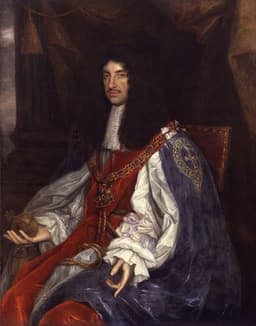
Charles II of England
Emperor · Modern
52.7Total

Eric XIV of Sweden
Emperor · Modern
45.1Total
Basic Information
Born
1630
1533
Died
1685
1577
Era
Modern
Modern
Nationality
England
Sweden
Occupation
Emperor
Emperor
Civilization
Western
Western
Score Comparison
Military (10%)
10.2
25.0
Political (20%)
60.0
45.1
Influence (20%)
62.0
49.4
Legacy (20%)
52.0
40.8
Leadership (15%)
68.0
48.4
Strategy (15%)
39.6
60.0
TOTAL
52.7
45.1
Charles II of England — Complete Timeline
1660 AD
Restoration of the MonarchyPolitical Action
Charles II was invited back to England by Parliament, restoring the monarchy after the death of Oliver Cromwell. The Declaration of Breda promised amnesty and religious tolerance, leading to a peaceful transition and the end of the Commonwealth.
RestorationMonarchyCommonwealth
Impact: nationalconstructive
1666 AD
Great Fire of LondonOther◆ Major
A massive fire destroyed much of London, including St. Paul's Cathedral and thousands of homes. Charles II oversaw the rebuilding efforts, appointing Christopher Wren to redesign the city, which modernized London's architecture.
DisasterRebuildingLondon
Impact: nationaltragic
1670 AD
Secret Treaty of DoverPolitical Action◆ Major
Charles II signed the Secret Treaty of Dover with Louis XIV of France, agreeing to convert to Catholicism and support French wars in exchange for subsidies. This secret pact undermined English Protestant interests and sparked political controversy.
TreatyCatholicismFrance
Impact: regional
1673 AD
Test Act of 1673Reform
Parliament passed the Test Act, requiring all officeholders to receive Anglican communion and renounce transubstantiation. Charles II reluctantly accepted it, which excluded Catholics from public office and deepened religious divisions.
Religious LegislationAnglicanismCatholic Exclusion
Impact: national
1678 AD
Popish PlotPolitical Action◆ Major
Titus Oates fabricated a conspiracy alleging a Catholic plot to assassinate Charles II and install his Catholic brother James. The resulting hysteria led to the execution of innocent Catholics and a political crisis, though Charles remained skeptical.
ConspiracyAnti-CatholicismPolitical Crisis
Impact: nationaldestructive
Eric XIV of Sweden — Complete Timeline
1561 AD
Coronation of Eric XIVPolitical Action◆ Major
Eric XIV was crowned King of Sweden in Uppsala, succeeding his father Gustav Vasa. His coronation marked the beginning of a reign characterized by centralization of power, expansion of the nobility's privileges, and increasing paranoia.
CoronationSuccession
Impact: national
1567 AD
Murder of the Sture FamilyPolitical Action◆ Major
In a paranoid rage, Eric XIV personally killed the nobleman Nils Sture and ordered the execution of several members of the Sture family, including the elderly Svante Sture. This act of violence against the aristocracy deepened his isolation and led to rebellion.
MurderNobilityParanoia
Impact: nationaltragic
1568 AD
Deposition of Eric XIVPolitical Action
Eric XIV was deposed by his half-brothers John and Charles, who led a rebellion against his increasingly erratic rule. He was imprisoned at Gripsholm Castle, and John III was proclaimed king.
DepositionRebellionImprisonment
Impact: nationaldestructive
1577 AD
Death by PoisoningOther
Eric XIV died in prison at
DeathPoisoningImprisonment
Impact: nationaltragic
Expert Analysis
Origins
**Charles II of England** was born on May 29, 1630, at St. James's Palace, the second son of Charles I and Henrietta Maria. His early life was marked by the English Civil War; at age 15, he fought alongside his father and witnessed the royalist defeat. After Charles I's execution in 1649, the young prince fled to exile in France, the Dutch Republic, and the Spanish Netherlands. His education was irregular, but he gained fluency in French and Italian and developed a pragmatic, secular outlook. His formative years were shaped by poverty and dependence on foreign courts, which instilled a deep desire for stability and a reluctance to ever "go on his travels again."
**Eric XIV of Sweden** was born on December 13, 1533, at Stockholm Castle, the eldest son of Gustav Vasa, who had liberated Sweden from Danish rule and established the Vasa dynasty. Eric received a thorough humanist education under tutors like the French scholar Dionysius Beurræus, becoming proficient in Latin, German, and French. He was groomed for kingship early, but his father's authoritarian rule and favoritism toward Eric's half-brother John bred insecurity. Eric's mother, Catherine of Saxe-Lauenburg, died when he was two, and his father remarried twice, creating a complex family dynamic that fueled Eric's later paranoia.
Rise to Power
Charles II's path to the throne was circuitous. After the death of Oliver Cromwell in 1658, the Protectorate collapsed under his son Richard. General George Monck, commanding English forces in Scotland, marched south and, in early 1660, called for free elections. The new Parliament was overwhelmingly royalist. In April 1660, Charles issued the Declaration of Breda, promising amnesty, religious toleration, and payment of arrears to the army. He was invited back and landed at Dover on May 25, 1660, his 30th birthday. The Restoration was a bloodless revolution, orchestrated by a coalition of moderates who saw monarchy as the best guarantee of order.
Eric XIV became king upon his father's death on September 29, 1560. His coronation on June 29, 1561, was a lavish affair that underscored his ambitions for absolute rule. Unlike Charles, Eric inherited a stable, centralized kingdom from Gustav Vasa. However, his rise was marred by immediate conflict with his half-brothers, who were granted large duchies by their father's will. Eric sought to centralize power and curb their autonomy, leading to a power struggle that would define his reign. His aggressive foreign policy, including attempts to dominate the Baltic, brought him into conflict with Denmark, Poland, and Russia.
Leadership & Governance
Charles II's leadership style was conciliatory and pragmatic. He preferred to rule through Parliament, avoiding the confrontations that had doomed his father. His government was marked by a series of compromises: the Clarendon Code (1661-1665) re-established Anglican supremacy but was enforced unevenly; the Secret Treaty of Dover (1670) with Louis XIV was a secret promise to convert to Catholicism in exchange for French subsidies, but Charles never fully implemented it. He managed the Great Fire of London (1666) with effective rebuilding plans, commissioning Christopher Wren to redesign St. Paul's Cathedral. His political score of 60.0 reflects his ability to navigate crises, though his reliance on court favorites and secret diplomacy weakened the crown's long-term credibility.
Eric XIV governed with a centralizing, authoritarian hand. He established a royal council of trusted advisors, often bypassing the traditional aristocracy. His foreign policy was aggressive: he intervened in Livonia, captured the fortress of Reval, and fought the Nordic Seven Years' War against Denmark (1563-1570). Domestically, he promoted trade and mining but was increasingly paranoid. His murder of the Sture family in 1567—personally stabbing Nils Sture and ordering the execution of his relatives—alienated the nobility and led to his deposition. His leadership score of 48.4 and political score of 45.1 reflect his inability to build stable alliances or govern without terror.
Triumph & Tragedy
Charles II's greatest triumph was the peaceful Restoration itself, which ended two decades of civil war and military rule. He also oversaw the rebuilding of London after the Great Fire, improving urban planning and fire safety. The Royal Society received his patronage, and the arts flourished. However, his legacy is tarnished by the Secret Treaty of Dover, which tied England to French interests, and the Popish Plot (1678), which exposed the fragility of religious tolerance. His failure to produce a legitimate heir left the throne to his Catholic brother James II, leading to the Glorious Revolution of 1688. His military score of 10.2 reflects his lack of significant military campaigns.
Eric XIV's triumph was his early foreign policy success: he expanded Swedish influence in the Baltic, securing Estonia and challenging Danish dominance. His patronage of learning, including the founding of the University of Tartu, was notable. But his tragedy was his descent into madness. The Sture murders irreparably damaged his reputation, and his deposition in 1568 by his half-brothers John and Charles ended his reign. He died in prison in 1577, likely poisoned on John III's orders. His strategy score of 60.0 indicates his initial diplomatic and military acumen, but his paranoia undid his achievements.
Character & Destiny
Charles II was known for his charm, wit, and laziness. He was nicknamed the "Merry Monarch" for his love of pleasure and his many mistresses. His pragmatism often bordered on cynicism; he famously said he had no desire to "go on his travels again," meaning he would compromise to stay on the throne. His character was shaped by exile: he learned to trust no one fully and to keep his own counsel. This allowed him to survive political storms but also led to a lack of deep reform. Historians assess him as a skilled political survivor but a mediocre ruler.
Eric XIV was intelligent, learned, and deeply suspicious. His education made him a patron of the arts, but his mental instability—possibly inherited from his mother's family—worsened over time. He believed he was constantly under threat, leading to violent outbursts. His character directly caused his downfall: the Sture murders turned the nobility against him, and his half-brothers capitalized on his isolation. Modern assessments note his strategic vision but criticize his inability to delegate or trust.
Legacy
Charles II's legacy is the Restoration settlement: the monarchy returned but with reduced powers, the Church of England re-established, and Parliament's role affirmed. The Habeas Corpus Act (1679) passed during his reign strengthened civil liberties. His cultural patronage influenced the English Renaissance. However, his reign also sowed the seeds of the Glorious Revolution. His legacy score of 52.0 reflects his moderate but lasting impact.
Eric XIV's legacy is more mixed. He is remembered as a tragic figure, a brilliant mind undone by madness. His centralization efforts laid groundwork for Swedish absolutism, but his deposition strengthened the aristocracy. His foreign policy gains were mostly retained by his successors. In Swedish history, he is often seen as a cautionary tale about the dangers of unchecked power. His legacy score of 40.8 reflects his limited long-term influence.
Conclusion
Charles II had a greater impact than Eric XIV. His total score of 52.7 to Eric's 45.1 reflects his ability to maintain stability and restore monarchy without triggering civil war. Charles preserved the English monarchy, albeit in a constitutional form, and oversaw a period of cultural and scientific growth. Eric, despite initial promise, self-destructed and left Sweden in the hands of a regency that reversed many of his policies. Charles's political acumen and legacy of parliamentary monarchy outweigh Eric's strategic achievements. While both faced personal flaws, Charles's pragmatism ensured his survival and his nation's stability, whereas Eric's paranoia led to his deposition and death. Therefore, Charles II of England holds the edge in historical significance.
Rankings
🥇
Charles II of EnglandLeader
Mil: 10.2Pol: 60.0Inf: 62.0
52.7
🥈
Eric XIV of Sweden
Mil: 25.0Pol: 45.1Inf: 49.4
45.1
+7.6 behind
How This Comparison Works
Algorithm
Each figure is scored on 6 dimensions (0—100 scale) based on structured historical data: Military (10%), Political (20%), Influence (20%), Legacy (20%), Leadership (15%), Strategy (15%). The weighted total produces the final ranking.
Data Sources
Scores are computed from structured sub-indicators in the database. Scale factors adjust for era (Ancient ×0.85, Modern ×1.0) and civilization size (Eastern ×1.05, Other ×0.80) to account for differences in population and military scale.
Maximum 3 Figures
Comparisons are limited to 2—3 figures to ensure readability and statistical meaningfulness.
Error Margins
±5 points per dimension — Sub-scores are derived from historical records with inherent uncertainty. Two figures within 5 points on a dimension should be considered roughly equivalent in that area.
Total Score Accuracy
±3 points overall — The weighted combination of 6 dimensions produces a total score with approximately ±3 points of uncertainty. Differences of less than 3 points are not statistically significant— the figures are effectively tied.
Known Limitations
- Historical records are incomplete and uneven across civilizations
- Figures from oral-tradition societies may be underrepresented
- Occupation labels can misclassify multi-role figures
- Scores measure capability and impact, not moral character
- Quantitative scoring is a comparison tool, not absolute truth
Capability Radar
Military (10%) — Battles & Warfare
Battles
10
45
Win Rate
10
40
Expansion
5
40
Political (20%) — Governance & Reform
Reform
60
50
Diplomacy
65
25
Economy
55
35
Influence (20%) — Cultural & Global Reach
Cultural
60
30
Global
50
15
Legacy (20%) — Historical Impact
Historical
65
35
Longevity
55
20
Leadership (15%) — Power & Stability
Tenure
55
30
Stability
50
10
Strategy (15%) — Tactics & Innovation
Strategy
5
45
Tactics
5
50
Reform
15
55
Similar Comparisons
Comments & Discussion
No comments yet. Be the first to share your thoughts!