Loading...
Charles II of England vs Seonjo of Joseon
Charles II of England leads by 4.6 pts · 2 figures compared
…
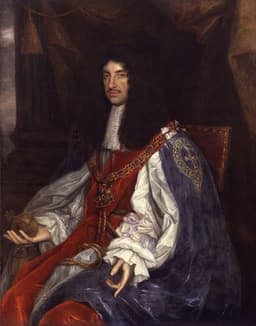
Charles II of England
Emperor · Modern
52.7Total

Seonjo of Joseon
Emperor · Modern
48.1Total
Basic Information
Born
1630
1552
Died
1685
1608
Era
Modern
Modern
Nationality
England
Korea
Occupation
Emperor
Emperor
Civilization
Western
Eastern
Score Comparison
Military (10%)
10.2
21.2
Political (20%)
60.0
42.2
Influence (20%)
62.0
58.0
Legacy (20%)
52.0
50.0
Leadership (15%)
68.0
64.0
Strategy (15%)
39.6
30.3
TOTAL
52.7
48.1
Charles II of England — Complete Timeline
1660 AD
Restoration of the MonarchyPolitical Action
Charles II was invited back to England by Parliament, restoring the monarchy after the death of Oliver Cromwell. The Declaration of Breda promised amnesty and religious tolerance, leading to a peaceful transition and the end of the Commonwealth.
RestorationMonarchyCommonwealth
Impact: nationalconstructive
1666 AD
Great Fire of LondonOther◆ Major
A massive fire destroyed much of London, including St. Paul's Cathedral and thousands of homes. Charles II oversaw the rebuilding efforts, appointing Christopher Wren to redesign the city, which modernized London's architecture.
DisasterRebuildingLondon
Impact: nationaltragic
1670 AD
Secret Treaty of DoverPolitical Action◆ Major
Charles II signed the Secret Treaty of Dover with Louis XIV of France, agreeing to convert to Catholicism and support French wars in exchange for subsidies. This secret pact undermined English Protestant interests and sparked political controversy.
TreatyCatholicismFrance
Impact: regional
1673 AD
Test Act of 1673Reform
Parliament passed the Test Act, requiring all officeholders to receive Anglican communion and renounce transubstantiation. Charles II reluctantly accepted it, which excluded Catholics from public office and deepened religious divisions.
Religious LegislationAnglicanismCatholic Exclusion
Impact: national
1678 AD
Popish PlotPolitical Action◆ Major
Titus Oates fabricated a conspiracy alleging a Catholic plot to assassinate Charles II and install his Catholic brother James. The resulting hysteria led to the execution of innocent Catholics and a political crisis, though Charles remained skeptical.
ConspiracyAnti-CatholicismPolitical Crisis
Impact: nationaldestructive
Seonjo of Joseon — Complete Timeline
1592 AD
Japanese invasions of Korea (Imjin War)War
Seonjo faced the Japanese invasions led by Toyotomi Hideyoshi. The Joseon army was initially defeated, and Seonjo fled to Uiju near the Chinese border, leaving Seoul to be captured by Japanese forces.
WarInvasionJoseon Dynasty
Impact: globaltragic
Flight to UijuWar◆ Major
Seonjo abandoned Seoul and fled to Uiju near the Chinese border as Japanese forces advanced. His flight demoralized the court and populace, but allowed him to request military aid from Ming China.
WarFlightJoseon Dynasty
Impact: nationaltragic
1593 AD
Ming intervention in the Imjin WarWar◆ Major
Seonjo secured military support from Ming China, which sent a large army to aid Joseon. The combined Ming-Joseon forces recaptured Pyongyang and pushed Japanese forces south, leading to a stalemate.
WarAllianceJoseon Dynasty
Impact: regional
1597 AD
Second Japanese invasionWar◆ Major
Japan launched a second invasion of Korea after peace negotiations failed. Seonjo again relied on Ming support, and the war continued until Hideyoshi's death in 1598 led to Japanese withdrawal.
WarInvasionJoseon Dynasty
Impact: regionaltragic
1598 AD
Post-war reconstruction effortsReform◆ Major
After the war, Seonjo initiated reconstruction efforts, including rebuilding infrastructure and reorganizing the military. However, factional conflicts and corruption hindered recovery.
ReconstructionReformJoseon Dynasty
Impact: nationalconstructive
Expert Analysis
Origins
Charles II of England was born on May 29, 1630, at St. James's Palace, the eldest surviving son of Charles I and Henrietta Maria. His childhood was marked by the English Civil War, and he spent his youth in exile after his father's execution in 1649. He received a broad education in languages, politics, and military strategy, but his formative years were defined by poverty and dependence on foreign courts.
Seonjo of Joseon was born on November 26, 1552, as Yi Yeon, the son of Prince Deokheung. He became king in 1567 at age 14 after his predecessor, Myeongjong, died without an heir. Seonjo was raised in a Confucian court and received a classical education emphasizing moral governance. His early reign was dominated by factional strife between Easterners and Westerners.
Rise to Power
Charles II's rise came after the death of Oliver Cromwell in 1658 and the collapse of the Protectorate. In 1660, General George Monck invited Charles to return, and the Declaration of Breda promised amnesty and religious toleration. Charles entered London on May 29, 1660, his 30th birthday, restoring the monarchy with broad support. His political score of 60.0 reflects his ability to navigate this transition.
Seonjo ascended the throne peacefully in 1567, but his authority was immediately challenged by entrenched factions. He initially relied on the scholar-official Yi Hwang to stabilize the court. However, his indecisiveness allowed factionalism to fester, leading to the split between Easterners (Dongin) and Westerners (Seoin) in 1575. Seonjo's political score of 42.2 is lower due to his failure to control these divisions.
Leadership & Governance
Charles II's leadership style was pragmatic and hedonistic. He prioritized stability over principle, tolerating religious dissent while secretly favoring Catholicism. His governance score of 68.0 is supported by his management of the Great Fire of London in 1666, where he personally oversaw rebuilding efforts and appointed Christopher Wren to redesign St. Paul's Cathedral. However, his Secret Treaty of Dover (1670) with France undermined English interests and revealed his duplicity.
Seonjo's leadership was cautious and often reactive. He fled Seoul in 1592 when Japanese forces invaded, a decision that demoralized his people but allowed him to secure Ming Chinese aid. His military score of 21.2 reflects the disastrous initial defeats, but his strategy of relying on Ming intervention eventually succeeded. Post-war, he attempted military reforms but was hampered by factional infighting.
Triumph & Tragedy
Charles II's greatest triumph was the Restoration itself, which ended a decade of Puritan rule and re-established the monarchy. His patronage of the arts, including the founding of the Royal Observatory, fostered a cultural renaissance. His greatest tragedy was the Popish Plot (1678-1681), a fabricated conspiracy that led to the execution of innocent Catholics and exacerbated anti-Catholic sentiment. Charles's failure to protect his Catholic brother James weakened the crown.
Seonjo's triumph was surviving the Imjin War (1592-1598) against Japan. Despite initial losses, the combined Joseon-Ming forces repelled the invaders, and Joseon remained independent. His tragedy was the devastation of the war: hundreds of thousands died, cultural treasures were destroyed, and the economy collapsed. Seonjo's flight to Uiju is remembered as a shameful act, and his post-war reconstruction was slow and incomplete.
Character & Destiny
Charles II was charming, lazy, and politically astute. He avoided the absolutism of his father by compromising with Parliament, but his secret Catholicism and reliance on French subsidies created long-term distrust. His character allowed him to survive the Exclusion Crisis (1679-1681), but he failed to secure a stable succession. Historians rate his leadership at 68.0, but his strategy score of 39.6 indicates poor long-term planning.
Seonjo was indecisive and easily swayed by factional advice. His flight during the Imjin War revealed a lack of courage, but his willingness to delegate military command to capable generals like Yi Sun-sin (who scored 92.0 in military) was wise. His inability to unite his court led to persistent instability. Seonjo's total score of 48.1 is dragged down by his strategy (30.3) and military (21.2) scores.
Legacy
Charles II's legacy is mixed. He restored the monarchy but ceded power to Parliament, accelerating the shift toward constitutional monarchy. The Habeas Corpus Act (1679) was passed during his reign, strengthening individual rights. His cultural patronage earned him the nickname "Merry Monarch," but his pro-Catholic policies fueled anti-Catholic sentiment that erupted after his death. His influence score of 62.0 reflects his role in shaping English political culture.
Seonjo's legacy is defined by the Imjin War. He is remembered as a king who fled his capital, but also one who secured Chinese aid and preserved Joseon independence. Post-war reforms, including the strengthening of the military and the promotion of Confucian education, had lasting effects. However, the factional strife he failed to control intensified and contributed to Joseon's decline. His influence score of 58.0 is slightly lower than Charles's.
Conclusion
Charles II of England had a greater impact than Seonjo of Joseon, as reflected in his higher total score of 52.7 versus 48.1. Charles's political maneuvering during the Restoration set England on a path toward constitutional monarchy and parliamentary supremacy, a system that influenced governments worldwide. Seonjo, while surviving a devastating invasion, failed to address internal divisions and his flight undermined his authority. Charles's legacy in shaping modern governance outweighs Seonjo's regional impact, making him the more consequential figure.
Rankings
🥇
Charles II of EnglandLeader
Mil: 10.2Pol: 60.0Inf: 62.0
52.7
🥈
Seonjo of Joseon
Mil: 21.2Pol: 42.2Inf: 58.0
48.1
+4.6 behind
How This Comparison Works
Algorithm
Each figure is scored on 6 dimensions (0—100 scale) based on structured historical data: Military (10%), Political (20%), Influence (20%), Legacy (20%), Leadership (15%), Strategy (15%). The weighted total produces the final ranking.
Data Sources
Scores are computed from structured sub-indicators in the database. Scale factors adjust for era (Ancient ×0.85, Modern ×1.0) and civilization size (Eastern ×1.05, Other ×0.80) to account for differences in population and military scale.
Maximum 3 Figures
Comparisons are limited to 2—3 figures to ensure readability and statistical meaningfulness.
Error Margins
±5 points per dimension — Sub-scores are derived from historical records with inherent uncertainty. Two figures within 5 points on a dimension should be considered roughly equivalent in that area.
Total Score Accuracy
±3 points overall — The weighted combination of 6 dimensions produces a total score with approximately ±3 points of uncertainty. Differences of less than 3 points are not statistically significant— the figures are effectively tied.
Known Limitations
- Historical records are incomplete and uneven across civilizations
- Figures from oral-tradition societies may be underrepresented
- Occupation labels can misclassify multi-role figures
- Scores measure capability and impact, not moral character
- Quantitative scoring is a comparison tool, not absolute truth
Capability Radar
Military (10%) — Battles & Warfare
Battles
10
15
Win Rate
10
10
Expansion
5
5
Political (20%) — Governance & Reform
Reform
60
30
Diplomacy
65
35
Economy
55
20
Influence (20%) — Cultural & Global Reach
Cultural
60
40
Global
50
40
Legacy (20%) — Historical Impact
Historical
65
55
Longevity
55
50
Leadership (15%) — Power & Stability
Tenure
55
60
Stability
50
15
Strategy (15%) — Tactics & Innovation
Strategy
5
20
Tactics
5
10
Reform
15
25
Similar Comparisons
Comments & Discussion
No comments yet. Be the first to share your thoughts!