Loading...
Charles II of Spain vs Julius Caesar
Julius Caesar leads by 37.9 pts · 2 figures compared
…
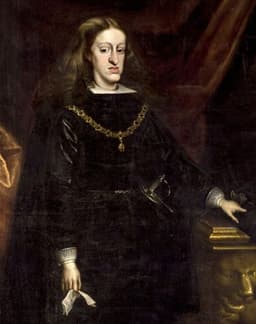
Charles II of Spain
Emperor · Modern
44.9Total

Julius Caesar
General · Ancient
82.8Total
Basic Information
Born
1661
-100
Died
1700
-44
Era
Modern
Ancient
Nationality
Spain
Roman Republic
Occupation
Emperor
General
Civilization
Western
Western
Score Comparison
Military (10%)
15.0
88.0
Political (20%)
26.4
78.0
Influence (20%)
53.3
85.0
Legacy (20%)
52.0
82.0
Leadership (15%)
48.4
80.0
Strategy (15%)
58.4
85.0
TOTAL
44.9
82.8
Charles II of Spain — Complete Timeline
1661 AD
Suffered from Severe Physical and Mental DisabilitiesOther◆ Major
Charles II was born with numerous health problems due to Habsburg inbreeding, including a deformed jaw, epilepsy, and intellectual disabilities. He was unable to walk until age eight and was considered unfit to rule, leading to a regency throughout his life.
InbreedingDisabilityHabsburg Dynasty
Impact: nationaltragic
1665 AD
Became King of SpainPolitical Action
Charles II inherited the Spanish throne at age four upon the death of his father Philip IV. His reign was marked by severe physical and mental disabilities due to generations of inbreeding, leading to a regency government.
SuccessionHabsburg DynastyRegency
Impact: global
1697 AD
Signed the Treaty of RyswickPolitical Action
Charles II's government signed the Treaty of Ryswick, ending the Nine Years' War with France. Spain ceded territories in the Caribbean and Europe to France, but the treaty temporarily stabilized relations before the succession crisis.
TreatyNine Years' WarDiplomacy
Impact: regional
1700 AD
Death Without Heir Triggered War of Spanish SuccessionPolitical Action
Charles II died without an heir, leaving his throne to Philip of Anjou (grandson of Louis XIV) in his will. This sparked the War of Spanish Succession (1701-1714) as European powers contested the Bourbon succession to the Spanish throne.
Succession CrisisWar of Spanish SuccessionBourbon Dynasty
Impact: global
Julius Caesar — Complete Timeline
58 BC
Gallic WarsWar◆ Major
Caesar, as proconsul of Gaul, launched a series of campaigns that conquered all of Gaul (modern France, Belgium, and parts of Switzerland). He fought numerous battles, including against the Helvetii, the Belgae, and the Gallic chieftain Vercingetorix. The wars brought immense wealth and a loyal army to Caesar.
Gallic WarsConquestRoman Expansion
Impact: regional
49 BC
Crossing the RubiconPolitical Action◆ Major
Caesar led Legio XIII across the Rubicon River into Italy, defying the Roman Senate's order to disband his army. This act triggered a civil war against Pompey and the Optimates, ultimately leading to Caesar's dictatorship and the end of the Roman Republic.
Roman Civil WarEnd of RepublicPower Struggle
Impact: global
48 BC
Battle of PharsalusWar◆ Major
Caesar's outnumbered army defeated the larger forces of Pompey the Great at Pharsalus in Greece. Caesar's tactical use of a reserve line to counter Pompey's cavalry charge proved decisive. Pompey fled to Egypt, where he was assassinated, leaving Caesar as the undisputed master of the Roman world.
Roman Civil WarBattleDecisive Victory
Impact: regional
44 BC
Appointment as Dictator for LifePolitical Action◆ Major
The Roman Senate appointed Caesar dictator perpetuo (dictator for life), granting him unprecedented personal power. This move concentrated military, legislative, and judicial authority in one person, effectively ending the Roman Republic's traditional system of checks and balances and alarming many senators.
DictatorshipEnd of RepublicPower Consolidation
Impact: regionaldestructive
Assassination on the Ides of MarchPolitical Action◆ Major
A group of Roman senators, led by Marcus Junius Brutus and Gaius Cassius Longinus, stabbed Caesar to death at a meeting of the Senate in the Theatre of Pompey. The assassination was intended to restore the Republic, but instead triggered another civil war that led to the rise of the Roman Empire.
AssassinationRoman PoliticsEnd of Republic
Impact: globaldestructive
Expert Analysis
charles-ii-of-spain-vs-julius-caesar
# Two Faces of Power: The Emperor Who Conquered and the King Who Could Not
The Ides of March, 44 BCE. A dictator lies bleeding on the floor of the Roman Senate, stabbed twenty-three times by men he once called friends. Forty-four years later and a thousand miles west, a sickly child is born in Madrid, his jaw so deformed that he cannot chew his food, his body so weak that he will not walk until age eight. One man changed the course of history through sheer will; the other was changed by history through no fault of his own. Julius Caesar and Charles II of Spain represent the two poles of leadership: the force that bends reality to its vision, and the vessel through which fate pours its cruelties. Their stories ask a haunting question: how much of power is choice, and how much is accident?
Origins
Caesar was born into the patrician Julian clan, a family claiming descent from the goddess Venus, but his Rome was a republic in crisis. The senatorial oligarchy was rotting, populist generals were rising, and the Mediterranean world groaned under the weight of slave revolts and provincial corruption. Caesar’s father died when he was sixteen, leaving him to navigate a world where ambition was the only currency that mattered. He learned early that in Rome, a man’s worth was measured by his debts—both financial and political—and he borrowed heavily to build his name.
Charles II entered a Spain that was already a ghost of its former glory. The Habsburg dynasty had ruled for two centuries, but its obsession with keeping power within the family had produced a genetic catastrophe. Charles’s mother was his father’s niece; his great-grandparents were siblings. The inbreeding that preserved the throne also destroyed the king. Born with the famous “Habsburg jaw” so severe he could barely speak, suffering from epilepsy and what modern doctors believe was a combination of pituitary deficiency and mental disability, Charles was not a ruler by choice but by biological accident. His Spain was bankrupt, its armies hollowed, its empire shrinking—and its king could barely hold a spoon.
Rise to Power
Caesar’s path to power was a masterclass in calculated risk. He fled Rome to avoid Sulla’s proscriptions, then returned to climb the senatorial ladder: quaestor in Spain, aedile who bankrupted himself to stage gladiatorial games, pontifex maximus who outmaneuvered his rivals. His true turning point came in 58 BCE, when he secured command of Gaul. Over eight years, he conquered a territory larger than Italy, fought over fifty battles against a million enemies, and wrote his own propaganda in the *Commentaries* that still read like military thrillers. When the Senate ordered him to disband his army, he crossed the Rubicon River in 49 BCE—an act of war against the Republic itself. “The die is cast,” he supposedly said, and with that sentence, he chose empire over constitution.
Charles II became king at age four, in 1665, because his father died. There was no Rubicon, no choice at all. His mother, Mariana of Austria, served as regent, and the court was a nest of scheming nobles and foreign ambassadors who treated the boy-king as a puppet. Charles’s “rise” was not an ascent but a slow descent into dependency. He was declared of age at fourteen, but his physical and mental frailty meant others ruled for him. His only significant political act—the 1697 Treaty of Ryswick, ending the Nine Years’ War—was signed by his ministers while the king suffered another epileptic seizure. He did not rise; he was carried.
Leadership & Governance
Caesar governed as he conquered: with speed, clarity, and ruthless pragmatism. As dictator, he reformed the calendar (giving us the Julian calendar), granted citizenship to Gauls and Spaniards, ordered land redistribution to veterans, and began public works that employed the poor. His military genius lay in speed and logistics—he once marched his army forty miles in a day to surprise a Gallic army—but his political wisdom was equally sharp. He knew that Rome’s provinces bled money, so he standardized taxes and cut corruption. He knew that the Senate hated him, so he packed it with his supporters. He knew that power needed spectacle, so he staged triumphs that lasted for days. His leadership was a fusion of vision and calculation, each move designed to centralize authority under one man—himself.
Charles II governed in name only. His court was paralyzed by factionalism between the French-leaning and Austrian-leaning nobles, each trying to secure the succession of their preferred candidate. The king’s councils met, but decisions were made by favorites—first his mother, then his half-brother John of Austria, then a series of confessors and ministers. Charles’s military score of 45.0 is generous; Spain’s army was a ruin, and the king never led a campaign. His political score of 40.9 reflects a reign where the treasury was empty, inflation soared, and the once-mighty Spanish Armada was a memory. He did not reform because he could not even conceive of reform. His governance was not a system but a slow collapse.
Triumph & Tragedy
Caesar’s greatest triumph was Gaul itself—the conquest of a land that would become the heart of medieval Europe, the defeat of Vercingetorix at Alesia in 52 BCE, a siege so brilliant that military academies still study it. His greatest tragedy was his own success: he had destroyed the Republic to save it, and in doing so, made himself a target. The Ides of March was not a surprise; Cicero had warned him, omens had been read, and his wife Calpurnia dreamed of his death. Caesar ignored them all. He died not because he was unloved but because he was too powerful. His tragedy was that he could not imagine a world where he was not needed.
Charles II’s triumph was survival. He lived to age thirty-nine despite a body that should have killed him in childhood. His tragedy was that his death undid everything: the Treaty of Ryswick, the fragile peace, the Habsburg legacy. In his will, he named Philip of Anjou, grandson of Louis XIV, as his heir—a decision that triggered the War of Spanish Succession (1701–1714), a conflict that killed hundreds of thousands and redrew the map of Europe. Charles did not start the war; he was its cause. His greatest failure was not something he did, but something he could not do: produce an heir. His infertility, a direct result of generations of inbreeding, meant that his dynasty ended with him.
Character & Destiny
Caesar’s character was a paradox: generous but calculating, clement to enemies but relentless in ambition, a man who wept at the death of his enemies yet ordered the massacre of Gallic tribes. He was driven by a hunger for glory that bordered on obsession. “It is better to be first in a little village than second in Rome,” he once said, and he meant it. His destiny was shaped by his refusal to accept limits. He could have stayed in Gaul, rich and respected. He could have accepted a pardon after crossing the Rubicon. He could have refused the crown. But Caesar was not built for compromise. His character demanded either triumph or death—and he got both.
Charles II’s character was shaped by his suffering. He was described by contemporaries as kind, pious, and melancholic—a man who knew he was a failure and who tried, in his limited way, to do his duty. He attended Mass daily, he wept at the suffering of his people, and he reportedly said on his deathbed, “I am nothing.” His destiny was not chosen but inherited. He was born into a body that could not rule, a throne that could not stand, and an empire that could not last. His tragedy is that he was a good man in a bad body, at the wrong time, in the wrong dynasty.
Legacy
Caesar’s legacy is the Roman Empire itself. His adopted heir Octavian became Augustus, the first emperor, and the world Caesar shaped lasted another five centuries in the West and a thousand years in the East. His name became a title—Kaiser, Tsar, Caesar—used by rulers from Germany to Russia. His writings are studied, his battles are taught, his assassination is the most famous murder in history. He scored 82.0 in legacy, but that number undersells him: Caesar is not just remembered; he is the template for every ambitious leader who ever dared to break the rules.
Charles II’s legacy is the War of Spanish Succession and the end of the Habsburg dynasty in Spain. He is remembered as “El Hechizado”—the Bewitched—because his contemporaries believed his deformities were caused by witchcraft. Modern historians see him as a victim of inbreeding, a cautionary tale about the dangers of absolute power concentrated in a single family. His legacy score of 68.8 reflects his role as a historical pivot: he was the last of his line, and his death reshaped Europe. But he is not remembered as a leader. He is remembered as a warning.
Conclusion
Standing at the edge of history, we see two men who shared a crown but nothing else. Caesar crossed a river and changed the world; Charles II could barely cross a room. One was a genius who chose his fate; the other was a prisoner of his blood. Their stories remind us that leadership is not just about power—it is about the capacity to wield it. Caesar had that capacity in abundance, and it destroyed him. Charles lacked it entirely, and it destroyed his kingdom. Perhaps the deepest truth is this: power does not care if you are ready for it. It comes, it uses you, and it moves on. The question is not whether you deserve the throne—it is whether the throne can survive you.
Rankings
🥇
Julius CaesarLeader
Mil: 88.0Pol: 78.0Inf: 85.0
82.8
🥈
Charles II of Spain
Mil: 15.0Pol: 26.4Inf: 53.3
44.9
+37.9 behind
How This Comparison Works
Algorithm
Each figure is scored on 6 dimensions (0—100 scale) based on structured historical data: Military (10%), Political (20%), Influence (20%), Legacy (20%), Leadership (15%), Strategy (15%). The weighted total produces the final ranking.
Data Sources
Scores are computed from structured sub-indicators in the database. Scale factors adjust for era (Ancient ×0.85, Modern ×1.0) and civilization size (Eastern ×1.05, Other ×0.80) to account for differences in population and military scale.
Maximum 3 Figures
Comparisons are limited to 2—3 figures to ensure readability and statistical meaningfulness.
Error Margins
±5 points per dimension — Sub-scores are derived from historical records with inherent uncertainty. Two figures within 5 points on a dimension should be considered roughly equivalent in that area.
Total Score Accuracy
±3 points overall — The weighted combination of 6 dimensions produces a total score with approximately ±3 points of uncertainty. Differences of less than 3 points are not statistically significant— the figures are effectively tied.
Known Limitations
- Historical records are incomplete and uneven across civilizations
- Figures from oral-tradition societies may be underrepresented
- Occupation labels can misclassify multi-role figures
- Scores measure capability and impact, not moral character
- Quantitative scoring is a comparison tool, not absolute truth
Capability Radar
Military (10%) — Battles & Warfare
Battles
37
95
Win Rate
41
92
Expansion
45
97
Political (20%) — Governance & Reform
Reform
5
90
Diplomacy
10
85
Economy
5
82
Influence (20%) — Cultural & Global Reach
Cultural
10
88
Global
40
94
Legacy (20%) — Historical Impact
Historical
60
95
Longevity
50
96
Leadership (15%) — Power & Stability
Tenure
35
75
Stability
5
60
Strategy (15%) — Tactics & Innovation
Strategy
45
94
Tactics
50
96
Reform
49
88
Similar Comparisons
Comments & Discussion
REPUBLICAN BLADE6/17/2026
Caesar wasn't just assassinated—he was hit with 23 stab wounds, and historians agree only one was fatal. That means the other 22 were postmortem frenzied hacking by senators who wanted to send a message, not kill cleanly. Charles II couldn't even chew his own food at 30. One man's enemies feared him dead so much they butchered a corpse. The other was pitied by his own servants. That's not choice versus accident—that's terrifying force versus tragic irrelevance.
哈布斯堡之殇6/17/2026
评论:拿凯撒跟卡洛斯二世比,根本就是关公战秦琼。凯撒在47岁横扫高卢,征服了800座城池、300个部落,杀了100万人,俘虏了同样数量。而卡洛斯二世一辈子连个仗都没打过,他的尸体解剖时心脏小得像核桃、肺烂成一团。一个用军事天才改写欧洲版图,一个靠近亲繁殖把自己生成了生物学上的悲剧。权力的两极?我选凯撒,因为至少他死得有尊严。
DATA SKEPTIC6/17/2026
Let's talk sample size. Caesar's entire "greatness" rests on maybe 15 years of civil war and political maneuvering before he got stabbed. Charles II got 35 years of pure unintentional data on Habsburg inbreeding—his great-uncle was also his grandfather. If we're measuring impact per year, Charles's genetic disaster taught us more about hereditary monarchy's fatal flaws than Caesar ever taught us about military strategy. Caesar was a flash in the pan. Charles was a slow-motion science experiment.
天命之辩6/17/2026
历史不是选择题,而是两种命运的对照。凯撒在卢比孔河投下骰子,用十一年把共和国打成帝国;卡洛斯二世连投骰子的力气都没有,他的身体就是哈布斯堡王朝的坟墓——四代近亲通婚让他的染色体比欧洲地图还乱。权力从来不是纯粹的意志或意外,凯撒用才华强写了历史,卡洛斯用基因缺陷证明了制度的自我毁灭。真要问哪个更悲惨?一个被朋友捅刀,一个被家族血脉活活吃掉。