Loading...
Charles the Bald vs Robert II the Pious
Charles the Bald leads by 5.8 pts · 2 figures compared
…
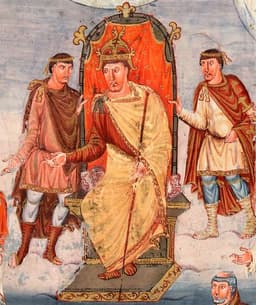
Charles the Bald
Emperor · Medieval
50.7Total
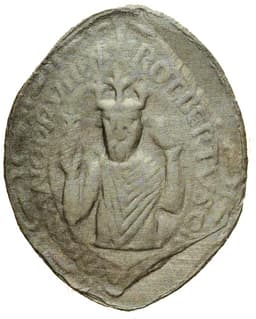
Robert II the Pious
Emperor · Medieval
44.9Total
Basic Information
Born
823
972
Died
877
1031
Era
Medieval
Medieval
Nationality
Frankish Empire
France
Occupation
Emperor
Emperor
Civilization
Western
Western
Score Comparison
Military (10%)
10.0
20.0
Political (20%)
68.0
37.9
Influence (20%)
54.9
50.2
Legacy (20%)
46.7
41.7
Leadership (15%)
65.0
65.0
Strategy (15%)
43.3
45.0
TOTAL
50.7
44.9
Charles the Bald — Complete Timeline
843 AD
Treaty of VerdunPolitical Action
Charles the Bald, along with his brothers Lothair and Louis the German, signed the Treaty of Verdun, dividing the Carolingian Empire into three kingdoms. Charles received West Francia, which became the foundation of modern France.
TreatyDivisionWest FranciaFrance
Impact: global
845 AD
Defense against Viking RaidsWar
Charles faced repeated Viking invasions, including the siege of Paris in 845. He paid large tributes (Danegeld) to buy off attackers, a strategy that temporarily secured peace but drained royal resources and exposed military weakness.
VikingsDanegeldSiege of Paris
Impact: national
875 AD
Coronation as Holy Roman EmperorPolitical Action◆ Major
Pope John VIII crowned Charles the Bald as Holy Roman Emperor, following the death of Louis II. This coronation asserted Charles's claim to imperial authority but was contested by other Carolingian rulers.
CoronationHoly Roman EmpirePapacy
Impact: regionalconstructive
Robert II the Pious — Complete Timeline
996 AD
Reign as King of the FranksPolitical Action◆ Major
Robert II succeeded his father Hugh Capet as King of the Franks. His reign was marked by efforts to consolidate royal power, but he faced challenges from powerful nobles and the Church, limiting his authority.
KingshipCapetianReign
Impact: national
998 AD
Excommunication for Marriage to Bertha of BurgundyPolitical Action◆ Major
Robert II was excommunicated by Pope Gregory V for marrying Bertha of Burgundy, his cousin, without papal dispensation. The excommunication was lifted after Robert repudiated Bertha, but it damaged his reputation and strained relations with the Church.
ExcommunicationMarriageChurch Conflict
Impact: nationaltragic
1000 AD
Patronage of the Cluniac ReformsCultural
Robert II supported the Cluniac monastic reforms, which aimed to purify the Church and reduce secular influence. His patronage strengthened the Cluniac movement and enhanced the Church's moral authority in France.
Church ReformClunyPatronage
Impact: regionalconstructive
1002 AD
Conflict with the Duchy of BurgundyWar
Robert II attempted to assert control over the Duchy of Burgundy after the death of Duke Henry I. The conflict lasted several years and resulted in limited success, as Burgundy remained largely independent under its own dukes.
WarBurgundyTerritorial Conflict
Impact: regional
Expert Analysis
Origins
**Charles the Bald** was born on June 13, 823, in Frankfurt, the son of Emperor Louis the Pious and his second wife Judith of Bavaria. He was a grandson of Charlemagne. His education was overseen by scholars like Walafrid Strabo, and he was given the kingdom of Aquitaine in 832 at age nine. His father's attempts to secure a kingdom for Charles led to conflicts with his older half-brothers.
**Robert II the Pious** was born c. 972 in Orléans, the son of Hugh Capet, Duke of the Franks, and Adelaide of Aquitaine. He was educated at the cathedral school of Reims under Gerbert of Aurillac (later Pope Sylvester II). His upbringing emphasized piety and learning, and he was associated with his father's rule from 987, becoming the second Capetian king.
Rise to Power
Charles the Bald rose through the civil wars that followed Louis the Pious's death. After the Treaty of Verdun in 843, he gained West Francia, the western third of the Carolingian Empire. His coronation as Holy Roman Emperor in 875 by Pope John VIII, after the death of Louis II, marked his peak. However, his imperial title was contested by his brother Louis the German and later by Charles the Fat.
Robert II succeeded his father Hugh Capet in 996, but his path was smoother due to Capetian heredity. He was crowned co-king in 987 and became sole ruler upon Hugh's death. His main challenge was asserting authority over powerful nobles, such as the counts of Blois and Anjou, and dealing with ecclesiastical conflicts over his marriages.
Leadership & Governance
Charles the Bald's leadership was characterized by political maneuvering and delegation. He issued capitularies and supported the Church, exemplified by the Edict of Pîtres (864) reforming coinage and military service. However, his reliance on paying Danegeld to Vikings (e.g., 845 siege of Paris, 7000 pounds of silver) weakened his treasury. His political score of 68.0 reflects his ability to navigate aristocratic factions, but his military score of 10.0 shows his weakness in defense.
Robert II the Pious focused on religious patronage and consolidating royal domain. He supported the Cluniac reforms, which aimed to purify the Church and reduce lay influence. His excommunication in 998 for marrying his cousin Bertha of Burgundy (without dispensation) damaged his authority; he later repudiated her and married Constance of Arles. His leadership score of 65.0 is similar to Charles's, but his political score of 37.9 indicates less success in expanding royal power.
Triumph & Tragedy
Charles the Bald's greatest triumph was securing the imperial crown in 875, a symbol of Carolingian prestige. He also successfully defended West Francia against Breton incursions and maintained a degree of unity. His greatest tragedy was the collapse of his imperial claims after his death in 877; his kingdom fragmented under Viking attacks and internal strife. His legacy score of 46.7 reflects the ephemeral nature of his achievements.
Robert II's triumph was the peaceful succession of his son Henry I in 1031, ensuring Capetian continuity. His patronage of Cluny strengthened the Church and boosted royal prestige. His tragedy was his failed marriage to Bertha, which led to excommunication and a seven-year break from the Church. He also failed to fully subdue Burgundy after the death of Duke Henry I in 1002, resulting in a prolonged conflict that ended with limited gains. His legacy score of 41.7 is lower than Charles's.
Character & Destiny
Charles the Bald was pragmatic and learned, earning the epithet 'the Bald' possibly from his lack of hair or from ironical reasons. He was a patron of learning, supporting scholars like John Scotus Eriugena. His indecisiveness in military matters and reliance on bribes led to vulnerability. His destiny was to be a transitional figure, unable to prevent the decline of the Carolingian dynasty.
Robert II was deeply religious, earning the nickname 'the Pious'. His piety sometimes overrode political sense, as in his marriage to Bertha. He was known for his clemency and justice, but his lack of military aggressiveness limited territorial expansion. His destiny was to consolidate the Capetian hold on the throne, laying foundations for future expansion.
Legacy
Charles the Bald's legacy is tied to the fragmentation of Charlemagne's empire. The Treaty of Verdun established borders that evolved into modern France and Germany. His support for learning preserved classical texts. However, his reign is often seen as a failure to stop Viking incursions. His total score of 50.7 reflects moderate impact.
Robert II's legacy is the consolidation of the Capetian dynasty, which ruled France until 1328. His support for Cluniac reforms strengthened the Church's independence. He also composed hymns and was a patron of the Peace and Truce of God movements, limiting feudal warfare. His total score of 44.9 shows a slightly lower impact, but his dynasty's longevity surpasses Charles's.
Conclusion
Charles the Bald, with a total score of 50.7, had a greater immediate impact on European politics through the division of the Carolingian Empire and his imperial coronation. Robert II the Pious, scoring 44.9, was more successful in the long term by establishing the Capetian dynasty's hereditary rule. However, Charles's influence on the shaping of West Francia and the imperial title gives him the edge. Charles the Bald is the more significant figure in medieval history.
Rankings
🥇
Charles the BaldLeader
Mil: 10.0Pol: 68.0Inf: 54.9
50.7
🥈
Robert II the Pious
Mil: 20.0Pol: 37.9Inf: 50.2
44.9
+5.8 behind
How This Comparison Works
Algorithm
Each figure is scored on 6 dimensions (0—100 scale) based on structured historical data: Military (10%), Political (20%), Influence (20%), Legacy (20%), Leadership (15%), Strategy (15%). The weighted total produces the final ranking.
Data Sources
Scores are computed from structured sub-indicators in the database. Scale factors adjust for era (Ancient ×0.85, Modern ×1.0) and civilization size (Eastern ×1.05, Other ×0.80) to account for differences in population and military scale.
Maximum 3 Figures
Comparisons are limited to 2—3 figures to ensure readability and statistical meaningfulness.
Error Margins
±5 points per dimension — Sub-scores are derived from historical records with inherent uncertainty. Two figures within 5 points on a dimension should be considered roughly equivalent in that area.
Total Score Accuracy
±3 points overall — The weighted combination of 6 dimensions produces a total score with approximately ±3 points of uncertainty. Differences of less than 3 points are not statistically significant— the figures are effectively tied.
Known Limitations
- Historical records are incomplete and uneven across civilizations
- Figures from oral-tradition societies may be underrepresented
- Occupation labels can misclassify multi-role figures
- Scores measure capability and impact, not moral character
- Quantitative scoring is a comparison tool, not absolute truth
Capability Radar
Military (10%) — Battles & Warfare
Battles
45
5
Win Rate
40
5
Expansion
35
5
Political (20%) — Governance & Reform
Reform
45
40
Diplomacy
55
30
Economy
50
30
Influence (20%) — Cultural & Global Reach
Cultural
40
30
Global
30
10
Legacy (20%) — Historical Impact
Historical
45
30
Longevity
35
20
Leadership (15%) — Power & Stability
Tenure
60
60
Stability
40
40
Strategy (15%) — Tactics & Innovation
Strategy
40
5
Tactics
35
5
Reform
30
5
Similar Comparisons
Comments & Discussion
No comments yet. Be the first to share your thoughts!