Loading...
Charles William Ferdinand vs Julius Caesar
Julius Caesar leads by 22.7 pts · 2 figures compared
…
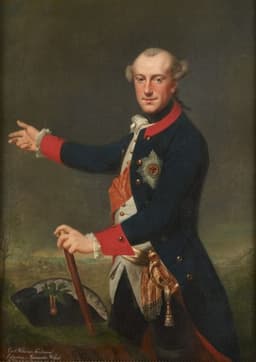
Charles William Ferdinand
General · Modern
60.1Total

Julius Caesar
General · Ancient
82.8Total
Basic Information
Born
1735
-100
Died
1806
-44
Era
Modern
Ancient
Nationality
Brunswick
Roman Republic
Occupation
General
General
Civilization
Western
Western
Score Comparison
Military (10%)
61.7
88.0
Political (20%)
68.0
78.0
Influence (20%)
54.9
85.0
Legacy (20%)
49.2
82.0
Leadership (15%)
80.0
80.0
Strategy (15%)
57.5
85.0
TOTAL
60.1
82.8
Charles William Ferdinand — Complete Timeline
1757 AD
Served as a general in the Seven Years' WarWar◆ Major
Charles William Ferdinand served as a general under Frederick the Great during the Seven Years' War. He distinguished himself in several battles, including the Battle of Rossbach, gaining a reputation as a capable military commander.
Seven Years' WarMilitary ServiceFrederick the Great
Impact: regional
1792 AD
Issued the Brunswick ManifestoPolitical Action◆ Major
As commander of the Allied army during the French Revolutionary Wars, Charles William Ferdinand issued the Brunswick Manifesto, threatening Paris with destruction if the French royal family was harmed. This document backfired, galvanizing French resistance and contributing to the fall of the monarchy.
French RevolutionManifestoThreat
Impact: globaldestructive
1806 AD
Commanded the Prussian army at the Battle of AuerstedtWar
Charles William Ferdinand, as Prussian field marshal, commanded the main Prussian army at the Battle of Auerstedt against Napoleon's forces. The Prussian army was decisively defeated, and Charles William Ferdinand was mortally wounded, dying two days later.
Napoleonic WarsBattleDefeat
Impact: globaltragic
Julius Caesar — Complete Timeline
58 BC
Gallic WarsWar◆ Major
Caesar, as proconsul of Gaul, launched a series of campaigns that conquered all of Gaul (modern France, Belgium, and parts of Switzerland). He fought numerous battles, including against the Helvetii, the Belgae, and the Gallic chieftain Vercingetorix. The wars brought immense wealth and a loyal army to Caesar.
Gallic WarsConquestRoman Expansion
Impact: regional
49 BC
Crossing the RubiconPolitical Action◆ Major
Caesar led Legio XIII across the Rubicon River into Italy, defying the Roman Senate's order to disband his army. This act triggered a civil war against Pompey and the Optimates, ultimately leading to Caesar's dictatorship and the end of the Roman Republic.
Roman Civil WarEnd of RepublicPower Struggle
Impact: global
48 BC
Battle of PharsalusWar◆ Major
Caesar's outnumbered army defeated the larger forces of Pompey the Great at Pharsalus in Greece. Caesar's tactical use of a reserve line to counter Pompey's cavalry charge proved decisive. Pompey fled to Egypt, where he was assassinated, leaving Caesar as the undisputed master of the Roman world.
Roman Civil WarBattleDecisive Victory
Impact: regional
44 BC
Appointment as Dictator for LifePolitical Action◆ Major
The Roman Senate appointed Caesar dictator perpetuo (dictator for life), granting him unprecedented personal power. This move concentrated military, legislative, and judicial authority in one person, effectively ending the Roman Republic's traditional system of checks and balances and alarming many senators.
DictatorshipEnd of RepublicPower Consolidation
Impact: regionaldestructive
Assassination on the Ides of MarchPolitical Action◆ Major
A group of Roman senators, led by Marcus Junius Brutus and Gaius Cassius Longinus, stabbed Caesar to death at a meeting of the Senate in the Theatre of Pompey. The assassination was intended to restore the Republic, but instead triggered another civil war that led to the rise of the Roman Empire.
AssassinationRoman PoliticsEnd of Republic
Impact: globaldestructive
Expert Analysis
charles-william-ferdinand-vs-julius-caesar
# The Crossing and the Manifesto
On a cold January night in 49 BCE, a middle-aged Roman general stood at the banks of a small river in northern Italy. The Rubicon was little more than a stream, but it marked the boundary between his province and Rome itself—between command and treason, between a general’s duty and a dictator’s ambition. He crossed. Seventeen centuries later, on a summer day in 1792, a Prussian field marshal in his late fifties sat in a carriage outside the walls of Paris, drafting a document that would threaten the French Revolution with fire and sword. He signed it. Both men acted with the confidence of commanders who believed they understood power. One would change the world; the other would be consumed by it.
Origins
Julius Caesar was born into the chaos of the late Roman Republic, a world of crumbling aristocratic norms and rising military strongmen. His family, the Julii, claimed descent from the goddess Venus, but they were politically marginal. Caesar’s father died when he was sixteen, leaving him to navigate the treacherous waters of Roman politics with little more than a name and a fierce ambition. He was a child of civil war, of Marius and Sulla, of proscriptions and massacres. From the start, he understood that the Republic was a game for those willing to break its rules.
Charles William Ferdinand, Duke of Brunswick, was born into the orderly world of the German Enlightenment. His father was a reigning prince, his mother a princess of England. He was educated by philosophers and mathematicians, trained in the arts of war by Frederick the Great himself. Where Caesar learned politics in the streets and forums of a dying republic, Brunswick learned it in the court of an absolute monarch. He was a man of the old order—rational, disciplined, and utterly certain that the world as he knew it was the only world that should exist.
Rise to Power
Caesar’s path was long and cunning. He served as a military tribune, then as a quaestor in Spain, where he wept before a statue of Alexander the Great because he had achieved nothing by an age when Alexander had conquered the world. He climbed the ladder of Roman offices—aedile, praetor, consul—borrowing vast sums to bribe his way forward, forging alliances with Pompey and Crassus, and finally winning command of Gaul. In eight years of relentless war, he conquered a territory larger than Italy itself, amassing wealth, loyalty, and an army that would follow him anywhere.
Brunswick’s rise was steadier, more predictable. He served with distinction in the Seven Years’ War, fighting alongside Frederick the Great at battles like Rossbach and Leuthen. By 1757, he was already a general. He inherited his duchy in 1780 and governed as an enlightened despot, patronizing the arts and reforming his small state. When the French Revolution erupted, he was the natural choice to lead the Allied armies against the new republic. He was, by all accounts, a competent soldier and a decent ruler. But he had never faced an enemy like the one that awaited him.
Leadership & Governance
Caesar governed through charisma, calculation, and terror. In Gaul, he was both butcher and benefactor—destroying entire tribes, then pardoning their leaders and granting them Roman citizenship. He understood that loyalty could be bought with mercy as easily as with fear. When he crossed the Rubicon, he marched not on Rome but toward it, offering clemency to his enemies even as he defeated them. His reforms as dictator—the calendar, the land redistribution, the colonization of veterans—were designed to create a new order that would outlast him.
Brunswick governed by the book—the book of eighteenth-century warfare, which prescribed careful maneuvers, limited objectives, and the protection of civilian property. The Brunswick Manifesto he issued in 1792 was a product of this mindset: a threat meant to intimidate the revolutionaries into submission, promising to restore the French monarchy and punish anyone who resisted. It was a rational document, written in the language of a bygone era. But the revolutionaries were not rational in the way he understood. They saw the manifesto not as a warning but as a declaration of war against the people themselves.
Triumph & Tragedy
Caesar’s greatest triumph was Gaul—a conquest that made him immortal. His greatest tragedy was his own success. By destroying the Republic, he made himself its master, but he also made his assassination inevitable. On the Ides of March, 44 BCE, sixty senators stabbed him to death in the Senate chamber. His last words, according to legend, were to his friend Brutus: “Et tu, Brute?”
Brunswick’s greatest triumph was surviving the Seven Years’ War with his reputation intact. His greatest tragedy was Auerstedt. In October 1806, he commanded the Prussian army against Napoleon’s forces. Wounded early in the battle, he was carried from the field, blinded and dying. Without his leadership, the Prussian army collapsed, and the kingdom itself nearly fell. He died a few weeks later, a casualty not just of French bullets but of a world he could no longer understand.
Character & Destiny
Caesar was a gambler who calculated every risk. He knew that the Republic was rotten, that the old rules no longer applied. He was arrogant, ruthless, and brilliant—a man who believed he was destined for greatness and made that belief a self-fulfilling prophecy. His personality drove him to cross the Rubicon, to seize power, and to refuse the crown that would have made him king. He wanted to be more than a king; he wanted to be a god.
Brunswick was a man of duty, not destiny. He believed in order, in hierarchy, in the old ways. When he issued the manifesto, he thought he was acting as a responsible commander, warning a rebellious populace of the consequences of resistance. He could not imagine that his words would unite the French against him, that they would fuel the very revolution he sought to crush. His tragedy was not that he was incompetent but that he was obsolete.
Legacy
Caesar’s legacy is the Roman Empire itself. His name became a title—Caesar, Kaiser, Tsar. His military campaigns are still studied in war colleges. His writings are still read as literature. He is the archetype of the ambitious general who reshapes history through sheer force of will.
Brunswick’s legacy is a cautionary tale. The manifesto that bears his name is remembered as a catastrophic miscalculation, a document that turned a foreign war into a revolutionary crusade. He is studied not for his victories but for his failures, not for what he built but for what he could not preserve.
Conclusion
One man crossed a river; the other signed a paper. Both believed they were acting for the best, both were products of their time, and both were destroyed by forces they helped unleash. Caesar understood that the future belonged to those who could seize it. Brunswick believed the past could be defended. History, as always, favored the gambler over the guardian. The Rubicon is still a metaphor for irreversible decisions; the Brunswick Manifesto is a footnote. In the end, the difference between a legend and a lesson is often just a matter of timing—and the willingness to cross the line.
Rankings
🥇
Julius CaesarLeader
Mil: 88.0Pol: 78.0Inf: 85.0
82.8
🥈
Charles William Ferdinand
Mil: 61.7Pol: 68.0Inf: 54.9
60.1
+22.7 behind
How This Comparison Works
Algorithm
Each figure is scored on 6 dimensions (0—100 scale) based on structured historical data: Military (10%), Political (20%), Influence (20%), Legacy (20%), Leadership (15%), Strategy (15%). The weighted total produces the final ranking.
Data Sources
Scores are computed from structured sub-indicators in the database. Scale factors adjust for era (Ancient ×0.85, Modern ×1.0) and civilization size (Eastern ×1.05, Other ×0.80) to account for differences in population and military scale.
Maximum 3 Figures
Comparisons are limited to 2—3 figures to ensure readability and statistical meaningfulness.
Error Margins
±5 points per dimension — Sub-scores are derived from historical records with inherent uncertainty. Two figures within 5 points on a dimension should be considered roughly equivalent in that area.
Total Score Accuracy
±3 points overall — The weighted combination of 6 dimensions produces a total score with approximately ±3 points of uncertainty. Differences of less than 3 points are not statistically significant— the figures are effectively tied.
Known Limitations
- Historical records are incomplete and uneven across civilizations
- Figures from oral-tradition societies may be underrepresented
- Occupation labels can misclassify multi-role figures
- Scores measure capability and impact, not moral character
- Quantitative scoring is a comparison tool, not absolute truth
Capability Radar
Military (10%) — Battles & Warfare
Battles
75
95
Win Rate
65
92
Expansion
55
97
Political (20%) — Governance & Reform
Reform
45
90
Diplomacy
55
85
Economy
40
82
Influence (20%) — Cultural & Global Reach
Cultural
30
88
Global
30
94
Legacy (20%) — Historical Impact
Historical
50
95
Longevity
35
96
Leadership (15%) — Power & Stability
Tenure
50
75
Stability
45
60
Strategy (15%) — Tactics & Innovation
Strategy
72
94
Tactics
70
96
Reform
60
88
Similar Comparisons
Comments & Discussion
No comments yet. Be the first to share your thoughts!