Loading...
Che Guevara vs Emilio Aguinaldo
Emilio Aguinaldo leads by 2.6 pts · 2 figures compared
…
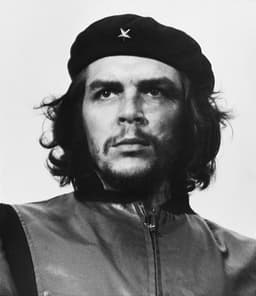
Che Guevara
Revolutionary · Modern
41.5Total

Emilio Aguinaldo
Revolutionary · Modern
44.1Total
Basic Information
Born
1928
1869
Died
—
1964
Era
Modern
Modern
Nationality
Argentina
Philippines
Occupation
Revolutionary
Revolutionary
Civilization
Western
Eastern
Score Comparison
Military (10%)
35.0
46.7
Political (20%)
25.0
29.3
Influence (20%)
55.0
54.1
Legacy (20%)
50.0
45.8
Leadership (15%)
30.0
43.8
Strategy (15%)
35.0
35.0
TOTAL
41.5
44.1
Che Guevara — Complete Timeline
1956 AD
Participation in the Cuban RevolutionWar
Guevara joined Fidel Castro's 26th of July Movement, landing in Cuba aboard the Granma. He became a key guerrilla commander, leading troops in the Battle of Santa Clara, which helped overthrow Fulgencio Batista's regime.
Cuban RevolutionGuerrilla WarfareCastro
Impact: regional
1961 AD
Appointment as Minister of IndustriesPolitical Action◆ Major
Guevara was appointed Minister of Industries in Cuba, where he implemented radical economic policies, including nationalization and central planning. His efforts to diversify the economy and reduce dependence on sugar largely failed.
Economic PolicyNationalizationCuba
Impact: national
1965 AD
Guerrilla Campaign in the CongoWar◆ Major
Guevara led a small Cuban force to support the Simba rebellion in the Democratic Republic of the Congo. The campaign was unsuccessful due to poor logistics, lack of local support, and superior opposition forces, leading to his withdrawal.
CongoGuerrillaFailed Revolution
Impact: regionaldestructive
1967 AD
Capture and Execution in BoliviaPolitical Action
Guevara was captured by Bolivian forces, trained and advised by the CIA, while leading a guerrilla insurgency. He was executed the next day in La Higuera. His death turned him into a global icon of revolutionary struggle.
ExecutionBoliviaMartyrdom
Impact: globaltragic
Emilio Aguinaldo — Complete Timeline
1896 AD
Execution of José Rizal (involvement)Political Action◆ Major
Aguinaldo, as a leader of the Katipunan, was involved in the Philippine Revolution against Spain, which was catalyzed by Rizal's execution. He led revolutionary forces in Cavite, winning early victories against Spanish troops.
Philippine RevolutionKatipunanCavite
Impact: national
1898 AD
Proclamation of Philippine IndependencePolitical Action
Aguinaldo proclaimed the independence of the Philippines from Spain in Kawit, Cavite, establishing the First Philippine Republic. This declaration followed the Spanish-American War and Aguinaldo's return from exile, asserting Filipino sovereignty.
IndependencePhilippine RevolutionFirst Republic
Impact: nationalprogressive
1899 AD
Battle of Manila (1899)War◆ Major
Aguinaldo's forces engaged American troops in Manila, marking the start of the Philippine-American War. The conflict arose from tensions over U.S. annexation of the Philippines, leading to a brutal war that lasted until 1902.
Philippine-American WarBattleColonial Conflict
Impact: nationaldestructive
1901 AD
Capture of Emilio AguinaldoPolitical Action
Aguinaldo was captured by U.S. forces in Palanan, Isabela, after a months-long pursuit led by General Frederick Funston. His capture effectively ended the organized phase of the Philippine-American War, leading to his oath of allegiance to the United States.
CapturePhilippine-American WarU.S. Occupation
Impact: nationaltragic
Expert Analysis
Origins
Ernesto "Che" Guevara was born in 1928 in Rosario, Argentina, into a middle-class family with leftist leanings. He studied medicine at the University of Buenos Aires, graduating in 1953. His travels through Latin America exposed him to poverty and imperialism, shaping his Marxist ideology. In contrast, Emilio Aguinaldo was born in 1869 in Kawit, Cavite, Philippines, into a wealthy Chinese-Filipino family. He studied at the Colegio de San Juan de Letran but left early to help manage the family farm. Aguinaldo became the capitan municipal (town head) in 1895, gaining leadership experience within the colonial system.
Rise to Power
Guevara's rise began in 1954 when he met Fidel Castro in Mexico City and joined the 26th of July Movement. He landed in Cuba aboard the Granma in 1956, surviving a devastating ambush. As a guerrilla commander, he led the decisive Battle of Santa Clara in December 1958, forcing Batista to flee. Aguinaldo rose through the Katipunan, a secret revolutionary society. He became president of the revolutionary government in 1897 after the Tejeros Convention, succeeding Andres Bonifacio. He led the Philippine Revolution against Spain, culminating in the proclamation of independence on June 12, 1898. However, the Philippine-American War soon followed, lasting from 1899 to 1902.
Leadership & Governance
Guevara's leadership style was charismatic but rigidly ideological. As Minister of Industries in Cuba from 1961 to 1965, he implemented central planning, nationalized private enterprises, and pushed for moral incentives over material ones. His policies led to production declines and economic inefficiency, scoring 25.0 in political leadership. Aguinaldo, as the first president of the Philippines, established a dictatorial government during wartime. He centralized authority, often clashing with other leaders, and ordered the execution of Andres Bonifacio in 1897. His governance was pragmatic but authoritarian, scoring 29.3 in political leadership. Both faced challenges of nation-building under threat: Guevara with U.S. embargo and Aguinaldo with American colonization.
Triumph & Tragedy
Guevara's greatest success was his role in the Cuban Revolution, toppling a U.S.-backed dictator and inspiring leftist movements worldwide. His guerrilla warfare manual became a textbook for revolutionaries. However, his failures include the disastrous Congo campaign in 1965 and his capture and execution in Bolivia in 1967, where he scored 35.0 in military leadership. Aguinaldo's triumph was leading the Philippine Revolution against Spain, achieving independence for a short period. He also established the first Philippine Republic. His tragedy lies in the Philippine-American War, where his forces were overwhelmed, leading to his capture in 1901. He later swore allegiance to the U.S., which many Filipinos viewed as betrayal. His military score of 46.7 reflects his tactical skills but ultimate defeat.
Character & Destiny
Guevara was idealistic, uncompromising, and willing to die for his beliefs. His personality—stern, disciplined, and dogmatic—alienated some allies but inspired fervent loyalty. His fate was sealed by his decision to export revolution to Bolivia, where conditions were unfavorable. Aguinaldo was pragmatic and ambitious, often prioritizing his leadership over ideology. He survived to old age, dying at 94, but his legacy is tainted by his collaboration with the U.S. after capture. Historians note that Guevara's character led him to martyrdom, while Aguinaldo's pragmatism led to surrender.
Legacy
Guevara's legacy is immense as a global symbol of rebellion and anti-imperialism. His image adorns T-shirts worldwide, and his ideas influenced movements from Africa to Latin America. He scores 55.0 in influence and 50.0 in legacy. Aguinaldo is remembered as the first president of the Philippines and a key figure in the fight for independence. However, his legacy is more national than global, scoring 54.1 in influence and 45.8 in legacy. Both men left lasting impacts: Guevara on revolutionary theory and iconography, Aguinaldo on Philippine national identity.
Conclusion
Emilio Aguinaldo had a slightly higher total score (44.1 vs. 41.5) due to his military achievements and direct leadership in a successful revolution against Spain. However, Che Guevara's global influence and symbolic power surpass Aguinaldo's regional importance. While Aguinaldo's impact was confined to the Philippines, Guevara inspired worldwide movements. Therefore, Che Guevara had greater overall impact, despite lower scores in military and political leadership. His legacy transcends borders, making him a more significant historical figure.
Rankings
🥇
Emilio AguinaldoLeader
Mil: 46.7Pol: 29.3Inf: 54.1
44.1
🥈
Che Guevara
Mil: 35.0Pol: 25.0Inf: 55.0
41.5
+2.6 behind
How This Comparison Works
Algorithm
Each figure is scored on 6 dimensions (0—100 scale) based on structured historical data: Military (10%), Political (20%), Influence (20%), Legacy (20%), Leadership (15%), Strategy (15%). The weighted total produces the final ranking.
Data Sources
Scores are computed from structured sub-indicators in the database. Scale factors adjust for era (Ancient ×0.85, Modern ×1.0) and civilization size (Eastern ×1.05, Other ×0.80) to account for differences in population and military scale.
Maximum 3 Figures
Comparisons are limited to 2—3 figures to ensure readability and statistical meaningfulness.
Error Margins
±5 points per dimension — Sub-scores are derived from historical records with inherent uncertainty. Two figures within 5 points on a dimension should be considered roughly equivalent in that area.
Total Score Accuracy
±3 points overall — The weighted combination of 6 dimensions produces a total score with approximately ±3 points of uncertainty. Differences of less than 3 points are not statistically significant— the figures are effectively tied.
Known Limitations
- Historical records are incomplete and uneven across civilizations
- Figures from oral-tradition societies may be underrepresented
- Occupation labels can misclassify multi-role figures
- Scores measure capability and impact, not moral character
- Quantitative scoring is a comparison tool, not absolute truth
Capability Radar
Military (10%) — Battles & Warfare
Battles
35
45
Win Rate
40
40
Expansion
25
30
Political (20%) — Governance & Reform
Reform
35
35
Diplomacy
20
30
Economy
15
20
Influence (20%) — Cultural & Global Reach
Cultural
75
55
Global
70
40
Legacy (20%) — Historical Impact
Historical
70
55
Longevity
65
50
Leadership (15%) — Power & Stability
Tenure
30
40
Stability
10
20
Strategy (15%) — Tactics & Innovation
Strategy
45
45
Tactics
55
50
Reform
30
35
Similar Comparisons
Comments & Discussion
No comments yet. Be the first to share your thoughts!