Loading...
Chea Sim vs Jiang Zemin
Jiang Zemin leads by 6.5 pts · 2 figures compared
…
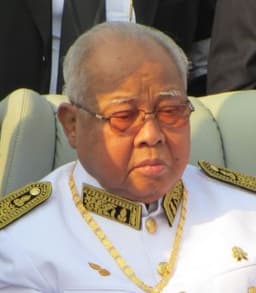
Chea Sim
Politician · Modern
52.1Total
Jiang Zemin
Politician · Modern
58.6Total
Basic Information
Born
1932
1926
Died
—
—
Era
Modern
Modern
Nationality
Cambodia
China
Occupation
Politician
Politician
Civilization
Eastern
Eastern
Score Comparison
Military (10%)
24.1
10.7
Political (20%)
54.7
82.0
Influence (20%)
51.8
65.0
Legacy (20%)
49.2
55.0
Leadership (15%)
72.0
78.0
Strategy (15%)
54.1
35.1
TOTAL
52.1
58.6
Chea Sim — Complete Timeline
1991 AD
Appointed President of the Cambodian People's PartyPolitical Action◆ Major
Chea Sim became the President of the Cambodian People's Party (CPP), the ruling party. He was a key figure in the party's leadership, overseeing its transition from a communist to a more pragmatic political organization.
Political PartyCPPLeadership
Impact: national
1993 AD
Became President of the National Assembly of CambodiaPolitical Action◆ Major
Chea Sim was elected President of the National Assembly following the 1993 UN-supervised elections. He played a central role in drafting the new constitution and establishing the coalition government between FUNCINPEC and the CPP.
ParliamentConstitutionCambodia
Impact: nationalconstructive
Served as Acting Head of StatePolitical Action
In the interim period before the restoration of the monarchy, Chea Sim served as Acting Head of State of Cambodia. He oversaw the transition to the constitutional monarchy under King Norodom Sihanouk.
Head of StateTransitionCambodia
Impact: national
Jiang Zemin — Complete Timeline
1989 AD
Appointed General Secretary of the Communist PartyPolitical Action◆ Major
Jiang Zemin succeeded Zhao Ziyang as General Secretary after the Tiananmen Square crackdown. He consolidated power and led China through a period of rapid economic growth.
Party LeadershipPost-Tiananmen
Impact: national
2000 AD
Promoted the 'Three Represents' TheoryPolitical Action◆ Major
Jiang Zemin introduced the 'Three Represents' theory, which allowed private entrepreneurs to join the Communist Party. This ideological shift accommodated China's market economy reforms.
IdeologyEconomic Reform
Impact: nationalconstructive
2001 AD
Oversaw China's Entry into the WTOPolitical Action
Under Jiang Zemin's leadership, China joined the World Trade Organization. This integration accelerated economic growth and opened Chinese markets to global trade.
WTOGlobalization
Impact: globalconstructive
Shanghai Cooperation Organization FoundedPolitical Action◆ Major
Jiang Zemin was instrumental in founding the Shanghai Cooperation Organization with Russia and Central Asian states. The SCO focused on security cooperation and counterterrorism.
DiplomacySecurity
Impact: regionalconstructive
Expert Analysis
Origins
Chea Sim was born in 1932 in rural Cambodia, the son of a farmer. He joined the anti-colonial resistance against the French and later aligned with the Cambodian People's Party (CPP), rising through its ranks. His early life was shaped by the turbulent decades of war, including the Khmer Rouge regime. Jiang Zemin was born in 1926 in Yangzhou, China, into a middle-class family. He studied electrical engineering at Shanghai Jiao Tong University and later worked in the Soviet Union. His technical background distinguished him from many party cadres.
Rise to Power
Chea Sim’s rise was tied to the CPP’s dominance after the Vietnamese intervention removed the Khmer Rouge in 1979. He became a key figure in the party’s security apparatus and was elected President of the National Assembly in 1993, following UN-supervised elections. He served as Acting Head of State in 1992-1993, overseeing the transition to a constitutional monarchy. Jiang Zemin rose after the Tiananmen Square protests in 1989, when he was appointed General Secretary of the Communist Party. He consolidated power by balancing hardliners and reformers, later becoming President in 1993. His pivotal moment was guiding China’s accession to the WTO in 2001, which accelerated economic integration.
Leadership & Governance
Chea Sim’s leadership style was pragmatic and behind-the-scenes. As CPP president, he maintained party unity through patronage and control over security forces. His governance focused on stability, often suppressing dissent. Jiang Zemin, in contrast, was a more visible figure, promoting the 'Three Represents' theory to broaden the party’s base. He oversaw massive economic reforms, including state-owned enterprise restructuring. While Chea Sim scored 72.0 in leadership, Jiang scored 78.0. Jiang’s strategy score (35.1) was lower than Chea’s (54.1), reflecting Chea’s effective maneuvering in Cambodia’s complex coalition politics.
Triumph & Tragedy
Chea Sim’s greatest success was stabilizing Cambodia after decades of war, but his legacy is marred by corruption and authoritarian practices. He failed to democratize the party. Jiang Zemin’s triumph was China’s economic transformation, with GDP growth averaging 10% during his tenure. His tragedy includes the Tiananmen crackdown that enabled his rise, which remains a deep stain. Jiang’s score in political impact (82.0) far exceeds Chea’s (54.7), but his military score (10.7) is lower than Chea’s (24.1), reflecting their different contexts.
Character & Destiny
Chea Sim was cautious and risk-averse, preferring to operate from the shadows. His destiny was intertwined with the CPP’s survival. Jiang Zemin was charismatic and ambitious, often compared to a 'rock star' for his public persona. He actively shaped his legacy through the 'Three Represents' and the Shanghai Cooperation Organization. Historians note Jiang’s adaptability in navigating post-Tiananmen politics, while Chea is seen as a relic of the Cold War era.
Legacy
Chea Sim’s legacy is confined to Cambodia: he helped entrench CPP rule but failed to foster democratic institutions. Jiang Zemin’s impact is global: the WTO entry reshaped world trade, and the SCO influenced Central Asian geopolitics. Jiang’s total score (58.6) edges Chea’s (52.1) by 6.5 points, reflecting his broader influence. However, Chea’s local legacy score (49.2) is close to Jiang’s (55.0), indicating enduring party control in Cambodia.
Conclusion
Jiang Zemin had greater historical impact. His policies integrated China into the global economy, affecting billions. Chea Sim, while pivotal in Cambodia, operated on a smaller stage. The data supports this: Jiang’s political score (82.0) and influence (65.0) dwarf Chea’s (54.7 and 51.8). Chea’s higher strategy score (54.1 vs 35.1) shows tactical skill, but Jiang’s strategic vision for China’s rise was more consequential. Thus, Jiang Zemin is the more significant figure.
Rankings
🥇
Jiang ZeminLeader
Mil: 10.7Pol: 82.0Inf: 65.0
58.6
🥈
Chea Sim
Mil: 24.1Pol: 54.7Inf: 51.8
52.1
+6.5 behind
How This Comparison Works
Algorithm
Each figure is scored on 6 dimensions (0—100 scale) based on structured historical data: Military (10%), Political (20%), Influence (20%), Legacy (20%), Leadership (15%), Strategy (15%). The weighted total produces the final ranking.
Data Sources
Scores are computed from structured sub-indicators in the database. Scale factors adjust for era (Ancient ×0.85, Modern ×1.0) and civilization size (Eastern ×1.05, Other ×0.80) to account for differences in population and military scale.
Maximum 3 Figures
Comparisons are limited to 2—3 figures to ensure readability and statistical meaningfulness.
Error Margins
±5 points per dimension — Sub-scores are derived from historical records with inherent uncertainty. Two figures within 5 points on a dimension should be considered roughly equivalent in that area.
Total Score Accuracy
±3 points overall — The weighted combination of 6 dimensions produces a total score with approximately ±3 points of uncertainty. Differences of less than 3 points are not statistically significant— the figures are effectively tied.
Known Limitations
- Historical records are incomplete and uneven across civilizations
- Figures from oral-tradition societies may be underrepresented
- Occupation labels can misclassify multi-role figures
- Scores measure capability and impact, not moral character
- Quantitative scoring is a comparison tool, not absolute truth
Capability Radar
Military (10%) — Battles & Warfare
Battles
50
16
Win Rate
55
18
Expansion
60
21
Political (20%) — Governance & Reform
Reform
40
85
Diplomacy
55
80
Economy
30
90
Influence (20%) — Cultural & Global Reach
Cultural
20
60
Global
30
75
Legacy (20%) — Historical Impact
Historical
50
70
Longevity
45
65
Leadership (15%) — Power & Stability
Tenure
75
75
Stability
45
85
Strategy (15%) — Tactics & Innovation
Strategy
62
23
Tactics
66
27
Reform
69
28
Similar Comparisons
Comments & Discussion
No comments yet. Be the first to share your thoughts!