Loading...
Chea Sim vs Ramsay MacDonald
Ramsay MacDonald leads by 2.2 pts · 2 figures compared
…
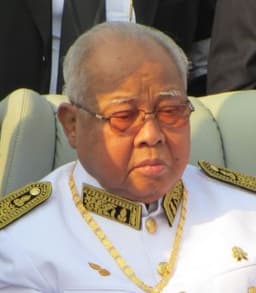
Chea Sim
Politician · Modern
52.1Total

Ramsay MacDonald
Politician · Modern
54.3Total
Basic Information
Born
1932
1866
Died
—
1937
Era
Modern
Modern
Nationality
Cambodia
United Kingdom
Occupation
Politician
Politician
Civilization
Eastern
Western
Score Comparison
Military (10%)
24.1
49.9
Political (20%)
54.7
68.0
Influence (20%)
51.8
58.0
Legacy (20%)
49.2
50.0
Leadership (15%)
72.0
53.2
Strategy (15%)
54.1
41.7
TOTAL
52.1
54.3
Chea Sim — Complete Timeline
1991 AD
Appointed President of the Cambodian People's PartyPolitical Action◆ Major
Chea Sim became the President of the Cambodian People's Party (CPP), the ruling party. He was a key figure in the party's leadership, overseeing its transition from a communist to a more pragmatic political organization.
Political PartyCPPLeadership
Impact: national
1993 AD
Became President of the National Assembly of CambodiaPolitical Action◆ Major
Chea Sim was elected President of the National Assembly following the 1993 UN-supervised elections. He played a central role in drafting the new constitution and establishing the coalition government between FUNCINPEC and the CPP.
ParliamentConstitutionCambodia
Impact: nationalconstructive
Served as Acting Head of StatePolitical Action
In the interim period before the restoration of the monarchy, Chea Sim served as Acting Head of State of Cambodia. He oversaw the transition to the constitutional monarchy under King Norodom Sihanouk.
Head of StateTransitionCambodia
Impact: national
Ramsay MacDonald — Complete Timeline
1924 AD
Formation of the First Labour GovernmentPolitical Action
MacDonald became the first Labour Prime Minister of the United Kingdom in January 1924, leading a minority government. This marked the first time the Labour Party held power, though the government lasted only nine months before falling over the Campbell Case.
Labour PartyFirst Labour GovernmentMinority Government
Impact: nationalconstructive
Recognition of the Soviet UnionPolitical Action◆ Major
MacDonald's government formally recognized the Soviet Union and signed the Anglo-Soviet Trade Agreement. This diplomatic move aimed to normalize relations and expand trade, but was controversial and contributed to the fall of the government after the Zinoviev letter affair.
Soviet UnionDiplomacyTrade
Impact: global
1931 AD
Formation of the National GovernmentPolitical Action
Facing a financial crisis and a split in the Labour cabinet, MacDonald formed a National Government with Conservatives and Liberals in August 1931. This action was seen as a betrayal by many in the Labour Party, leading to his expulsion from the party.
National GovernmentGreat DepressionLabour Split
Impact: nationaldestructive
1931 General ElectionPolitical Action◆ Major
MacDonald led the National Government to a landslide victory in the 1931 general election, winning 554 seats. The Labour Party was reduced to 52 seats, its worst result. This gave the National Government a massive majority to implement austerity measures.
ElectionNational GovernmentLandslide
Impact: national
1935 AD
Resignation as Prime MinisterPolitical Action◆ Major
MacDonald resigned as Prime Minister in June 1935 due to declining health and was succeeded by Stanley Baldwin. He remained in the cabinet as Lord President of the Council until 1937, but his political influence had waned.
ResignationNational GovernmentSuccession
Impact: national
Expert Analysis
Origins
Chea Sim was born in 1932 in rural Cambodia, the son of a farmer. He joined the Khmer Rouge resistance in the 1960s but defected to the pro-Vietnamese faction after 1975. His early life was marked by war and revolution. Ramsay MacDonald was born in 1866 in Lossiemouth, Scotland, into a working-class family. He left school at 15 but educated himself, becoming a journalist and socialist activist. His background was one of poverty and self-improvement.
Rise to Power
Chea Sim rose through the ranks of the Cambodian People's Party (CPP) after the Vietnamese invasion in 1979. He became Minister of Interior in 1981 and President of the National Assembly in 1993, a position he held until 2006. His power base was the party apparatus and control over security forces. MacDonald became leader of the Labour Party in 1911, navigating the split over World War I. He formed the first Labour government in 1924, a minority government that lasted 9 months. His rise was due to Labour's growing electoral strength and his skill in coalition-building.
Leadership & Governance
Chea Sim was a behind-the-scenes operator, focusing on party unity and loyalty. He supported Hun Sen as Prime Minister and helped maintain CPP dominance through patronage and coercion. His governance score is 72.0, reflecting his effectiveness within Cambodia's authoritarian system. MacDonald was a conciliatory leader, trying to bridge Labour, Liberals, and Conservatives. He formed the National Government in 1931, which split Labour and led to accusations of betrayal. His political score is 68.0, showing his ability to lead but also his controversial decisions.
Triumph & Tragedy
Chea Sim's greatest success was steering Cambodia through the 1990s transition, including the 1993 constitution and 1998 elections that kept the CPP in power. His greatest failure was the lack of democratic reforms and the perpetuation of corruption. MacDonald's triumph was becoming the first Labour PM and normalizing relations with the Soviet Union. His tragedy was the 1931 crisis: his National Government cut unemployment benefits, leading to Labour's decimation and his own vilification as a traitor. His legacy score is 50.0, reflecting mixed judgments.
Character & Destiny
Chea Sim was cautious, patient, and ruthless when needed. He avoided the spotlight but controlled the party's machinery. His character led to stability but also stagnation. MacDonald was idealistic but pragmatic, willing to compromise. His indecisiveness in 1931 led to a split that defined his later reputation. Historians see him as a tragic figure who lost his party.
Legacy
Chea Sim's legacy is the CPP's continued rule in Cambodia, with his influence still felt through party structures. His influence score is 51.8. MacDonald's legacy is Labour's establishment as a major party, but his National Government is controversial. He is remembered as both a pioneer and a traitor. In total scores, MacDonald leads 54.3 to 52.1, a narrow margin.
Conclusion
Ramsay MacDonald had a greater impact on global history by legitimizing Labour governance and shaping British politics. Chea Sim's influence was largely domestic and authoritarian. MacDonald's legacy, despite its flaws, transformed the UK's political landscape, while Chea Sim's maintained a single-party system. MacDonald's higher total score (54.3 vs 52.1) reflects his broader significance.
Rankings
🥇
Ramsay MacDonaldLeader
Mil: 49.9Pol: 68.0Inf: 58.0
54.3
🥈
Chea Sim
Mil: 24.1Pol: 54.7Inf: 51.8
52.1
+2.2 behind
How This Comparison Works
Algorithm
Each figure is scored on 6 dimensions (0—100 scale) based on structured historical data: Military (10%), Political (20%), Influence (20%), Legacy (20%), Leadership (15%), Strategy (15%). The weighted total produces the final ranking.
Data Sources
Scores are computed from structured sub-indicators in the database. Scale factors adjust for era (Ancient ×0.85, Modern ×1.0) and civilization size (Eastern ×1.05, Other ×0.80) to account for differences in population and military scale.
Maximum 3 Figures
Comparisons are limited to 2—3 figures to ensure readability and statistical meaningfulness.
Error Margins
±5 points per dimension — Sub-scores are derived from historical records with inherent uncertainty. Two figures within 5 points on a dimension should be considered roughly equivalent in that area.
Total Score Accuracy
±3 points overall — The weighted combination of 6 dimensions produces a total score with approximately ±3 points of uncertainty. Differences of less than 3 points are not statistically significant— the figures are effectively tied.
Known Limitations
- Historical records are incomplete and uneven across civilizations
- Figures from oral-tradition societies may be underrepresented
- Occupation labels can misclassify multi-role figures
- Scores measure capability and impact, not moral character
- Quantitative scoring is a comparison tool, not absolute truth
Capability Radar
Military (10%) — Battles & Warfare
Battles
50
29
Win Rate
55
30
Expansion
60
37
Political (20%) — Governance & Reform
Reform
40
55
Diplomacy
55
50
Economy
30
45
Influence (20%) — Cultural & Global Reach
Cultural
20
40
Global
30
50
Legacy (20%) — Historical Impact
Historical
50
55
Longevity
45
45
Leadership (15%) — Power & Stability
Tenure
75
60
Stability
45
40
Strategy (15%) — Tactics & Innovation
Strategy
62
38
Tactics
66
38
Reform
69
44
Similar Comparisons
Comments & Discussion
No comments yet. Be the first to share your thoughts!