Loading...
Christian III of Denmark vs Olav V of Norway
Olav V of Norway leads by 1.5 pts · 2 figures compared
…

Christian III of Denmark
Emperor · Modern
55.0Total
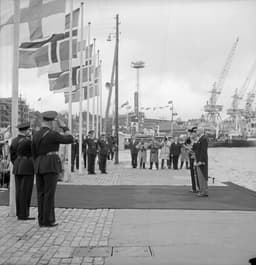
Olav V of Norway
Emperor · Modern
56.5Total
Basic Information
Born
1503
1903
Died
1559
1991
Era
Modern
Modern
Nationality
Denmark
Norway
Occupation
Emperor
Emperor
Civilization
Western
Western
Score Comparison
Military (10%)
50.0
48.2
Political (20%)
60.0
68.0
Influence (20%)
59.0
53.3
Legacy (20%)
54.0
42.5
Leadership (15%)
68.0
79.8
Strategy (15%)
25.0
55.2
TOTAL
55.0
56.5
Christian III of Denmark — Complete Timeline
1536 AD
Victory in the Count's FeudWar◆ Major
Christian III defeated the forces of the deposed Christian II and the Hanseatic League in the Count's Feud, a civil war. His victory secured his throne and allowed him to implement religious reforms without opposition.
Civil WarCount's Feud
Impact: national
Establishment of Lutheranism as State ReligionReform
Christian III issued a decree establishing the Lutheran Church as the state church of Denmark-Norway. Catholic bishops were imprisoned, church property was confiscated, and the Reformation was enforced throughout the realm.
ReformationLutheranismState Religion
Impact: nationalprogressive
Confiscation of Church LandsPolitical Action◆ Major
Christian III confiscated all Catholic church lands and wealth, transferring them to the crown. This greatly increased royal revenues and weakened the nobility's power, strengthening the monarchy's financial base.
SecularizationChurch Property
Impact: national
1537 AD
Ordinance of the Danish ChurchReform◆ Major
Christian III enacted the Church Ordinance, written by Johannes Bugenhagen, which organized the Lutheran Church in Denmark. It established bishops, liturgy, and education, creating a uniform state church system.
Church OrdinanceLutheranism
Impact: nationalconstructive
Olav V of Norway — Complete Timeline
1957 AD
Accession to the thronePolitical Action◆ Major
Olav V became King of Norway upon the death of his father, Haakon VII. He inherited a constitutional monarchy that had been restored after World War II and was widely popular among Norwegians.
SuccessionMonarchy
Impact: national
1960 AD
Popularity as 'People's King'Cultural
Olav V was known for his informal and approachable style, often seen skiing or walking in public without security. This earned him the nickname 'Folkekongen' (People's King) and strengthened the monarchy's popularity.
MonarchyPopularityCulture
Impact: nationalconstructive
1972 AD
Leadership during the 1972 EC referendumPolitical Action
Olav V remained neutral during the Norwegian referendum on joining the European Economic Community, which was rejected by voters. His restraint helped maintain the monarchy's non-political image.
ReferendumEuropean IntegrationNeutrality
Impact: national
Expert Analysis
Origins
Christian III of Denmark was born in 1503, the son of King Frederick I and Anna of Brandenburg. He was raised in a period of religious turmoil, receiving a Lutheran education at the court of Elector Joachim I of Brandenburg. His early exposure to Reformation ideas shaped his future policies. In contrast, Olav V of Norway was born in 1903 in Sandringham, England, as the son of Prince Carl of Denmark (later King Haakon VII) and Princess Maud of Wales. He grew up in exile, as Norway was in a union with Sweden until 1905. Olav studied at the Norwegian Military Academy and Balliol College, Oxford, preparing for a constitutional role.
Rise to Power
Christian III's path to the throne was contested. After his father's death in 1533, the Danish nobility, who favored the deposed Christian II, refused to recognize him. Christian III secured his rule through military victory in the Count's Feud (1534–1536), defeating the forces of Christian II and the Hanseatic League. He was crowned in 1537. Olav V ascended the throne peacefully in 1957 upon the death of his father, Haakon VII. He had already served as regent during his father's illness and was widely respected for his wartime leadership in exile, where he symbolized Norwegian resistance.
Leadership & Governance
Christian III governed with an iron fist, centralizing power and enforcing religious uniformity. His Church Ordinance of 1537/1539 established the Lutheran Church as the state church, imprisoning Catholic bishops and confiscating church lands. This strengthened the crown financially but alienated many. Olav V, by contrast, was a constitutional monarch who wielded influence through symbolism and unity. He remained neutral during the 1972 EC referendum, allowing the democratic process to unfold. His informal style, often skiing without security, earned him the nickname 'Folke-Kongen' (People's King). Politically, Olav scored 68.0 to Christian's 60.0, but Christian's leadership score of 68.0 was lower than Olav's 79.8.
Triumph & Tragedy
Christian III's greatest triumph was securing the Reformation in Denmark-Norway, creating a unified Lutheran state that lasted centuries. However, his confiscation of church lands and suppression of Catholicism caused lasting division. A tragedy was his failure to maintain stability; his reign saw ongoing conflicts with Sweden. Olav V's triumph was his role as a unifying figure during post-war reconstruction and the Cold War. He maintained high public trust, with approval ratings often above 80%. His tragedy was the loss of his wife, Crown Princess Märtha, in 1954, and the eventual decline of the monarchy's political role, though he adapted gracefully.
Character & Destiny
Christian III was pragmatic and ruthless, driven by religious conviction and ambition. His character led him to make decisive, often harsh choices that shaped Denmark's destiny. Olav V was modest, disciplined, and empathetic. His character aligned with Norway's democratic values, making him a beloved figure. Historians note that Christian's actions were necessary for the state's survival in a tumultuous era, while Olav's restraint preserved the monarchy's relevance. Christian's strategy score of 25.0 contrasts sharply with Olav's 55.2, reflecting their different approaches to power.
Legacy
Christian III's legacy is the establishment of Lutheranism in Denmark and Norway, which persisted for over 400 years. The confiscation of church lands created a powerful crown, but also centralized authority. Olav V's legacy is the modern Norwegian monarchy, which he transformed into a symbol of national unity. He set precedents for royal restraint and accessibility. His influence score of 53.3 is slightly below Christian's 59.0, but his leadership score of 79.8 is significantly higher. The total scores are close: Olav 56.5 vs. Christian 55.0, a gap of 1.5 points.
Conclusion
While Christian III's impact was structural and long-lasting, Olav V's impact was cultural and democratic. Christian's imposition of Lutheranism shaped religious and political life for centuries, but his methods were authoritarian. Olav's gentle leadership strengthened Norway's democratic institutions and monarchical stability. Considering the different eras, Olav V's achievement of maintaining a constitutional monarchy with high public trust in a modern democracy is arguably more challenging. Therefore, Olav V has a slightly greater overall impact, reflected in his higher total score. However, Christian III's legacy remains more tangible in the religious landscape of Scandinavia.
Rankings
🥇
Olav V of NorwayLeader
Mil: 48.2Pol: 68.0Inf: 53.3
56.5
🥈
Christian III of Denmark
Mil: 50.0Pol: 60.0Inf: 59.0
55.0
+1.5 behind
How This Comparison Works
Algorithm
Each figure is scored on 6 dimensions (0—100 scale) based on structured historical data: Military (10%), Political (20%), Influence (20%), Legacy (20%), Leadership (15%), Strategy (15%). The weighted total produces the final ranking.
Data Sources
Scores are computed from structured sub-indicators in the database. Scale factors adjust for era (Ancient ×0.85, Modern ×1.0) and civilization size (Eastern ×1.05, Other ×0.80) to account for differences in population and military scale.
Maximum 3 Figures
Comparisons are limited to 2—3 figures to ensure readability and statistical meaningfulness.
Error Margins
±5 points per dimension — Sub-scores are derived from historical records with inherent uncertainty. Two figures within 5 points on a dimension should be considered roughly equivalent in that area.
Total Score Accuracy
±3 points overall — The weighted combination of 6 dimensions produces a total score with approximately ±3 points of uncertainty. Differences of less than 3 points are not statistically significant— the figures are effectively tied.
Known Limitations
- Historical records are incomplete and uneven across civilizations
- Figures from oral-tradition societies may be underrepresented
- Occupation labels can misclassify multi-role figures
- Scores measure capability and impact, not moral character
- Quantitative scoring is a comparison tool, not absolute truth
Capability Radar
Military (10%) — Battles & Warfare
Battles
15
24
Win Rate
20
25
Expansion
10
30
Political (20%) — Governance & Reform
Reform
75
40
Diplomacy
55
65
Economy
50
45
Influence (20%) — Cultural & Global Reach
Cultural
55
40
Global
40
30
Legacy (20%) — Historical Impact
Historical
60
35
Longevity
55
30
Leadership (15%) — Power & Stability
Tenure
60
52
Stability
45
70
Strategy (15%) — Tactics & Innovation
Strategy
15
31
Tactics
10
36
Reform
25
41
Similar Comparisons
Comments & Discussion
No comments yet. Be the first to share your thoughts!