Loading...
Christian VI of Denmark vs Gwanghaegun of Joseon
Gwanghaegun of Joseon leads by 1.3 pts · 2 figures compared
…
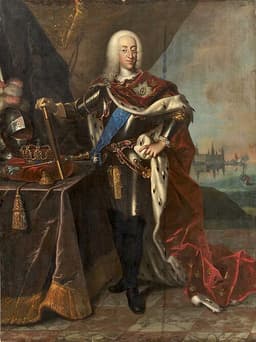
Christian VI of Denmark
Emperor · Modern
53.2Total

Gwanghaegun of Joseon
Emperor · Modern
54.5Total
Basic Information
Born
1699
1575
Died
1746
1641
Era
Modern
Modern
Nationality
Denmark
Korea
Occupation
Emperor
Emperor
Civilization
Western
Eastern
Score Comparison
Military (10%)
22.6
50.0
Political (20%)
68.0
68.0
Influence (20%)
53.3
52.5
Legacy (20%)
42.5
45.0
Leadership (15%)
72.0
74.0
Strategy (15%)
60.0
38.3
TOTAL
53.2
54.5
Christian VI of Denmark — Complete Timeline
1705 AD
Establishment of the Danish Missionary SocietyCultural
Christian VI supported the founding of the Danish Missionary Society, which sent missionaries to India and Greenland. This expanded Danish colonial influence and spread Lutheranism abroad.
MissionColonialismLutheranism
Impact: global
1730 AD
Introduction of Pietism as State ReligionReform◆ Major
Christian VI promoted Pietism, a strict Lutheran movement, as the official religious policy. He enforced religious observance, banned secular entertainment, and established missionary work, deeply influencing Danish society.
PietismReligionReform
Impact: national
1733 AD
Construction of Christiansborg PalaceCultural◆ Major
Christian VI commissioned the construction of Christiansborg Palace in Copenhagen, a grand Baroque palace that became the royal residence. It symbolized the absolute monarchy and remained the seat of government.
ArchitectureChristiansborgRoyal Palace
Impact: nationalconstructive
1735 AD
Economic Reforms and MercantilismReform
Christian VI implemented mercantilist economic policies, including state monopolies and trade regulations. These reforms aimed to boost Danish industry and reduce imports, but they also stifled private enterprise.
EconomyMercantilismReform
Impact: national
Gwanghaegun of Joseon — Complete Timeline
1608 AD
Accession to the thronePolitical Action◆ Major
Gwanghaegun became king of Joseon following the death of his father, Seonjo. His reign was marked by pragmatic diplomacy and efforts to rebuild the country after the Imjin War.
SuccessionJoseon Dynasty
Impact: national
1618 AD
Pragmatic diplomacy with Ming and Later JinPolitical Action
Gwanghaegun pursued a policy of neutrality between Ming China and the rising Later Jin (Manchu) dynasty. He refused to send troops to aid Ming against the Manchus, prioritizing Joseon's security.
DiplomacyNeutralityJoseon Dynasty
Impact: regional
1623 AD
Deposition by the Westerner factionPolitical Action
Gwanghaegun was overthrown in a coup led by the Westerner (Seoin) faction, who opposed his diplomatic policies and accused him of tyranny. He was deposed and exiled to Jeju Island.
CoupDepositionJoseon Dynasty
Impact: nationaldestructive
Exile to Jeju IslandPolitical Action◆ Major
After his deposition, Gwanghaegun was exiled to Jeju Island, where he lived under house arrest until his death in 1641. His exile marked the end of his pragmatic but controversial reign.
ExileJoseon DynastyDeposition
Impact: nationaltragic
Expert Analysis
Origins
Christian VI was born on 30 November 1699 in Copenhagen, the second son of King Frederick IV and Louise of Mecklenburg-Güstrow. His early life was overshadowed by his elder brother, Prince Christian, who died in 1702, making Christian the heir apparent. Raised in a court influenced by German Pietism, he received a strict Lutheran education. His marriage to Sophia Magdalene of Brandenburg-Kulmbach in 1721 reinforced his religious convictions. Christian ascended the throne on 12 October 1730 at age 30, inheriting a kingdom recovering from the Great Northern War (1700–1721).
Gwanghaegun was born on 26 June 1575 in Hanyang (modern Seoul), the second son of King Seonjo and a concubine, Lady Kim. His mother's low status complicated his early years. He was formally recognized as crown prince in 1592, during the Japanese invasions of Korea (Imjin War), after his elder brother Imhae was deemed unfit. Gwanghaegun led military efforts during the war, gaining experience in diplomacy and defense. His education emphasized Confucian classics and statecraft.
Rise to Power
Christian VI's rise was straightforward: he became king upon his father's death in 1730. His early reign focused on consolidating power and promoting Pietism. He dismissed many of his father's advisors and appointed Pietist clergy to key positions. In 1733 he introduced the Pietist Confirmation, making religious education mandatory. His construction of Christiansborg Palace (1733–1745) symbolized his authority, though it drained state finances.
Gwanghaegun's rise was more turbulent. He became crown prince during the Imjin War and served as regent for his aging father from 1606. Upon Seonjo's death in 1608, Gwanghaegun ascended the throne despite factional opposition. His legitimacy was challenged by the Westerner faction, who favored his brother. He consolidated power by purging rivals and suppressing a rebellion in 1612. His early reign focused on rebuilding the country after war and navigating the rise of the Manchu Later Jin dynasty.
Leadership & Governance
Christian VI governed with a top-down, religiously driven style. He enforced Pietist orthodoxy: banned secular entertainments like theater and dance, mandated church attendance, and introduced sumptuary laws. His economic policies were mercantilist: state monopolies on salt and tobacco, and protectionist tariffs. He supported the Danish Missionary Society (founded 1705), sending missionaries to Greenland and India. However, his rigid piety alienated the nobility and commoners. His political score of 68.0 reflects his effective control but limited innovation.
Gwanghaegun's leadership was pragmatic and diplomatic. He pursued neutrality between Ming China and the rising Later Jin, refusing to send troops to aid Ming against the Manchus in 1619—a decision that saved Korean lives but angered pro-Ming factions. He implemented land reforms to aid peasants, restored Confucian institutions, and promoted scholarship. He also strengthened defenses and rebuilt the capital. However, his diplomacy was seen as weak by the Westerner faction, leading to his deposition. His leadership score of 74.0 is higher than Christian's 72.0, but his strategy score of 38.3 is low, indicating poor long-term planning.
Triumph & Tragedy
Christian VI's greatest triumph was the construction of Christiansborg Palace, a symbol of royal power that remains a landmark. His promotion of Pietism created a more religiously uniform society. However, his rigid policies led to economic stagnation and unpopularity. The costly palace and mercantilist policies strained the treasury. His military score of 22.6 reflects Denmark's reduced role after the Great Northern War.
Gwanghaegun's triumph was his successful neutrality policy, which kept Joseon out of devastating wars. He also rebuilt the economy and promoted cultural projects, including the publication of historical texts. His tragedy was his deposition in 1623 by the Westerner faction, who installed King Injo. He was exiled to Jeju Island, where he died in 1641. His diplomatic pragmatism was vindicated later, as Joseon later submitted to the Manchus after Injo's failed resistance.
Character & Destiny
Christian VI was devout, stern, and introverted. His personality led to a court dominated by religious zealots and a lack of political flexibility. His character shaped a reign of control but limited vision. Historians note that his piety was genuine but his policies were too harsh for the time.
Gwanghaegun was cautious, pragmatic, and intellectually inclined. He was a skilled diplomat but lacked the charisma to unite factions. His character made him a target for ambitious nobles. His deposition was a result of his inability to build a strong factional base, despite sound policies.
Legacy
Christian VI's legacy is mixed. Christiansborg Palace remains a seat of government, but his Pietist policies were largely reversed after his death. His reign is often seen as a period of cultural austerity. His legacy score of 42.5 reflects limited long-term impact.
Gwanghaegun's legacy has been reassessed positively in modern Korea. He is seen as a pragmatic leader who prioritized national survival. His diplomatic approach is studied as a model of neutrality. However, his deposition meant his reforms were cut short. His legacy score of 45.0 is slightly higher than Christian's.
Conclusion
Christian VI and Gwanghaegun both scored 68.0 in political ability, but Gwanghaegun's higher leadership (74.0 vs 72.0) and slightly higher total (54.5 vs 53.2) indicate a more effective ruler given his challenging circumstances. Christian VI's rigid piety and economic mismanagement limited his success, while Gwanghaegun's pragmatic diplomacy preserved his kingdom despite internal opposition. Therefore, Gwanghaegun had greater impact, as his decisions shaped Joseon's survival during a critical period, whereas Christian VI's policies were largely reversed.
Rankings
🥇
Gwanghaegun of JoseonLeader
Mil: 50.0Pol: 68.0Inf: 52.5
54.5
🥈
Christian VI of Denmark
Mil: 22.6Pol: 68.0Inf: 53.3
53.2
+1.3 behind
How This Comparison Works
Algorithm
Each figure is scored on 6 dimensions (0—100 scale) based on structured historical data: Military (10%), Political (20%), Influence (20%), Legacy (20%), Leadership (15%), Strategy (15%). The weighted total produces the final ranking.
Data Sources
Scores are computed from structured sub-indicators in the database. Scale factors adjust for era (Ancient ×0.85, Modern ×1.0) and civilization size (Eastern ×1.05, Other ×0.80) to account for differences in population and military scale.
Maximum 3 Figures
Comparisons are limited to 2—3 figures to ensure readability and statistical meaningfulness.
Error Margins
±5 points per dimension — Sub-scores are derived from historical records with inherent uncertainty. Two figures within 5 points on a dimension should be considered roughly equivalent in that area.
Total Score Accuracy
±3 points overall — The weighted combination of 6 dimensions produces a total score with approximately ±3 points of uncertainty. Differences of less than 3 points are not statistically significant— the figures are effectively tied.
Known Limitations
- Historical records are incomplete and uneven across civilizations
- Figures from oral-tradition societies may be underrepresented
- Occupation labels can misclassify multi-role figures
- Scores measure capability and impact, not moral character
- Quantitative scoring is a comparison tool, not absolute truth
Capability Radar
Military (10%) — Battles & Warfare
Battles
34
20
Win Rate
40
25
Expansion
42
10
Political (20%) — Governance & Reform
Reform
55
40
Diplomacy
50
75
Economy
45
50
Influence (20%) — Cultural & Global Reach
Cultural
40
30
Global
20
25
Legacy (20%) — Historical Impact
Historical
35
45
Longevity
30
35
Leadership (15%) — Power & Stability
Tenure
60
55
Stability
65
30
Strategy (15%) — Tactics & Innovation
Strategy
47
35
Tactics
51
30
Reform
53
15
Similar Comparisons
Comments & Discussion
No comments yet. Be the first to share your thoughts!