Loading...
Christian VI of Denmark vs Idris of Libya
Christian VI of Denmark leads by 0.6 pts · 2 figures compared
…
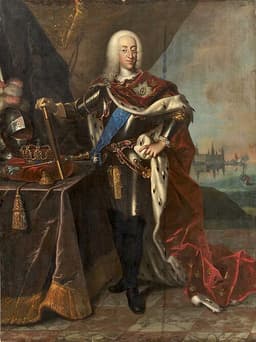
Christian VI of Denmark
Emperor · Modern
53.2Total

Idris of Libya
Emperor · Modern
52.6Total
Basic Information
Born
1699
1889
Died
1746
1983
Era
Modern
Modern
Nationality
Denmark
Libya
Occupation
Emperor
Emperor
Civilization
Western
Middle Eastern
Score Comparison
Military (10%)
22.6
43.3
Political (20%)
68.0
61.3
Influence (20%)
53.3
50.2
Legacy (20%)
42.5
40.0
Leadership (15%)
72.0
74.0
Strategy (15%)
60.0
54.3
TOTAL
53.2
52.6
Christian VI of Denmark — Complete Timeline
1705 AD
Establishment of the Danish Missionary SocietyCultural
Christian VI supported the founding of the Danish Missionary Society, which sent missionaries to India and Greenland. This expanded Danish colonial influence and spread Lutheranism abroad.
MissionColonialismLutheranism
Impact: global
1730 AD
Introduction of Pietism as State ReligionReform◆ Major
Christian VI promoted Pietism, a strict Lutheran movement, as the official religious policy. He enforced religious observance, banned secular entertainment, and established missionary work, deeply influencing Danish society.
PietismReligionReform
Impact: national
1733 AD
Construction of Christiansborg PalaceCultural◆ Major
Christian VI commissioned the construction of Christiansborg Palace in Copenhagen, a grand Baroque palace that became the royal residence. It symbolized the absolute monarchy and remained the seat of government.
ArchitectureChristiansborgRoyal Palace
Impact: nationalconstructive
1735 AD
Economic Reforms and MercantilismReform
Christian VI implemented mercantilist economic policies, including state monopolies and trade regulations. These reforms aimed to boost Danish industry and reduce imports, but they also stifled private enterprise.
EconomyMercantilismReform
Impact: national
Idris of Libya — Complete Timeline
1951 AD
Became King of LibyaPolitical Action◆ Major
Idris was proclaimed King of the newly independent United Kingdom of Libya. His reign established a constitutional monarchy and aligned Libya with the West, granting military bases to the United States and Britain.
IndependenceMonarchyLibyan State
Impact: national
1969 AD
Ousted by Muammar Gaddafi's CoupPolitical Action
While undergoing medical treatment in Turkey, King Idris was overthrown in a bloodless military coup led by Muammar Gaddafi. The coup ended the Libyan monarchy and ushered in decades of Gaddafi's rule.
Coup d'étatGaddafiEnd of Monarchy
Impact: nationaltragic
1983 AD
Died in Exile in EgyptPolitical Action
Idris died in Cairo, Egypt, where he had lived in exile since his overthrow. His death marked the end of the Senussi dynasty's political influence in Libya, though the family remained a symbol of the pre-Gaddafi era.
ExileDeathSenussi Dynasty
Impact: nationaltragic
Expert Analysis
Origins
Christian VI of Denmark was born on November 30, 1699, in Copenhagen, the son of King Frederick IV and Louise of Mecklenburg-Güstrow. He received a strict Lutheran upbringing, which deeply influenced his later religious policies. His education emphasized piety and duty, and he was known for his reserved and devout character. Idris of Libya was born on March 12, 1889, in Al-Jaghbub, Libya, into the Senussi religious order. His grandfather, Muhammad ibn Ali al-Senussi, founded the order, and Idris was raised in a religious environment. He studied Islamic theology and became the leader of the Senussi order in 1916. His early life was marked by resistance against Italian colonization.
Rise to Power
Christian VI ascended the Danish throne in 1730 upon his father's death. He continued the absolutist monarchy established in 1660, but his reign was shaped by his personal piety. He did not engage in major wars, focusing instead on internal reforms. Idris rose to prominence through his leadership of the Senussi order. During World War I, he negotiated with the British and Italians, eventually gaining recognition as the Emir of Cyrenaica in 1920. After World War II, he led Libya to independence, becoming its first king in 1951. His key turning point was the UN decision to grant Libya independence, which he skillfully navigated.
Leadership & Governance
Christian VI's governance was characterized by his promotion of Pietism, a strict Lutheran movement. He issued the "Pietist Rescript" in 1732, requiring church attendance and banning secular entertainments like theater and dancing. He also built Christiansborg Palace (1733-1740), a grand Baroque complex that symbolized royal power. Economically, he pursued mercantilist policies, establishing state monopolies in trade and industry. However, his religious zeal led to censorship and a stifling cultural atmosphere. Idris ruled as a constitutional monarch, aligning Libya with the West and granting oil concessions to American and British companies. He maintained a relatively hands-off approach, allowing local autonomy in Cyrenaica and Tripolitania. His leadership score of 74.0 reflects his ability to unite disparate regions, but his reliance on foreign support weakened his position.
Triumph & Tragedy
Christian VI's greatest success was the construction of Christiansborg Palace, which became the royal residence and a symbol of Danish absolutism. He also stabilized the economy through mercantilism, though these policies had mixed results. His major failure was the enforcement of Pietism, which alienated many subjects and led to a cultural decline. His religious policies were widely unpopular, and after his death, many were reversed. Idris's triumph was leading Libya to independence and establishing a stable monarchy. He also modernized the country's infrastructure with oil revenues. His tragedy was his overthrow in 1969 by Muammar Gaddafi's coup while he was abroad for medical treatment. He died in exile in Egypt in 1983, never returning to Libya. His failure to address social inequalities and his close ties to Western powers contributed to his downfall.
Character & Destiny
Christian VI was deeply religious, introverted, and serious. His character drove him to impose his faith on the state, which shaped his reign but also limited his popularity. He lacked the charisma of his father or his son, Frederick V. His destiny was to be remembered as a pious but unpopular king. Idris was pragmatic, cautious, and religiously devout. He prioritized stability and gradual reform, but his aversion to confrontation and reliance on foreign support made him vulnerable. His character led him to avoid direct rule in favor of delegation, which ultimately failed to build a strong national identity. Both monarchs were shaped by their religious backgrounds, but Idris's secular approach contrasted with Christian's theocratic tendencies.
Legacy
Christian VI's legacy is tied to Christiansborg Palace, which remains the seat of the Danish Parliament. His religious policies had a lasting impact on Danish Lutheranism, though they were largely dismantled after his death. His score of 42.5 in Legacy reflects the limited endurance of his reforms. Idris's legacy is more complex: he is remembered as the founder of modern Libya, but his monarchy was short-lived. The Senussi dynasty ended with his overthrow, and Libya descended into dictatorship under Gaddafi. His legacy score of 40.0 is slightly lower, as his achievements were overshadowed by Gaddafi's rule. However, his role in Libya's independence remains significant.
Conclusion
In this comparison, Christian VI scores 53.2 overall versus Idris's 52.6, a narrow gap of 0.6 points. Christian VI holds a slight edge in Political (68.0 vs 61.3) and Leadership (72.0 vs 74.0, but Idris leads in Leadership), but Idris's military score is higher (43.3 vs 22.6). However, Christian VI's impact on Danish institutions, particularly Christiansborg Palace, has proven more enduring. Idris's reign, while foundational for Libya, was too brief and ended in failure. Therefore, Christian VI had greater long-term impact, as his architectural and religious policies shaped Denmark for decades, while Idris's legacy was largely erased by Gaddafi's coup. The data supports Christian VI as the more influential monarch, despite his unpopularity.
Rankings
🥇
Christian VI of DenmarkLeader
Mil: 22.6Pol: 68.0Inf: 53.3
53.2
🥈
Idris of Libya
Mil: 43.3Pol: 61.3Inf: 50.2
52.6
+0.6 behind
How This Comparison Works
Algorithm
Each figure is scored on 6 dimensions (0—100 scale) based on structured historical data: Military (10%), Political (20%), Influence (20%), Legacy (20%), Leadership (15%), Strategy (15%). The weighted total produces the final ranking.
Data Sources
Scores are computed from structured sub-indicators in the database. Scale factors adjust for era (Ancient ×0.85, Modern ×1.0) and civilization size (Eastern ×1.05, Other ×0.80) to account for differences in population and military scale.
Maximum 3 Figures
Comparisons are limited to 2—3 figures to ensure readability and statistical meaningfulness.
Error Margins
±5 points per dimension — Sub-scores are derived from historical records with inherent uncertainty. Two figures within 5 points on a dimension should be considered roughly equivalent in that area.
Total Score Accuracy
±3 points overall — The weighted combination of 6 dimensions produces a total score with approximately ±3 points of uncertainty. Differences of less than 3 points are not statistically significant— the figures are effectively tied.
Known Limitations
- Historical records are incomplete and uneven across civilizations
- Figures from oral-tradition societies may be underrepresented
- Occupation labels can misclassify multi-role figures
- Scores measure capability and impact, not moral character
- Quantitative scoring is a comparison tool, not absolute truth
Capability Radar
Military (10%) — Battles & Warfare
Battles
34
5
Win Rate
40
5
Expansion
42
5
Political (20%) — Governance & Reform
Reform
55
40
Diplomacy
50
50
Economy
45
40
Influence (20%) — Cultural & Global Reach
Cultural
40
30
Global
20
20
Legacy (20%) — Historical Impact
Historical
35
30
Longevity
30
20
Leadership (15%) — Power & Stability
Tenure
60
60
Stability
65
30
Strategy (15%) — Tactics & Innovation
Strategy
47
5
Tactics
51
5
Reform
53
5
Similar Comparisons
Comments & Discussion
No comments yet. Be the first to share your thoughts!