Loading...
Christian VI of Denmark vs Nizam Ali Khan
Christian VI of Denmark leads by 1.9 pts · 2 figures compared
…
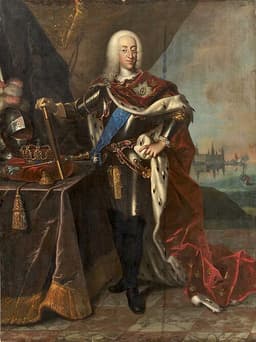
Christian VI of Denmark
Emperor · Modern
53.2Total

Nizam Ali Khan
Emperor · Modern
51.3Total
Basic Information
Born
1699
1734
Died
1746
1803
Era
Modern
Modern
Nationality
Denmark
India
Occupation
Emperor
Emperor
Civilization
Western
Indian
Score Comparison
Military (10%)
22.6
20.0
Political (20%)
68.0
60.0
Influence (20%)
53.3
55.7
Legacy (20%)
42.5
48.3
Leadership (15%)
72.0
72.0
Strategy (15%)
60.0
35.0
TOTAL
53.2
51.3
Christian VI of Denmark — Complete Timeline
1705 AD
Establishment of the Danish Missionary SocietyCultural
Christian VI supported the founding of the Danish Missionary Society, which sent missionaries to India and Greenland. This expanded Danish colonial influence and spread Lutheranism abroad.
MissionColonialismLutheranism
Impact: global
1730 AD
Introduction of Pietism as State ReligionReform◆ Major
Christian VI promoted Pietism, a strict Lutheran movement, as the official religious policy. He enforced religious observance, banned secular entertainment, and established missionary work, deeply influencing Danish society.
PietismReligionReform
Impact: national
1733 AD
Construction of Christiansborg PalaceCultural◆ Major
Christian VI commissioned the construction of Christiansborg Palace in Copenhagen, a grand Baroque palace that became the royal residence. It symbolized the absolute monarchy and remained the seat of government.
ArchitectureChristiansborgRoyal Palace
Impact: nationalconstructive
1735 AD
Economic Reforms and MercantilismReform
Christian VI implemented mercantilist economic policies, including state monopolies and trade regulations. These reforms aimed to boost Danish industry and reduce imports, but they also stifled private enterprise.
EconomyMercantilismReform
Impact: national
Nizam Ali Khan — Complete Timeline
1762 AD
Became Nizam of HyderabadPolitical Action◆ Major
Nizam Ali Khan ascended the throne of Hyderabad after the death of his brother, Salabat Jung. His reign was marked by a pragmatic alliance with the British East India Company, which shaped Hyderabad's foreign policy.
SuccessionHyderabadNizam
Impact: regional
1768 AD
Signed the Treaty of Masulipatam with the BritishPolitical Action◆ Major
Nizam Ali Khan signed the Treaty of Masulipatam with the British East India Company, which formalized an alliance. In exchange for military support, he ceded the Northern Circars to the British, marking a significant territorial loss.
TreatyBritish East India CompanyTerritorial Cession
Impact: regionaldestructive
1780 AD
Fought in the Second Anglo-Mysore WarWar
Nizam Ali Khan allied with the British East India Company against Tipu Sultan of Mysore in the Second Anglo-Mysore War. The conflict ended inconclusively with the Treaty of Mangalore in 1784, but it weakened Mysore's power.
Anglo-Mysore WarAllianceTipu Sultan
Impact: regional
1795 AD
Defeated by the Marathas at the Battle of KhardaWar◆ Major
Nizam Ali Khan's forces were decisively defeated by the Maratha Confederacy at the Battle of Kharda. The defeat forced him to cede territory and pay a large indemnity, weakening Hyderabad's position in the Deccan.
Maratha ConfederacyBattleDefeat
Impact: regionaltragic
Expert Analysis
Origins
Christian VI of Denmark was born in 1699, the son of King Frederick IV and Louise of Mecklenburg-Güstrow. His upbringing was deeply influenced by Pietism, a strict Lutheran movement emphasizing personal piety and moral discipline. He received a thorough education in theology and governance, preparing him for absolute rule. His early experiences shaped his commitment to religious uniformity and state control.
Nizam Ali Khan was born in 1734, the fourth son of Nizam-ul-Mulk, the founder of the Asaf Jahi dynasty in Hyderabad. His early life was spent in the turbulent politics of the Deccan, where he learned military and diplomatic skills. After his father's death, he navigated through family feuds and external threats, eventually seizing power in 1762.
Rise to Power
Christian VI ascended the Danish throne in 1730 upon his father's death. Unlike his father, who was known for his lavish lifestyle, Christian VI immediately imposed a pious and austere court. He consolidated power by centralizing administration and promoting Pietism as the state religion, banning secular entertainments and enforcing church attendance.
Nizam Ali Khan rose to power through a coup in 1762, deposing his brother Salabat Jung. He quickly sought to stabilize Hyderabad amid threats from the Marathas, Mysore, and the British East India Company. His pragmatic approach led him to sign the Treaty of Masulipatam in 1768, allying with the British against Mysore and the Marathas, securing British military support in exchange for territory.
Leadership & Governance
Christian VI's leadership was characterized by religious zeal and mercantilist policies. He enforced Pietism as state religion, requiring all officials to profess the faith and banning theater and dancing. His economic reforms included state monopolies on trade, such as the Danish East India Company, and promoting industry and agriculture. However, his rigid policies stifled cultural life and led to resentment among the nobility and commoners.
Nizam Ali Khan ruled as a pragmatic autocrat, balancing between internal factions and external powers. He maintained Hyderabad's autonomy by skillfully playing off the British, Marathas, and Mysore. He implemented administrative reforms, including land revenue systems, but his reliance on British support compromised his sovereignty. His governance was marked by realpolitik, often sacrificing territory for stability.
Triumph & Tragedy
Christian VI's greatest triumph was the construction of Christiansborg Palace (1733-1745), a symbol of royal power and architectural grandeur. He also supported the Danish Missionary Society, expanding Danish influence in India and Greenland. However, his greatest failure was his oppressive religious policy, which alienated many subjects and stifled intellectual and cultural life, leading to a decline in Denmark's cultural influence.
Nizam Ali Khan's triumph was his successful alliance with the British, which preserved Hyderabad as a princely state until India's independence. He also expanded Hyderabad's territory through strategic marriages and diplomacy. His tragedy was the defeat at the Battle of Kharda in 1795 by the Marathas, which forced him to cede territories and pay heavy tribute. Additionally, his alliance with the British gradually reduced Hyderabad to a vassal state.
Character & Destiny
Christian VI was deeply religious, introverted, and rigid. His character led him to impose his beliefs on the nation, resulting in a somber court and a repressed society. His destiny was a reign that strengthened state control but weakened Denmark's cultural and intellectual vitality. Historians often view him as a well-meaning but ineffective ruler, scoring 72.0 in leadership but only 22.6 in military affairs.
Nizam Ali Khan was pragmatic, cautious, and shrewd. He was a survivor in a volatile region, making calculated decisions to maintain power. His character led him to prioritize stability over independence, which ultimately sealed Hyderabad's fate as a British protectorate. He scored 72.0 in leadership but only 35.0 in strategy, reflecting his reactive rather than proactive approach.
Legacy
Christian VI's legacy is mixed: he is remembered for Christiansborg Palace and the establishment of Pietism, but his reign is often seen as a period of stagnation. The palace remains a key landmark, and his religious policies influenced Danish Lutheranism for decades. However, his scores in influence (53.3) and legacy (42.5) reflect his limited long-term impact.
Nizam Ali Khan's legacy is more enduring: he founded the Hyderabad state that lasted until 1948, and his alliance with the British set the template for princely states under colonial rule. He is remembered as a shrewd ruler who preserved his dynasty, scoring 55.7 in influence and 48.3 in legacy. However, his military and strategic scores (20.0 and 35.0) indicate his dependence on external powers.
Conclusion
While both rulers scored similarly overall (Christian VI 53.2 vs. Nizam Ali Khan 51.3), Christian VI's impact was more profound in shaping Denmark's religious and political landscape, even if negatively. Nizam Ali Khan's pragmatic alliances ensured his dynasty's survival but at the cost of independence. Christian VI's policies had a direct, lasting effect on Danish society, whereas Nizam Ali Khan's legacy was more about maintaining the status quo. Therefore, Christian VI had a greater, albeit more controversial, impact on history.
Rankings
🥇
Christian VI of DenmarkLeader
Mil: 22.6Pol: 68.0Inf: 53.3
53.2
🥈
Nizam Ali Khan
Mil: 20.0Pol: 60.0Inf: 55.7
51.3
+1.9 behind
How This Comparison Works
Algorithm
Each figure is scored on 6 dimensions (0—100 scale) based on structured historical data: Military (10%), Political (20%), Influence (20%), Legacy (20%), Leadership (15%), Strategy (15%). The weighted total produces the final ranking.
Data Sources
Scores are computed from structured sub-indicators in the database. Scale factors adjust for era (Ancient ×0.85, Modern ×1.0) and civilization size (Eastern ×1.05, Other ×0.80) to account for differences in population and military scale.
Maximum 3 Figures
Comparisons are limited to 2—3 figures to ensure readability and statistical meaningfulness.
Error Margins
±5 points per dimension — Sub-scores are derived from historical records with inherent uncertainty. Two figures within 5 points on a dimension should be considered roughly equivalent in that area.
Total Score Accuracy
±3 points overall — The weighted combination of 6 dimensions produces a total score with approximately ±3 points of uncertainty. Differences of less than 3 points are not statistically significant— the figures are effectively tied.
Known Limitations
- Historical records are incomplete and uneven across civilizations
- Figures from oral-tradition societies may be underrepresented
- Occupation labels can misclassify multi-role figures
- Scores measure capability and impact, not moral character
- Quantitative scoring is a comparison tool, not absolute truth
Capability Radar
Military (10%) — Battles & Warfare
Battles
34
45
Win Rate
40
40
Expansion
42
40
Political (20%) — Governance & Reform
Reform
55
45
Diplomacy
50
75
Economy
45
60
Influence (20%) — Cultural & Global Reach
Cultural
40
30
Global
20
35
Legacy (20%) — Historical Impact
Historical
35
50
Longevity
30
40
Leadership (15%) — Power & Stability
Tenure
60
70
Stability
65
55
Strategy (15%) — Tactics & Innovation
Strategy
47
50
Tactics
51
35
Reform
53
30
Similar Comparisons
Comments & Discussion
No comments yet. Be the first to share your thoughts!