Loading...
Chukwuemeka Odumegwu Ojukwu vs Julius Caesar
Julius Caesar leads by 25.9 pts · 2 figures compared
…
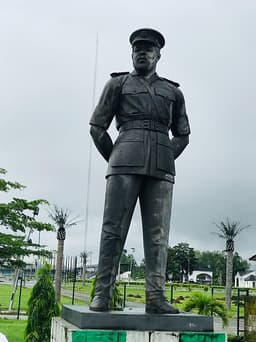
Chukwuemeka Odumegwu Ojukwu
General · Modern
56.9Total

Julius Caesar
General · Ancient
82.8Total
Basic Information
Born
1933
-100
Died
—
-44
Era
Modern
Ancient
Nationality
Nigeria
Roman Republic
Occupation
General
General
Civilization
Other
Western
Score Comparison
Military (10%)
40.0
88.0
Political (20%)
68.0
78.0
Influence (20%)
60.0
85.0
Legacy (20%)
50.0
82.0
Leadership (15%)
64.5
80.0
Strategy (15%)
55.0
85.0
TOTAL
56.9
82.8
Chukwuemeka Odumegwu Ojukwu — Complete Timeline
1967 AD
Led Biafra in the Nigerian Civil WarWar◆ Major
Ojukwu served as the military leader and head of state of Biafra throughout the 30-month Nigerian Civil War (1967-1970). He commanded Biafran forces against the Nigerian federal army, directing the defense of the secessionist state through a prolonged and devastating conflict.
Civil WarBiafraMilitary Leadership
Impact: regional
Declared Independence of BiafraPolitical Action
On May 30, 1967, Lieutenant Colonel Chukwuemeka Odumegwu Ojukwu declared the secession of the Eastern Region of Nigeria as the independent Republic of Biafra. This act followed months of ethnic violence against Igbo people in the north and failed negotiations with the federal government.
SecessionBiafraNigeria
Impact: regional
1970 AD
Surrendered and Went into ExileWar◆ Major
On January 12, 1970, Ojukwu fled Biafra for Ivory Coast as Nigerian forces closed in. His chief of staff, Philip Effiong, surrendered Biafra three days later. Ojukwu remained in exile in Ivory Coast for 13 years, granted asylum by President F
SurrenderExileBiafra
Impact: regionaltragic
Julius Caesar — Complete Timeline
58 BC
Gallic WarsWar◆ Major
Caesar, as proconsul of Gaul, launched a series of campaigns that conquered all of Gaul (modern France, Belgium, and parts of Switzerland). He fought numerous battles, including against the Helvetii, the Belgae, and the Gallic chieftain Vercingetorix. The wars brought immense wealth and a loyal army to Caesar.
Gallic WarsConquestRoman Expansion
Impact: regional
49 BC
Crossing the RubiconPolitical Action◆ Major
Caesar led Legio XIII across the Rubicon River into Italy, defying the Roman Senate's order to disband his army. This act triggered a civil war against Pompey and the Optimates, ultimately leading to Caesar's dictatorship and the end of the Roman Republic.
Roman Civil WarEnd of RepublicPower Struggle
Impact: global
48 BC
Battle of PharsalusWar◆ Major
Caesar's outnumbered army defeated the larger forces of Pompey the Great at Pharsalus in Greece. Caesar's tactical use of a reserve line to counter Pompey's cavalry charge proved decisive. Pompey fled to Egypt, where he was assassinated, leaving Caesar as the undisputed master of the Roman world.
Roman Civil WarBattleDecisive Victory
Impact: regional
44 BC
Appointment as Dictator for LifePolitical Action◆ Major
The Roman Senate appointed Caesar dictator perpetuo (dictator for life), granting him unprecedented personal power. This move concentrated military, legislative, and judicial authority in one person, effectively ending the Roman Republic's traditional system of checks and balances and alarming many senators.
DictatorshipEnd of RepublicPower Consolidation
Impact: regionaldestructive
Assassination on the Ides of MarchPolitical Action◆ Major
A group of Roman senators, led by Marcus Junius Brutus and Gaius Cassius Longinus, stabbed Caesar to death at a meeting of the Senate in the Theatre of Pompey. The assassination was intended to restore the Republic, but instead triggered another civil war that led to the rise of the Roman Empire.
AssassinationRoman PoliticsEnd of Republic
Impact: globaldestructive
Expert Analysis
chukwuemeka-odumegwu-ojukwu-vs-julius-caesar
### The Crossing and the Secession: Caesar and Ojukwu
In January 49 BCE, a Roman general stood on the banks of a small river in northern Italy. The Rubicon was a boundary, not of empire, but of law—a line no commander could cross with his army. On the other side lay the Senate, his enemies, and a civil war. Gaius Julius Caesar hesitated, then gave the order. History records his words: *“Alea iacta est”*—the die is cast. Two thousand years later, on May 30, 1967, another general faced a different kind of boundary. In the city of Enugu, Lieutenant Colonel Chukwuemeka Odumegwu Ojukwu stood before a microphone and declared that the Eastern Region of Nigeria was no longer part of the federation. He called it Biafra. Both men crossed lines that could not be uncrossed. But while Caesar’s gamble forged an empire, Ojukwu’s led to a starving republic that lasted only thirty months. What made the difference? The answer lies not in ambition alone, but in the worlds that shaped them.
### Origins
Julius Caesar was born into a patrician family in 100 BCE, at a time when the Roman Republic was already cracking under the weight of its own success. His uncle by marriage, Gaius Marius, had reformed the army and made it loyal to generals rather than the state. His father died when Caesar was sixteen, leaving him to navigate a world of civil wars, proscriptions, and shifting alliances. Caesar was not born into power—he clawed his way into it, borrowing vast sums, cultivating the masses, and learning that in Rome, survival meant winning.
Chukwuemeka Odumegwu Ojukwu was born in 1933 into a different kind of privilege. His father, Sir Louis Odumegwu Ojukwu, was one of Nigeria’s wealthiest men, a transport magnate who had made a fortune during World War II. Young Emeka was sent to Britain for education—first to Epsom College, then to Oxford, where he earned a master’s degree in history. He returned to Nigeria in the 1950s, a polished intellectual in a country hurtling toward independence. But where Caesar grew up in a republic tearing itself apart, Ojukwu grew up in a colony about to be born. His world was not ancient, but new—and that newness was fragile.
### Rise to Power
Caesar’s path to power was long and ruthless. He served as a military tribune, then a quaestor in Spain, then aedile in Rome, spending his own money on lavish games to win popularity. He forged the First Triumvirate with Pompey and Crassus in 60 BCE, a private alliance that controlled the state. Then came the governorship of Gaul, where between 58 and 50 BCE he conquered a territory larger than Italy itself. His Commentaries turned military reports into political propaganda. By the time the Senate ordered him to disband his army, he had a loyal, battle-hardened force—and the will to use it.
Ojukwu’s rise was faster and more political. After independence in 1960, Nigeria was a patchwork of regions and ethnicities—Hausa in the north, Yoruba in the west, Igbo in the east. Ojukwu joined the army, rising to lieutenant colonel by 1966. That year, a series of coups shattered the young republic. Northern soldiers retaliated against Igbo officers, and massacres followed. Ojukwu, as military governor of the Eastern Region, became the refuge for his people. When the northern-led federal government refused to grant autonomy, he declared secession. He did not conquer his way to power; the crisis thrust it upon him.
### Leadership & Governance
Caesar governed as a conqueror and a reformer. In Gaul, he was ruthless—he slaughtered, enslaved, and pacified. But he also understood the value of clemency. He pardoned enemies, extended citizenship to provincials, and reformed the calendar. As dictator, he centralized power, redistributed land to veterans, and began public works that would outlast him. His military genius lay in speed and logistics; he crossed the English Channel, built a bridge across the Rhine in ten days, and won the Battle of Alesia by besieging the besiegers. He was a politician in armor, a writer with a sword.
Ojukwu led a nation under siege. Biafra was blockaded by sea and surrounded by Nigerian forces. He organized a government, printed currency, and built an army from scratch. But he was not a military genius. His strategy was defensive—hold ground, hope for international recognition, wait for the world to intervene. The world did not. His leadership was moral and symbolic: he became the face of a people fighting for survival. But he could not manufacture arms, food, or medicine. By 1969, Biafra was starving. His political score of 61.0 reflects the reality that he was better at inspiring loyalty than at winning wars.
### Triumph & Tragedy
Caesar’s greatest triumph was the conquest of Gaul—a campaign that doubled Rome’s territory and made him the richest man in the Republic. His greatest tragedy was the Ides of March, 44 BCE, when sixty senators stabbed him to death in the Theatre of Pompey. He died believing he had saved Rome, but his murder plunged it into another civil war. He left no heir, only a grandnephew named Octavian, who would become Augustus.
Ojukwu’s greatest triumph was the declaration of Biafra itself—a moment of defiance that electrified a people and drew global attention. His greatest tragedy was the surrender. On January 12, 1970, as Nigerian troops closed in, he fled to Ivory Coast, leaving his chief of staff, Philip Effiong, to sign the capitulation. The war had killed perhaps two million people, mostly from starvation. Ojukwu survived, but his dream did not.
### Character & Destiny
Caesar was audacious, calculating, and relentless. He believed in his own star. He took risks—crossing the Rubicon, fighting in Britain, pardoning enemies—because he trusted his ability to win. His personality shaped history: without his ambition, the Republic might have limped on for another generation. But his confidence also blinded him. He ignored warnings of the conspiracy, dismissed the soothsayer’s *“Beware the Ides of March,”* and walked into the Senate unarmed.
Ojukwu was proud, intellectual, and stubborn. He believed in the justice of Biafra’s cause, and he refused to compromise. That stubbornness gave his people hope, but it also prolonged a war they could not win. He fled rather than face capture, a decision that haunts his legacy. Where Caesar died for his gamble, Ojukwu lived for his—and lived to see Biafra reduced to a memory.
### Legacy
Caesar’s legacy is the Roman Empire. His name became a title—Kaiser, Tsar. His writings are still read. His reforms outlasted his assassins. He is remembered as the man who ended the Republic, but also as the man who made the Empire possible. His total score of 83.3 reflects a figure who changed the course of Western civilization.
Ojukwu’s legacy is more ambiguous. In southeastern Nigeria, he is a hero—the father of Biafran nationalism. His influence score of 73.5 and legacy of 66.8 show a figure who shaped a region, not a world. He returned from exile in 1982, was pardoned, and remained a political voice until his death. But Biafra never rose again. He is remembered as a symbol of resistance, not of victory.
### Conclusion
Caesar and Ojukwu both crossed lines that defined their worlds. But Caesar crossed into history, while Ojukwu crossed into a footnote. The difference was not courage—both had it. It was context. Caesar inherited a crumbling system and the tools to rebuild it: a professional army, a cultural memory of empire, and a Senate too divided to stop him. Ojukwu inherited a fragile new nation, a world that did not recognize his state, and a war he could not win. One man’s gamble created an empire; the other’s created a tragedy. In the end, the die is cast by the hand that throws it—but also by the table it lands on.
Rankings
🥇
Julius CaesarLeader
Mil: 88.0Pol: 78.0Inf: 85.0
82.8
🥈
Chukwuemeka Odumegwu Ojukwu
Mil: 40.0Pol: 68.0Inf: 60.0
56.9
+25.9 behind
How This Comparison Works
Algorithm
Each figure is scored on 6 dimensions (0—100 scale) based on structured historical data: Military (10%), Political (20%), Influence (20%), Legacy (20%), Leadership (15%), Strategy (15%). The weighted total produces the final ranking.
Data Sources
Scores are computed from structured sub-indicators in the database. Scale factors adjust for era (Ancient ×0.85, Modern ×1.0) and civilization size (Eastern ×1.05, Other ×0.80) to account for differences in population and military scale.
Maximum 3 Figures
Comparisons are limited to 2—3 figures to ensure readability and statistical meaningfulness.
Error Margins
±5 points per dimension — Sub-scores are derived from historical records with inherent uncertainty. Two figures within 5 points on a dimension should be considered roughly equivalent in that area.
Total Score Accuracy
±3 points overall — The weighted combination of 6 dimensions produces a total score with approximately ±3 points of uncertainty. Differences of less than 3 points are not statistically significant— the figures are effectively tied.
Known Limitations
- Historical records are incomplete and uneven across civilizations
- Figures from oral-tradition societies may be underrepresented
- Occupation labels can misclassify multi-role figures
- Scores measure capability and impact, not moral character
- Quantitative scoring is a comparison tool, not absolute truth
Capability Radar
Military (10%) — Battles & Warfare
Battles
55
95
Win Rate
40
92
Expansion
30
97
Political (20%) — Governance & Reform
Reform
40
90
Diplomacy
45
85
Economy
35
82
Influence (20%) — Cultural & Global Reach
Cultural
45
88
Global
45
94
Legacy (20%) — Historical Impact
Historical
55
95
Longevity
40
96
Leadership (15%) — Power & Stability
Tenure
50
75
Stability
20
60
Strategy (15%) — Tactics & Innovation
Strategy
55
94
Tactics
50
96
Reform
45
88
Similar Comparisons
Comments & Discussion
LegionLens6/17/2026
Caesar crossed the Rubicon with a veteran army and near-universal military momentum; Ojukwu faced a Nigerian federal force that outnumbered him 3:1 and had total air superiority. Comparing them as equals glosses over the fact that Rome's civil war was a knife fight among elites, while Biafra was an asymmetric slaughter. Ojukwu’s gamble wasn't just quixotic—it was tactically doomed from Day One. Rome had no B-26s bombing grain silos.
古代典守6/17/2026
把奥朱克武跟凯撒比,本质上是用罗马元老院的剧场政治去套非洲后殖民的绝望现实。凯撒赌的是职位和荣誉,奥朱克武赌的是百万平民的生存。最讽刺的是,凯撒那句“骰子已掷”是纯正的政治修辞,而比夫拉194天的空袭伤亡表明:奥朱克武连掷骰子都没得选——对手早把桌子掀了。
SkepticScribe6/17/2026
The "Rubicon" analogy is elegant but hollow. Caesar’s crossing was a deliberate escalation against Roman rivals—Ojukwu’s secession came after pogroms had killed tens of thousands of Easterners. You can’t equate a power play with a survival reflex. Even the Biafran army was outgunned and starving. Comparing their "gambles" ignores that one man held all the cards (Caesar), while the other was bleeding out mid-game.
史鉴铁嘴6/17/2026
这比较最大的毛病在“野心”二字。凯撒过卢比孔河时,罗马已经是军阀割据的烂摊子,他不过是加速崩盘。奥朱克武在1967年面对的是刚独立7年、军官刚戒严统治1年的尼日利亚,联邦还没烂透。比夫拉只撑了30个月,不是奥朱克武不够狠,是1960年代的非洲没有罗马那种帝国扩张的余粮来吞并失败。