Loading...
Claire Chennault vs Zuo Zongtang
Zuo Zongtang leads by 0.9 pts · 2 figures compared
…
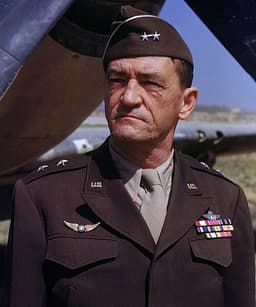
Claire Chennault
General · Modern
69.3Total

Zuo Zongtang
General · Modern
70.2Total
Basic Information
Born
1893
1812
Died
1958
1885
Era
Modern
Modern
Nationality
United States
China
Occupation
General
General
Civilization
Western
Eastern
Score Comparison
Military (10%)
61.7
78.0
Political (20%)
62.7
78.0
Influence (20%)
75.0
55.0
Legacy (20%)
72.0
72.0
Leadership (15%)
68.0
78.0
Strategy (15%)
68.0
72.0
TOTAL
69.3
70.2
Claire Chennault — Complete Timeline
1937 AD
Development of Air Power TheoryCultural
Chennault developed and advocated for the use of fighter aircraft in offensive operations, contrary to prevailing US doctrine. His theories were later validated in combat and influenced US air tactics in World War II.
Air PowerTheoryTactics
Impact: nationalconstructive
Retirement from US Army Air CorpsPolitical Action
Chennault retired from the US Army Air Corps due to deafness and disagreements over air doctrine. He then accepted a position as an advisor to the Chinese Air Force, where he began developing the Flying Tigers.
US ArmyRetirementChina
Impact: national
1941 AD
Formation of the Flying TigersWar◆ Major
Chennault organized and commanded the American Volunteer Group, known as the Flying Tigers, to fight the Japanese in China. The group of volunteer pilots flew P-40 Warhawks and achieved notable success against Japanese aircraft.
World War IIChinaFlying Tigers
Impact: regionalconstructive
1943 AD
Command of 14th Air ForceWar◆ Major
Chennault was appointed commander of the US 14th Air Force in China. He led the air force in operations against Japanese forces, including attacks on shipping, airfields, and supply lines.
World War IIChinaAir Force
Impact: regional
Zuo Zongtang — Complete Timeline
1864 AD
Suppression of the Taiping RebellionWar◆ Major
Zuo Zongtang commanded Hunan Army forces that recaptured Hangzhou and other cities from Taiping rebels. His military efforts contributed to the eventual defeat of the Taiping Rebellion, which had devastated much of southern China.
Taiping RebellionMilitary campaign
Impact: national
1866 AD
Establishment of the Fuzhou Naval YardReform◆ Major
Zuo Zongtang founded the Fuzhou Naval Yard and Arsenal as part of the Self-Strengthening Movement. This shipyard built modern warships and trained Chinese engineers, aiming to modernize China's naval capabilities against foreign threats.
Self-StrengtheningNaval modernization
Impact: nationalconstructive
1868 AD
Suppression of the Nian RebellionWar
Zuo Zongtang led Qing forces to defeat the Nian rebels in northern China. His use of cavalry and fortified positions broke the rebellion, which had threatened Qing control over the Yellow River region.
Nian RebellionMilitary campaign
Impact: regional
1878 AD
Recovery of XinjiangWar
Zuo Zongtang led a Qing army to defeat Yakub Beg's forces and reassert Chinese control over Xinjiang. This campaign ended the Muslim rebellion and restored Qing authority in the region, securing China's northwestern frontier.
Military campaignTerritorial recovery
Impact: nationalconstructive
1880 AD
Promotion of Agricultural Development in XinjiangReform
After recovering Xinjiang, Zuo Zongtang implemented agricultural policies including irrigation projects and land reclamation. These measures aimed to settle Han Chinese farmers and integrate the region economically into the Qing empire.
Agricultural policySettlement
Impact: regionalconstructive
Expert Analysis
Origins
Claire Lee Chennault was born on September 6, 1893, in Commerce, Texas. He grew up in a farming family and developed an early interest in aviation. After attending Louisiana State University, he enlisted in the US Army in 1917 and earned his pilot wings. Chennault's early career was marked by his advocacy for fighter aviation, which clashed with the US Army Air Corps' focus on bombers. His deafness and nonconformist views led to his retirement in 1937.
Zuo Zongtang was born on November 10, 1812, in Xiangyin, Hunan, China. He came from a scholarly family but failed the imperial examinations multiple times. Instead, he turned to practical studies, including agriculture, geography, and military science. Zuo's early career involved teaching and farming, but his expertise in military affairs brought him into the service of the Qing dynasty during the Taiping Rebellion.
Rise to Power
Chennault's rise came through his connection with China. In 1937, he was invited by Generalissimo Chiang Kai-shek to survey the Chinese Air Force. He soon became a key advisor and, in 1941, formed the American Volunteer Group (AVG), known as the Flying Tigers. With 100 P-40 Warhawks and volunteer pilots, Chennault's unit gained fame for its success against Japanese aircraft. His leadership of the AVG and later the US 14th Air Force made him a prominent figure in the China-Burma-India theater.
Zuo Zongtang's rise began during the Taiping Rebellion (1850-1864). He organized local militias and, by 1861, commanded the Hunan Army. His victory at Hangzhou in 1864 was a turning point. Thereafter, he suppressed the Nian Rebellion (1868) and then turned to the Muslim revolt in the northwest. His greatest achievement was the recovery of Xinjiang (1876-1878), which restored Qing control over the region.
Leadership & Governance
Chennault's leadership was characterized by innovation and determination. He developed offensive fighter tactics, such as the "boom and zoom" attack, which maximized the P-40's advantages. He maintained high morale among his volunteers, despite limited resources. However, his abrasive style and criticism of Allied leadership, including General Joseph Stilwell, created tensions. Chennault's governance of the 14th Air Force was effective but often at odds with the broader Allied strategy.
Zuo Zongtang was a pragmatic and disciplined leader. He emphasized logistics, using a combination of infantry, cavalry, and artillery. In Xinjiang, he established agricultural colonies to supply his troops. He also promoted the Self-Strengthening Movement, founding the Fuzhou Naval Yard in 1866 to modernize China's navy. Zuo's approach was methodical; he advanced slowly, building supply lines and securing territory before moving forward.
Triumph & Tragedy
Chennault's greatest triumph was the Flying Tigers' performance. From 1941 to 1942, the AVG claimed 296 Japanese aircraft destroyed for the loss of 12 pilots in combat. This success boosted Chinese morale and demonstrated the effectiveness of fighter aviation. However, Chennault's later command of the 14th Air Force faced challenges: his aggressive strategy led to high pilot attrition, and his relationship with Stilwell undermined his effectiveness. He also failed to prevent the Japanese Ichigo Offensive in 1944, which overran many US airbases.
Zuo Zongtang's triumph was the reconquest of Xinjiang. He defeated Yakub Beg's forces and reasserted Chinese control, preserving the region's territorial integrity. He also promoted development, including irrigation and land reclamation. His tragedy was that his modernizing efforts, including the Fuzhou Naval Yard, were ultimately undermined by Qing conservatism and lack of funds. The naval yard failed to produce a modern fleet, and his agricultural policies in Xinjiang had limited long-term impact.
Character & Destiny
Chennault was a determined and independent thinker, often clashing with authority. His deafness and stubbornness isolated him from peers, but his conviction in his theories proved correct. His destiny was tied to China; he remained loyal to Chiang Kai-shek even after the war. He died of lung cancer in 1958, his legacy secured by the Flying Tigers' mythic status.
Zuo Zongtang was a Confucian scholar-official with a practical bent. He was known for his integrity and dedication to the Qing dynasty. His destiny was to be a loyal servant who saved the dynasty from multiple rebellions. However, his achievements were limited by the Qing's decline. He died in 1885, honored but with his reforms incomplete.
Legacy
Chennault's legacy is the Flying Tigers, which became a symbol of US-China cooperation. His tactical innovations influenced fighter doctrine. His total score of 69.3 reflects his impact, with high influence (75.0) and legacy (72.0). However, his military (61.7) and political (62.7) scores are lower due to limited strategic scope.
Zuo Zongtang's legacy is the preservation of Xinjiang as part of China. His military (78.0) and political (78.0) scores are high, reflecting his effective campaigns and statecraft. His influence (55.0) is lower because his work was within the Qing framework. His total score of 70.2 edges out Chennault's 69.3.
Conclusion
Zuo Zongtang had a greater overall impact. His military campaigns directly preserved Chinese territory and ended major rebellions. Chennault's contributions were significant but more limited in scope. Zuo's total score of 70.2 against Chennault's 69.3 reflects his broader achievements in both military and political realms.
Rankings
🥇
Zuo ZongtangLeader
Mil: 78.0Pol: 78.0Inf: 55.0
70.2
🥈
Claire Chennault
Mil: 61.7Pol: 62.7Inf: 75.0
69.3
+0.9 behind
How This Comparison Works
Algorithm
Each figure is scored on 6 dimensions (0—100 scale) based on structured historical data: Military (10%), Political (20%), Influence (20%), Legacy (20%), Leadership (15%), Strategy (15%). The weighted total produces the final ranking.
Data Sources
Scores are computed from structured sub-indicators in the database. Scale factors adjust for era (Ancient ×0.85, Modern ×1.0) and civilization size (Eastern ×1.05, Other ×0.80) to account for differences in population and military scale.
Maximum 3 Figures
Comparisons are limited to 2—3 figures to ensure readability and statistical meaningfulness.
Error Margins
±5 points per dimension — Sub-scores are derived from historical records with inherent uncertainty. Two figures within 5 points on a dimension should be considered roughly equivalent in that area.
Total Score Accuracy
±3 points overall — The weighted combination of 6 dimensions produces a total score with approximately ±3 points of uncertainty. Differences of less than 3 points are not statistically significant— the figures are effectively tied.
Known Limitations
- Historical records are incomplete and uneven across civilizations
- Figures from oral-tradition societies may be underrepresented
- Occupation labels can misclassify multi-role figures
- Scores measure capability and impact, not moral character
- Quantitative scoring is a comparison tool, not absolute truth
Capability Radar
Military (10%) — Battles & Warfare
Battles
65
85
Win Rate
70
80
Expansion
60
85
Political (20%) — Governance & Reform
Reform
50
70
Diplomacy
75
75
Economy
30
70
Influence (20%) — Cultural & Global Reach
Cultural
65
60
Global
65
60
Legacy (20%) — Historical Impact
Historical
70
75
Longevity
60
65
Leadership (15%) — Power & Stability
Tenure
40
70
Stability
35
75
Strategy (15%) — Tactics & Innovation
Strategy
75
90
Tactics
85
85
Reform
80
75
Similar Comparisons
Comments & Discussion
No comments yet. Be the first to share your thoughts!