Loading...
Joachim Murat vs Zuo Zongtang
Zuo Zongtang leads by 11.9 pts · 2 figures compared
…
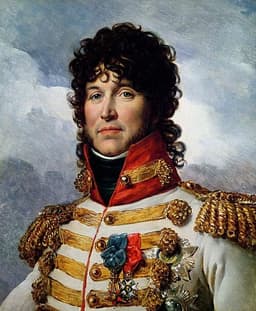
Joachim Murat
General · Modern
58.3Total

Zuo Zongtang
General · Modern
70.2Total
Basic Information
Born
1767
1812
Died
1815
1885
Era
Modern
Modern
Nationality
France
China
Occupation
General
General
Civilization
Western
Eastern
Score Comparison
Military (10%)
74.7
78.0
Political (20%)
68.0
78.0
Influence (20%)
58.3
55.0
Legacy (20%)
56.0
72.0
Leadership (15%)
40.0
78.0
Strategy (15%)
60.7
72.0
TOTAL
58.3
70.2
Joachim Murat — Complete Timeline
1798 AD
Battle of the PyramidsWar◆ Major
Murat led a cavalry charge that broke the Mamluk lines near Cairo. This victory secured French control of Lower Egypt during Napoleon's Egyptian campaign.
Egyptian CampaignCavalryNapoleonic Wars
Impact: regional
1799 AD
Battle of AbukirWar◆ Major
Murat led a decisive cavalry charge that defeated the Ottoman army at Abukir, Egypt. He captured the Ottoman commander and was promoted to general of division.
Egyptian CampaignCavalryNapoleonic Wars
Impact: regional
1805 AD
Battle of AusterlitzWar◆ Major
Murat commanded the French cavalry reserve at Austerlitz. His cavalry pursued the fleeing Russian and Austrian forces after the Allied center collapsed, contributing to the decisive French victory.
Napoleonic WarsBattleCavalry
Impact: global
1808 AD
Appointed King of NaplesPolitical Action◆ Major
Napoleon appointed Murat as King of Naples, replacing Joseph Bonaparte who became King of Spain. Murat ruled the Kingdom of Naples from 1808 to 1815, implementing French administrative reforms.
Kingdom of NaplesMonarchyNapoleonic Era
Impact: regional
1813 AD
Battle of LeipzigWar◆ Major
Murat commanded the French cavalry at the Battle of Leipzig. His forces were defeated by the Allied coalition, and he later negotiated with the Allies to preserve his throne, abandoning Napoleon.
Napoleonic WarsBattleDefeatBetrayal
Impact: global
1815 AD
Hundred Days CampaignWar◆ Major
Murat declared war on Austria in an attempt to regain his throne during Napoleon's Hundred Days. He was defeated at the Battle of Tolentino and fled to France, losing his kingdom.
Hundred DaysNapoleonic WarsDefeat
Impact: regionaltragic
Execution by Firing SquadPolitical Action◆ Major
Murat was captured by Bourbon forces after attempting to land in Calabria to reclaim his throne. He was tried by a military court and executed by firing squad at the Castello di Pizzo.
ExecutionBourbon RestorationDeath
Impact: nationaltragic
Zuo Zongtang — Complete Timeline
1864 AD
Suppression of the Taiping RebellionWar◆ Major
Zuo Zongtang commanded Hunan Army forces that recaptured Hangzhou and other cities from Taiping rebels. His military efforts contributed to the eventual defeat of the Taiping Rebellion, which had devastated much of southern China.
Taiping RebellionMilitary campaign
Impact: national
1866 AD
Establishment of the Fuzhou Naval YardReform◆ Major
Zuo Zongtang founded the Fuzhou Naval Yard and Arsenal as part of the Self-Strengthening Movement. This shipyard built modern warships and trained Chinese engineers, aiming to modernize China's naval capabilities against foreign threats.
Self-StrengtheningNaval modernization
Impact: nationalconstructive
1868 AD
Suppression of the Nian RebellionWar
Zuo Zongtang led Qing forces to defeat the Nian rebels in northern China. His use of cavalry and fortified positions broke the rebellion, which had threatened Qing control over the Yellow River region.
Nian RebellionMilitary campaign
Impact: regional
1878 AD
Recovery of XinjiangWar
Zuo Zongtang led a Qing army to defeat Yakub Beg's forces and reassert Chinese control over Xinjiang. This campaign ended the Muslim rebellion and restored Qing authority in the region, securing China's northwestern frontier.
Military campaignTerritorial recovery
Impact: nationalconstructive
1880 AD
Promotion of Agricultural Development in XinjiangReform
After recovering Xinjiang, Zuo Zongtang implemented agricultural policies including irrigation projects and land reclamation. These measures aimed to settle Han Chinese farmers and integrate the region economically into the Qing empire.
Agricultural policySettlement
Impact: regionalconstructive
Expert Analysis
Origins
Joachim Murat was born on March 25, 1767, in Labastide-Fortunière, France, the son of an innkeeper. He studied for the priesthood but ran away to join a cavalry regiment in 1787. His early military career was marked by rapid promotion during the French Revolutionary Wars, catching the attention of Napoleon Bonaparte. Zuo Zongtang was born on November 10, 1812, in Xiangyin, Hunan, China, into a scholarly family. He passed the provincial civil service exams but failed the metropolitan exams multiple times, leading him to focus on practical statecraft, agriculture, and military studies. His early career included teaching and local administrative roles.
Rise to Power
Murat rose to prominence through his service in Napoleon's Italian and Egyptian campaigns. At the Battle of the Pyramids (1798), his cavalry charge broke the Mamluk lines, securing French control of Lower Egypt. He was promoted to general of division after the Battle of Abukir (1799), where he captured the Ottoman commander. His marriage to Napoleon's sister Caroline in 1800 cemented his political position. He became Marshal of the Empire in 1804 and was appointed King of Naples in 1808. Zuo Zongtang's rise came during the Taiping Rebellion (1850-1864). He organized local militias in Hunan and proved effective in battle. By 1862, he was appointed Governor of Zhejiang and recaptured Hangzhou from the Taiping in 1864. His success led to command of the campaign against the Nian Rebellion (1866-1868), which he suppressed using cavalry and fortified positions.
Leadership & Governance
Murat's leadership style was flamboyant and charismatic, leading from the front in spectacular cavalry charges. As King of Naples, he attempted reforms including abolishing feudalism, reorganizing the army, and promoting public works. However, his governance was overshadowed by Napoleonic demands and his own ambition. Zuo Zongtang was a pragmatic and disciplined leader, emphasizing logistics, agricultural development, and modernization. He founded the Fuzhou Naval Yard (1866) as part of the Self-Strengthening Movement, building modern warships and training Chinese engineers. In Xinjiang, he implemented irrigation projects and land reclamation to stabilize the region. His leadership scored 78.0 in political and 78.0 in leadership, compared to Murat's 68.0 and 40.0 respectively.
Triumph & Tragedy
Murat's greatest triumphs include his decisive cavalry charges at Austerlitz (1805) and Abukir (1799), which earned him a reputation as one of Europe's finest cavalry commanders. His tragedy came during the Hundred Days (1815) when he declared war on Austria to regain his throne, was defeated at Tolentino, and fled to Corsica. He was captured trying to reclaim Naples and executed by firing squad on October 13, 1815. Zuo Zongtang's greatest triumph was the recovery of Xinjiang (1875-1878), defeating Yakub Beg's forces and reasserting Chinese control over 1.6 million square kilometers. His tragedy was the failure of the Self-Strengthening Movement to prevent China's decline; the Fuzhou Naval Yard's fleet was destroyed in the Sino-French War (1884-1885). Zuo died in 1885, disappointed by China's weakness.
Character & Destiny
Murat was known for his vanity, impulsiveness, and love of spectacle. His military score of 74.7 reflects his tactical brilliance but strategic limitations. His political score of 68.0 shows his ability to gain power but not to maintain it. His character led him to overreach, ultimately costing him his life. Zuo Zongtang was resolute, pragmatic, and deeply patriotic. His military score of 78.0 and strategy score of 72.0 reflect his methodical approach. His leadership score of 78.0 indicates his ability to inspire and organize. His character allowed him to achieve lasting territorial gains for China, but his destiny was tied to a declining empire.
Legacy
Murat's legacy is that of a romantic cavalry hero, remembered for his dashing charges and his brief reign as King of Naples. He influenced cavalry tactics in the 19th century, but his political legacy is negligible. His total score is 58.3. Zuo Zongtang's legacy is far more substantial: he secured Xinjiang for China, which remains an integral part of the country today. He also pioneered Chinese military modernization and industrial development. His political and leadership scores of 78.0 each, and legacy score of 72.0, reflect his enduring impact. He is remembered as a national hero in China.
Conclusion
Zuo Zongtang had a greater impact than Joachim Murat. With a total score of 70.2 compared to Murat's 58.3, Zuo's achievements in recovering and stabilizing Xinjiang, suppressing major rebellions, and initiating modernization projects have had lasting consequences for China. Murat's military brilliance was impressive but ultimately served Napoleon's ambitions and left no enduring political structure. Zuo's legacy is tangible in China's territorial integrity and early modernization efforts. While Murat scored 74.7 in military versus Zuo's 78.0, the gap in leadership (40.0 vs 78.0) and legacy (56.0 vs 72.0) is decisive. Zuo Zongtang stands as the more consequential historical figure.
Rankings
🥇
Zuo ZongtangLeader
Mil: 78.0Pol: 78.0Inf: 55.0
70.2
🥈
Joachim Murat
Mil: 74.7Pol: 68.0Inf: 58.3
58.3
+11.9 behind
How This Comparison Works
Algorithm
Each figure is scored on 6 dimensions (0—100 scale) based on structured historical data: Military (10%), Political (20%), Influence (20%), Legacy (20%), Leadership (15%), Strategy (15%). The weighted total produces the final ranking.
Data Sources
Scores are computed from structured sub-indicators in the database. Scale factors adjust for era (Ancient ×0.85, Modern ×1.0) and civilization size (Eastern ×1.05, Other ×0.80) to account for differences in population and military scale.
Maximum 3 Figures
Comparisons are limited to 2—3 figures to ensure readability and statistical meaningfulness.
Error Margins
±5 points per dimension — Sub-scores are derived from historical records with inherent uncertainty. Two figures within 5 points on a dimension should be considered roughly equivalent in that area.
Total Score Accuracy
±3 points overall — The weighted combination of 6 dimensions produces a total score with approximately ±3 points of uncertainty. Differences of less than 3 points are not statistically significant— the figures are effectively tied.
Known Limitations
- Historical records are incomplete and uneven across civilizations
- Figures from oral-tradition societies may be underrepresented
- Occupation labels can misclassify multi-role figures
- Scores measure capability and impact, not moral character
- Quantitative scoring is a comparison tool, not absolute truth
Capability Radar
Military (10%) — Battles & Warfare
Battles
75
85
Win Rate
70
80
Expansion
65
85
Political (20%) — Governance & Reform
Reform
45
70
Diplomacy
50
75
Economy
40
70
Influence (20%) — Cultural & Global Reach
Cultural
55
60
Global
55
60
Legacy (20%) — Historical Impact
Historical
60
75
Longevity
50
65
Leadership (15%) — Power & Stability
Tenure
60
70
Stability
35
75
Strategy (15%) — Tactics & Innovation
Strategy
55
90
Tactics
85
85
Reform
40
75
Similar Comparisons
Comments & Discussion
No comments yet. Be the first to share your thoughts!