Loading...
Clovis I vs Nahapana
Clovis I leads by 15.1 pts · 2 figures compared
…

Clovis I
Emperor · Ancient
57.1Total
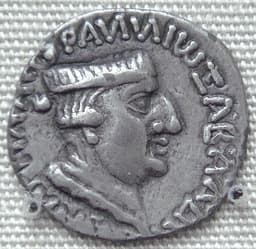
Nahapana
Emperor · Ancient
42.0Total
Basic Information
Born
466
33
Died
511
78
Era
Ancient
Ancient
Nationality
Frankish Empire
India
Occupation
Emperor
Emperor
Civilization
Western
Indian
Score Comparison
Military (10%)
67.3
46.7
Political (20%)
45.0
30.8
Influence (20%)
55.0
45.5
Legacy (20%)
52.0
36.7
Leadership (15%)
72.0
55.3
Strategy (15%)
60.7
38.3
TOTAL
57.1
42.0
Clovis I — Complete Timeline
486 AD
Battle of SoissonsWar
Clovis defeated Syagrius, the last Roman ruler in Gaul, at Soissons. This victory ended Roman control in the region and established Clovis as the dominant power in northern Gaul, laying the foundation for the Frankish kingdom.
Frankish ExpansionRoman GaulSyagrius
Impact: regional
496 AD
Conversion to ChristianityCultural
Clovis converted to Nicene Christianity after the Battle of Tolbiac, following a vow to the Christian God. He was baptized by Bishop Remigius at Reims, becoming the first Germanic king to adopt Catholicism, which aligned him with the Gallo-Roman population and the Church.
ConversionCatholicismReimsChurch
Impact: globalconstructive
507 AD
Issuance of the Salic LawReform◆ Major
Clovis codified the Salic Law, a legal code combining Frankish customary law with Roman influences. It regulated inheritance, property, and criminal penalties, and later influenced medieval European legal systems.
Legal CodeSalic LawInheritance
Impact: regionalconstructive
Nahapana — Complete Timeline
50 AD
Expanded Kshaharata TerritoryWar◆ Major
Nahapana expanded the Kshaharata kingdom by conquering parts of Gujarat, Malwa, and the Deccan. He defeated local rulers and established control over a large area, making his kingdom a major power in western India.
ConquestExpansionKshaharata
Impact: regional
55 AD
Issued Coins with Brahmi and Greek ScriptsCultural
Nahapana issued silver and copper coins featuring his name in Brahmi and Greek scripts. These coins were widely circulated and influenced later Satavahana coinage, reflecting cultural syncretism.
CoinageCultural SyncretismTrade
Impact: regionalconstructive
60 AD
Controlled Major Trade RoutesOther◆ Major
Nahapana's kingdom controlled key trade routes connecting the Deccan to the western coast, including the port of Bharuch. He issued coins and facilitated trade with the Roman Empire, amassing significant wealth.
TradeCoinageWealth
Impact: regional
78 AD
Defeated by Gautamiputra SatakarniWar
Nahapana, the Kshaharata Shaka ruler, was decisively defeated by the Satavahana king Gautamiputra Satakarni. The battle ended Nahapana's rule and resulted in the Satavahanas reclaiming territories in the Deccan and western India.
DefeatSatavahanaEnd of Reign
Impact: regionaltragic
Expert Analysis
Origins
Clovis I (c. 466–511) was born into the Merovingian dynasty, the son of King Childeric I of the Salian Franks and Queen Basina. He inherited a small kingdom in what is now Belgium and northern France. His early life was shaped by the collapse of Roman authority in Gaul, leaving a power vacuum filled by competing barbarian tribes and residual Roman forces. Clovis received a military upbringing, typical for Frankish nobility, and was likely illiterate but shrewd in political and military affairs.
Nahapana (c. 1st–2nd century CE) was a ruler of the Kshaharata dynasty, a branch of the Western Satraps (Shakas) in India. His origins are obscure; he likely belonged to a Scythian (Shaka) lineage that had migrated into the Indian subcontinent centuries earlier. He rose to power in the region of Gujarat and Malwa, building on the foundation laid by previous Kshaharata rulers. His name appears on coins and inscriptions, but detailed biographical records are scarce, relying primarily on numismatic and epigraphic evidence.
Rise to Power
Clovis became king of the Salian Franks at age 15 after his father's death in 481. His first major achievement was the defeat of Syagrius, the last Roman commander in Gaul, at the Battle of Soissons in 486. This victory gave Clovis control over the region between the Somme and the Loire, eliminating a key rival. He then expanded his territory through a series of campaigns against other Frankish chieftains, notably the Ripuarian Franks, and against the Alemanni, whom he defeated at the Battle of Tolbiac in 496. This battle was pivotal: Clovis converted to Nicene Christianity after invoking the Christian God during the fight, leading to his baptism by Bishop Remigius at Reims around 496–499.
Nahapana's rise is less documented. He expanded the Kshaharata kingdom by conquering parts of Gujarat, Malwa, and the Deccan, defeating local rulers like the Satavahanas and the Kshatrapas. He controlled key trade routes connecting the Deccan to the western coast, including the port of Bharuch (ancient Barygaza). His coins, issued in silver and copper with Brahmi and Greek scripts, indicate a sophisticated administration and extensive commercial networks. He likely came to power through military conquest and strategic alliances, but specific dates and events are unknown.
Leadership & Governance
Clovis was a military and political leader who unified the Frankish tribes under his rule. He issued the Salic Law, a legal code combining Frankish customary law with Roman influences, which regulated inheritance, property, and criminal matters. This code reinforced patriarchal authority and excluded women from inheriting land, a provision that later influenced French succession. Clovis also established the Merovingian dynasty, which ruled the Franks for over 200 years. His conversion to Christianity gave him legitimacy among the Gallo-Roman population and the support of the Catholic Church, contrasting with other Germanic kings who were Arian Christians.
Nahapana's governance focused on economic prosperity through trade. He controlled the lucrative trade routes connecting the Deccan to the western coast, facilitating the exchange of spices, textiles, and precious stones. His coins, featuring his name in Brahmi and Greek scripts, were widely circulated and influenced later Satavahana coinage. He also patronized Buddhism, as evidenced by inscriptions and donations to monastic establishments. However, his administrative structure is poorly understood; his rule was likely feudal, with local governors managing territories.
Triumph & Tragedy
Clovis's greatest success was the unification of the Franks and the establishment of a Christian kingdom that became the foundation of modern France. His victory at Soissons and his conversion were turning points. However, his reign was marred by familial violence: he orchestrated the murder of several rival Frankish kings, including his own relatives, to consolidate power. This brutality tarnished his legacy and set a precedent for Merovingian dynastic strife.
Nahapana's triumph was his expansion of the Kshaharata kingdom and control over trade routes, which brought prosperity. He issued coins that were a model for later rulers. His tragedy was his decisive defeat by Gautamiputra Satakarni, the Satavahana king, around 125 CE. This defeat ended his rule and resulted in the loss of his territory and wealth. The exact details of the battle are unknown, but it is recorded in Satavahana inscriptions as a major victory.
Character & Destiny
Clovis was ambitious, ruthless, and politically astute. His conversion to Christianity was likely a calculated move to gain support from the Roman Catholic Church and his Gallo-Roman subjects. He was also a pragmatist, using both warfare and diplomacy to expand his realm. His character shaped his destiny: his military prowess and political cunning allowed him to unite the Franks, but his cruelty sowed seeds of future conflict.
Nahapana appears to have been a capable administrator and military leader, but his defeat by Gautamiputra suggests that he may have overextended his control or faced a more formidable opponent. His character is not well-documented, but his coinage and inscriptions indicate a ruler who valued economic development and cultural synthesis, as seen in the use of multiple scripts.
Legacy
Clovis's legacy is profound: he founded the Merovingian dynasty, which ruled the Franks until 751. His conversion to Christianity established a precedent for the alliance between the Frankish monarchy and the Catholic Church, influencing European history for centuries. The Salic Law influenced later European legal systems, particularly in France. He is remembered as the first Christian king of the Franks and a unifier of Gaul.
Nahapana's legacy is more limited. His coins and inscriptions provide valuable insights into the economic history of western India. He is remembered primarily as the ruler defeated by Gautamiputra Satakarni, a key figure in the Satavahana dynasty. His control of trade routes facilitated commerce, but his kingdom did not endure. His influence on later coinage is noted, but his political impact was short-lived.
Conclusion
Clovis I had a greater impact on history than Nahapana. Clovis's unification of the Franks, conversion to Christianity, and issuance of the Salic Law laid foundations for medieval Europe. His total score of 57.1 reflects his significant but not overwhelming influence. Nahapana, scoring 42.0, was a regional ruler whose achievements were overshadowed by his defeat and the ephemeral nature of his kingdom. While Nahapana's economic contributions are notable, Clovis's political and religious legacy shaped the course of Western civilization. Therefore, Clovis I is the more consequential figure.
Rankings
🥇
Clovis ILeader
Mil: 67.3Pol: 45.0Inf: 55.0
57.1
🥈
Nahapana
Mil: 46.7Pol: 30.8Inf: 45.5
42.0
+15.1 behind
How This Comparison Works
Algorithm
Each figure is scored on 6 dimensions (0—100 scale) based on structured historical data: Military (10%), Political (20%), Influence (20%), Legacy (20%), Leadership (15%), Strategy (15%). The weighted total produces the final ranking.
Data Sources
Scores are computed from structured sub-indicators in the database. Scale factors adjust for era (Ancient ×0.85, Modern ×1.0) and civilization size (Eastern ×1.05, Other ×0.80) to account for differences in population and military scale.
Maximum 3 Figures
Comparisons are limited to 2—3 figures to ensure readability and statistical meaningfulness.
Error Margins
±5 points per dimension — Sub-scores are derived from historical records with inherent uncertainty. Two figures within 5 points on a dimension should be considered roughly equivalent in that area.
Total Score Accuracy
±3 points overall — The weighted combination of 6 dimensions produces a total score with approximately ±3 points of uncertainty. Differences of less than 3 points are not statistically significant— the figures are effectively tied.
Known Limitations
- Historical records are incomplete and uneven across civilizations
- Figures from oral-tradition societies may be underrepresented
- Occupation labels can misclassify multi-role figures
- Scores measure capability and impact, not moral character
- Quantitative scoring is a comparison tool, not absolute truth
Capability Radar
Military (10%) — Battles & Warfare
Battles
65
30
Win Rate
70
20
Expansion
70
35
Political (20%) — Governance & Reform
Reform
65
20
Diplomacy
75
25
Economy
55
30
Influence (20%) — Cultural & Global Reach
Cultural
70
20
Global
60
10
Legacy (20%) — Historical Impact
Historical
75
25
Longevity
70
15
Leadership (15%) — Power & Stability
Tenure
70
40
Stability
60
30
Strategy (15%) — Tactics & Innovation
Strategy
65
25
Tactics
60
25
Reform
55
15
Similar Comparisons
Comments & Discussion
No comments yet. Be the first to share your thoughts!