Loading...
Clovis I vs Julius Caesar
Julius Caesar leads by 25.7 pts · 2 figures compared
…
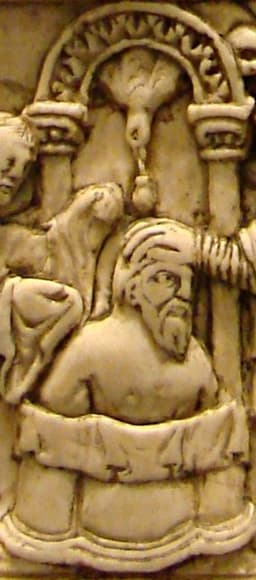
Clovis I
Emperor · Ancient
57.1Total

Julius Caesar
General · Ancient
82.8Total
Basic Information
Born
466
-100
Died
511
-44
Era
Ancient
Ancient
Nationality
Frankish Empire
Roman Republic
Occupation
Emperor
General
Civilization
Western
Western
Score Comparison
Military (10%)
67.3
88.0
Political (20%)
45.0
78.0
Influence (20%)
55.0
85.0
Legacy (20%)
52.0
82.0
Leadership (15%)
72.0
80.0
Strategy (15%)
60.7
85.0
TOTAL
57.1
82.8
Clovis I — Complete Timeline
486 AD
Battle of SoissonsWar
Clovis defeated Syagrius, the last Roman ruler in Gaul, at Soissons. This victory ended Roman control in the region and established Clovis as the dominant power in northern Gaul, laying the foundation for the Frankish kingdom.
Frankish ExpansionRoman GaulSyagrius
Impact: regional
496 AD
Conversion to ChristianityCultural
Clovis converted to Nicene Christianity after the Battle of Tolbiac, following a vow to the Christian God. He was baptized by Bishop Remigius at Reims, becoming the first Germanic king to adopt Catholicism, which aligned him with the Gallo-Roman population and the Church.
ConversionCatholicismReimsChurch
Impact: globalconstructive
507 AD
Issuance of the Salic LawReform◆ Major
Clovis codified the Salic Law, a legal code combining Frankish customary law with Roman influences. It regulated inheritance, property, and criminal penalties, and later influenced medieval European legal systems.
Legal CodeSalic LawInheritance
Impact: regionalconstructive
Julius Caesar — Complete Timeline
58 BC
Gallic WarsWar◆ Major
Caesar, as proconsul of Gaul, launched a series of campaigns that conquered all of Gaul (modern France, Belgium, and parts of Switzerland). He fought numerous battles, including against the Helvetii, the Belgae, and the Gallic chieftain Vercingetorix. The wars brought immense wealth and a loyal army to Caesar.
Gallic WarsConquestRoman Expansion
Impact: regional
49 BC
Crossing the RubiconPolitical Action◆ Major
Caesar led Legio XIII across the Rubicon River into Italy, defying the Roman Senate's order to disband his army. This act triggered a civil war against Pompey and the Optimates, ultimately leading to Caesar's dictatorship and the end of the Roman Republic.
Roman Civil WarEnd of RepublicPower Struggle
Impact: global
48 BC
Battle of PharsalusWar◆ Major
Caesar's outnumbered army defeated the larger forces of Pompey the Great at Pharsalus in Greece. Caesar's tactical use of a reserve line to counter Pompey's cavalry charge proved decisive. Pompey fled to Egypt, where he was assassinated, leaving Caesar as the undisputed master of the Roman world.
Roman Civil WarBattleDecisive Victory
Impact: regional
44 BC
Appointment as Dictator for LifePolitical Action◆ Major
The Roman Senate appointed Caesar dictator perpetuo (dictator for life), granting him unprecedented personal power. This move concentrated military, legislative, and judicial authority in one person, effectively ending the Roman Republic's traditional system of checks and balances and alarming many senators.
DictatorshipEnd of RepublicPower Consolidation
Impact: regionaldestructive
Assassination on the Ides of MarchPolitical Action◆ Major
A group of Roman senators, led by Marcus Junius Brutus and Gaius Cassius Longinus, stabbed Caesar to death at a meeting of the Senate in the Theatre of Pompey. The assassination was intended to restore the Republic, but instead triggered another civil war that led to the rise of the Roman Empire.
AssassinationRoman PoliticsEnd of Republic
Impact: globaldestructive
Expert Analysis
clovis-i-vs-julius-caesar
# The Conqueror and the Convert
On a winter morning in 496, somewhere in the misty forests of the Rhine, a Frankish king faced annihilation. The Alemanni had driven his army to the edge of defeat, and Clovis I, still a pagan, raised his eyes to heaven and made a desperate vow: if the Christian God would grant him victory, he would convert. Across the centuries and the Mediterranean, another general had made a similarly audacious gamble—Julius Caesar, crossing the Rubicon in 49 BCE with a single legion, betting everything on the idea that one man could remake the world. Both men won their gambles. Both transformed the West. But their paths diverged in ways that reveal something profound about the difference between raw ambition and the architecture of lasting power.
Origins
Caesar was born into the twilight of the Roman Republic, a world of senatorial intrigue, crumbling traditions, and boundless opportunity for those bold enough to seize it. His family, the Julii, claimed descent from the goddess Venus, but in practical terms they were political outsiders, part of the populist faction that had been locked out of power by the conservative optimates. From childhood, Caesar breathed the air of a republic that was already dying—its institutions hollowed by corruption, its armies loyal to generals rather than the state. He was shaped by this decay, learning early that the old rules no longer applied.
Clovis, by contrast, emerged from the shadows of Rome's collapse. Born in 466, he was the son of Childeric I, a chieftain of the Salian Franks who had fought as a Roman ally. The Western Roman Empire had fallen a decade before Clovis took the throne in 481. Where Caesar faced a republic in crisis, Clovis faced a void. Gaul was a patchwork of Roman holdouts, barbarian kingdoms, and tribal territories—a world waiting for a new order. Clovis was not a man of the city or the senate; he was a war leader who rode at the head of his warband, his authority resting on personal loyalty and the distribution of plunder.
Rise to Power
Caesar's ascent was a masterpiece of calculated risk. He climbed the cursus honorum—the ladder of Roman offices—with a blend of bribery, marriage alliances, and military glory. His consulship in 59 BCE was a triumph of political manipulation, but his true power came from the Gallic Wars (58–50 BCE), where he built a veteran army fanatically loyal to him alone. When the Senate ordered him to disband his forces, he chose war over submission. The crossing of the Rubicon was not just a military act; it was a philosophical declaration that personal ambition trumped the rule of law.
Clovis rose more directly. In 486, at the age of twenty, he faced Syagrius, the last Roman ruler in Gaul, at the Battle of Soissons. Syagrius commanded a remnant of Roman military organization and prestige. Clovis crushed him, absorbing Roman territory and, crucially, Roman administrative practices. This victory was not a political gamble but a tribal conquest—Clovis did not need to justify his actions to a senate or a people. He needed only to win, and he did.
Leadership & Governance
Caesar governed as a revolutionary. As dictator, he reformed the calendar, extended Roman citizenship to provincials, initiated public works, and centralized power in his own hands. His military genius was tactical and strategic—he understood that speed, surprise, and the morale of his troops could overcome any numerical disadvantage. At Alesia in 52 BCE, he besieged a Gallic stronghold while simultaneously building a second wall to hold off a relief army, a feat of engineering and logistics that still astounds military historians. Yet his political wisdom was flawed: he pardoned his enemies and believed his personal charisma could bind the Republic together. He was wrong.
Clovis governed as a consolidator. His issuance of the Salic Law in 507 was a stroke of genius—a written legal code that blended Frankish custom with Roman legal principles, creating a framework that both his Germanic warriors and his Roman subjects could accept. He did not abolish the old Roman administrative structures; he placed himself at their head. His conversion to Nicene Christianity in 496 was not merely personal piety but a political masterstroke. The Gallo-Roman population was overwhelmingly Catholic; by rejecting Arianism (the heresy embraced by other Germanic kings), Clovis positioned himself as the defender of orthodoxy and won the support of the Church. Where Caesar broke the old order, Clovis fused the old with the new.
Triumph & Tragedy
Caesar's greatest moment was his triumph—the four-day celebration in Rome after his Gallic victories, parading captives and gold through the streets. His greatest failure was his inability to see that the Republic could not be saved by one man. His assassination on the Ides of March, 44 BCE, was the tragedy of a man who trusted that his enemies would accept his mercy. He died at fifty-five, still in his prime, leaving a world plunged into civil war.
Clovis's triumph was more subtle but more enduring. By his death in 511, he had unified most of Gaul under Frankish rule, converted a pagan people to Christianity, and established a dynasty that would rule for nearly three hundred years. His tragedy was the Frankish custom of dividing the kingdom among his sons—a practice that would plunge the Merovingian dynasty into centuries of fratricidal warfare. But even this fragmentation could not undo the core of his achievement: the fusion of Roman and Germanic worlds.
Character & Destiny
Caesar was driven by an insatiable need for glory. "I came, I saw, I conquered," he wrote of his lightning campaign in Asia Minor—three words that capture his essence. He was charismatic, ruthless, and ultimately careless with his own safety. He believed that destiny belonged to the bold, and he was right, but he forgot that boldness invites opposition. His character made him a conqueror but not a founder.
Clovis was driven by the need for order. He was calculating, patient, and willing to adapt. His conversion was not a sudden revelation but a strategic decision; his legal code was not a revolutionary act but a bridge between cultures. He understood that power, to last, must be institutionalized. His character made him a founder.
Legacy
Caesar's legacy is the Roman Empire—the institution that emerged from his assassination. His name became synonymous with imperial authority: "Caesar" transformed into "Kaiser" and "Tsar." His military writings, the *Commentaries*, remain studied in war colleges today. But his personal ambition destroyed the Republic he claimed to serve.
Clovis's legacy is France. The Salic Law influenced European legal systems for a millennium. His conversion made the Frankish kingdom the eldest daughter of the Church, a relationship that would shape the entire Middle Ages. His dynasty, the Merovingians, would eventually give way to the Carolingians, but the foundation he laid—a Christian, Roman-influenced kingdom in Gaul—never disappeared.
Conclusion
Standing at the end of their stories, one sees two different answers to the same question: how does a man remake the world? Caesar answered with fire—personal glory, military conquest, the will of a single man imposed on history. He burned brightly and was consumed. Clovis answered with water—absorption, adaptation, the slow fusion of peoples and laws. He flowed around obstacles and became the riverbed itself. Both succeeded, but only one built something that outlasted his own ambition. Perhaps that is the difference between a conqueror and a founder: the one who builds for himself builds for a moment; the one who builds for others builds for ages.
Rankings
🥇
Julius CaesarLeader
Mil: 88.0Pol: 78.0Inf: 85.0
82.8
🥈
Clovis I
Mil: 67.3Pol: 45.0Inf: 55.0
57.1
+25.7 behind
How This Comparison Works
Algorithm
Each figure is scored on 6 dimensions (0—100 scale) based on structured historical data: Military (10%), Political (20%), Influence (20%), Legacy (20%), Leadership (15%), Strategy (15%). The weighted total produces the final ranking.
Data Sources
Scores are computed from structured sub-indicators in the database. Scale factors adjust for era (Ancient ×0.85, Modern ×1.0) and civilization size (Eastern ×1.05, Other ×0.80) to account for differences in population and military scale.
Maximum 3 Figures
Comparisons are limited to 2—3 figures to ensure readability and statistical meaningfulness.
Error Margins
±5 points per dimension — Sub-scores are derived from historical records with inherent uncertainty. Two figures within 5 points on a dimension should be considered roughly equivalent in that area.
Total Score Accuracy
±3 points overall — The weighted combination of 6 dimensions produces a total score with approximately ±3 points of uncertainty. Differences of less than 3 points are not statistically significant— the figures are effectively tied.
Known Limitations
- Historical records are incomplete and uneven across civilizations
- Figures from oral-tradition societies may be underrepresented
- Occupation labels can misclassify multi-role figures
- Scores measure capability and impact, not moral character
- Quantitative scoring is a comparison tool, not absolute truth
Capability Radar
Military (10%) — Battles & Warfare
Battles
65
95
Win Rate
70
92
Expansion
70
97
Political (20%) — Governance & Reform
Reform
65
90
Diplomacy
75
85
Economy
55
82
Influence (20%) — Cultural & Global Reach
Cultural
70
88
Global
60
94
Legacy (20%) — Historical Impact
Historical
75
95
Longevity
70
96
Leadership (15%) — Power & Stability
Tenure
70
75
Stability
60
60
Strategy (15%) — Tactics & Innovation
Strategy
65
94
Tactics
60
96
Reform
55
88
Similar Comparisons
Comments & Discussion
Conqueror's Choice6/17/2026
Caesar had the Republic, Clovis had nothing but mud and oaths. Caesar could have written himself into history with a legion's discipline; Clovis had to create a kingdom from scratch. Yet Clovis's conversion wasn't just political—it was the single most decisive act of Christian consolidation in the West. Caesar's secular ambition built a temporary empire; Clovis's baptism built France itself. Give me the barbarian who out-Romaned Rome.|
伪装成哥特的高卢人6/17/2026
拿克洛维跟凯撒比?凯撒有军团、有元老院、有亚历山大当模板,克洛维连个像样的首都都没有。但你看结果:凯撒的继承者叫奥古斯都,克洛维的继承者叫法兰西。凯撒把罗马推向内战,克洛维把《萨利克法典》留给欧洲——一部法律比十场高卢战役更持久。别迷信古典霸权了。
Alesia's Ghost6/17/2026
Comparing Clovis to Caesar is like comparing a chieftain to a titan. Caesar conquered Gaul in nine years, writing about it himself to shape its memory; Clovis defeated Syagrius and called it a nation. But here's the unsung fact: Caesar's conquest killed or enslaved perhaps a million Gauls; Clovis integrated them into the new Frankish identity. One built death tolls, the other built loyalty. I know which legacy I'd rather inherit.
数据刺猬6/17/2026
别跟我扯“伟大”,先看数字:凯撒在高卢杀了100万人,克洛维的征服战伤亡可能不到1/10。凯撒的债务高达数百万塞斯特斯,克洛维的财富不过几袋战利品和教会的荫庇。两人都是赌徒,但赔率完全不同:凯撒赌的是罗马,克洛维赌的是未来。在生存概率上,克洛维的胜率更低——而他的国家存活了1300年。数据不会撒谎。