Loading...
This comparison has not been analyzed yet.
One-time AI generation (~1 minute). Scores and timeline are already available below.
Croesus vs Liu Xiu
Liu Xiu leads by 15.9 pts · 2 figures compared
…
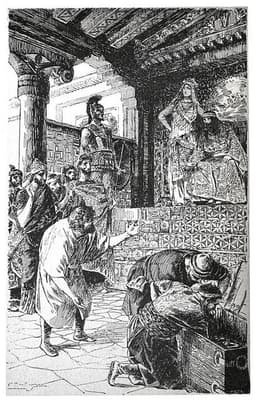
Croesus
Emperor · Ancient
50.6Total
Liu Xiu
Emperor · Ancient
66.5Total
Basic Information
Born
-595
-5
Died
-546
57
Era
Ancient
Ancient
Nationality
Lydia
China
Occupation
Emperor
Emperor
Civilization
Middle Eastern
Eastern
Score Comparison
Military (10%)
46.7
65.0
Political (20%)
68.0
79.2
Influence (20%)
54.1
56.7
Legacy (20%)
47.5
55.0
Leadership (15%)
40.0
80.0
Strategy (15%)
43.7
82.0
TOTAL
50.6
66.5
Croesus — Complete Timeline
550 BC
Dedication of Votive Offerings at DelphiCultural
Croesus sent numerous lavish gifts to the Oracle at Delphi, including gold and silver statues, bowls, and a golden lion. These offerings were among the most famous dedications in Greek history, symbolizing his legendary wealth and piety.
DelphiWealthReligion
Impact: regionalconstructive
547 BC
Defeat by Cyrus the Great at the Battle of ThymbraWar
Croesus led the Lydian army against the Persian forces of Cyrus the Great at Thymbra. The Lydian forces were defeated, leading to the siege and fall of Sardis. This battle ended the Kingdom of Lydia and incorporated it into the Persian Empire.
Lydian-Persian WarConquestFall of Lydia
Impact: regionaldestructive
Consultation of the Oracle at DelphiCultural◆ Major
Croesus consulted the Delphic oracle before attacking Persia, receiving the ambiguous prophecy that a great empire would fall. He interpreted this as Persia's defeat, but the fallen empire was his own. This event became a classic example of oracular ambiguity.
OracleProphecyLydian-Persian War
Impact: regionaltragic
546 BC
Capture and Near-Execution by CyrusPolitical Action◆ Major
After the fall of Sardis, Croesus was captured by Cyrus. According to Herodotus, Cyrus ordered Croesus to be burned alive, but the king's cries of 'Solon' caused Cyrus to reconsider and spare him. Croesus then became an advisor to Cyrus.
CaptivityCyrus the GreatHerodotus
Impact: regionaltragic
Liu Xiu — Complete Timeline
23 AD
Battle of KunyangWar
Liu Xiu led a small force of 3,000 men to relieve the siege of Kunyang against a much larger Xin army. His tactical brilliance and a timely sandstorm led to a decisive victory, breaking the back of Wang Mang's forces and paving the way for the restoration of Han.
Han DynastyBattleRestoration
Impact: national
25 AD
Proclaimed Emperor Guangwu of HanPolitical Action
Liu Xiu declared himself emperor in Luoyang, restoring the Han dynasty after the fall of Wang Mang's Xin dynasty. He took the reign name Guangwu and began the Eastern Han period, reunifying China under Han rule.
Han DynastyRestorationEmperor
Impact: globalconstructive
Established the Eastern Han Capital at LuoyangPolitical Action◆ Major
Emperor Guangwu moved the capital from Chang'an to Luoyang, marking the beginning of the Eastern Han dynasty. This shift was strategic, as Luoyang was more defensible and centrally located for controlling the empire.
Han DynastyCapitalEastern Han
Impact: nationalconstructive
27 AD
Conquest of the Red EyebrowsWar◆ Major
Emperor Guangwu defeated the Red Eyebrows rebel army, one of the major peasant forces that had risen after Wang Mang's fall. The victory eliminated a key rival and consolidated his control over the central plains.
Han DynastyRebellionConquest
Impact: national
30 AD
Implemented the 'Reduction of Taxes and Corvée' PolicyReform◆ Major
Emperor Guangwu reduced taxes and forced labor requirements to alleviate the suffering of peasants after decades of war. This policy helped restore agricultural production and stabilize the economy, earning him popular support.
Han DynastyEconomic ReformTaxation
Impact: nationalconstructive
36 AD
Reunification of ChinaWar
Emperor Guangwu completed the reunification of China by defeating the last independent warlord, Gongsun Shu, in Sichuan. This ended the civil wars that followed Wang Mang's usurpation and restored Han authority over all of China.
Han DynastyUnificationCivil War
Impact: globalconstructive
This comparison has not been analyzed yet.
One-time AI generation (~1 minute). Scores and timeline are already available below.
Rankings
🥇
Liu XiuLeader
Mil: 65.0Pol: 79.2Inf: 56.7
66.5
🥈
Croesus
Mil: 46.7Pol: 68.0Inf: 54.1
50.6
+15.9 behind
How This Comparison Works
Algorithm
Each figure is scored on 6 dimensions (0—100 scale) based on structured historical data: Military (10%), Political (20%), Influence (20%), Legacy (20%), Leadership (15%), Strategy (15%). The weighted total produces the final ranking.
Data Sources
Scores are computed from structured sub-indicators in the database. Scale factors adjust for era (Ancient ×0.85, Modern ×1.0) and civilization size (Eastern ×1.05, Other ×0.80) to account for differences in population and military scale.
Maximum 3 Figures
Comparisons are limited to 2—3 figures to ensure readability and statistical meaningfulness.
Error Margins
±5 points per dimension — Sub-scores are derived from historical records with inherent uncertainty. Two figures within 5 points on a dimension should be considered roughly equivalent in that area.
Total Score Accuracy
±3 points overall — The weighted combination of 6 dimensions produces a total score with approximately ±3 points of uncertainty. Differences of less than 3 points are not statistically significant— the figures are effectively tied.
Known Limitations
- Historical records are incomplete and uneven across civilizations
- Figures from oral-tradition societies may be underrepresented
- Occupation labels can misclassify multi-role figures
- Scores measure capability and impact, not moral character
- Quantitative scoring is a comparison tool, not absolute truth
Capability Radar
Military (10%) — Battles & Warfare
Battles
30
85
Win Rate
20
90
Expansion
35
85
Political (20%) — Governance & Reform
Reform
40
90
Diplomacy
50
85
Economy
85
88
Influence (20%) — Cultural & Global Reach
Cultural
45
75
Global
40
70
Legacy (20%) — Historical Impact
Historical
55
85
Longevity
50
80
Leadership (15%) — Power & Stability
Tenure
60
85
Stability
55
90
Strategy (15%) — Tactics & Innovation
Strategy
20
92
Tactics
25
88
Reform
10
80
Similar Comparisons
Comments & Discussion
No comments yet. Be the first to share your thoughts!