Loading...
Liu Xiu vs Qin Shi Huang
Qin Shi Huang leads by 18.7 pts · 2 figures compared
…
Liu Xiu
Emperor · Ancient
66.5Total
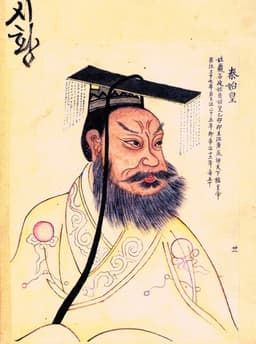
Qin Shi Huang
Emperor · Ancient
85.2Total
Basic Information
Born
-5
-259
Died
57
-210
Era
Ancient
Ancient
Nationality
China
China
Occupation
Emperor
Emperor
Civilization
Eastern
Eastern
Score Comparison
Military (10%)
65.0
80.0
Political (20%)
79.2
90.0
Influence (20%)
56.7
85.0
Legacy (20%)
55.0
90.0
Leadership (15%)
80.0
78.0
Strategy (15%)
82.0
82.0
TOTAL
66.5
85.2
Liu Xiu — Complete Timeline
23 AD
Battle of KunyangWar
Liu Xiu led a small force of 3,000 men to relieve the siege of Kunyang against a much larger Xin army. His tactical brilliance and a timely sandstorm led to a decisive victory, breaking the back of Wang Mang's forces and paving the way for the restoration of Han.
Han DynastyBattleRestoration
Impact: national
25 AD
Proclaimed Emperor Guangwu of HanPolitical Action
Liu Xiu declared himself emperor in Luoyang, restoring the Han dynasty after the fall of Wang Mang's Xin dynasty. He took the reign name Guangwu and began the Eastern Han period, reunifying China under Han rule.
Han DynastyRestorationEmperor
Impact: globalconstructive
Established the Eastern Han Capital at LuoyangPolitical Action◆ Major
Emperor Guangwu moved the capital from Chang'an to Luoyang, marking the beginning of the Eastern Han dynasty. This shift was strategic, as Luoyang was more defensible and centrally located for controlling the empire.
Han DynastyCapitalEastern Han
Impact: nationalconstructive
27 AD
Conquest of the Red EyebrowsWar◆ Major
Emperor Guangwu defeated the Red Eyebrows rebel army, one of the major peasant forces that had risen after Wang Mang's fall. The victory eliminated a key rival and consolidated his control over the central plains.
Han DynastyRebellionConquest
Impact: national
30 AD
Implemented the 'Reduction of Taxes and Corvée' PolicyReform◆ Major
Emperor Guangwu reduced taxes and forced labor requirements to alleviate the suffering of peasants after decades of war. This policy helped restore agricultural production and stabilize the economy, earning him popular support.
Han DynastyEconomic ReformTaxation
Impact: nationalconstructive
36 AD
Reunification of ChinaWar
Emperor Guangwu completed the reunification of China by defeating the last independent warlord, Gongsun Shu, in Sichuan. This ended the civil wars that followed Wang Mang's usurpation and restored Han authority over all of China.
Han DynastyUnificationCivil War
Impact: globalconstructive
Qin Shi Huang — Complete Timeline
246 BC
Construction of the Mausoleum and Terracotta ArmyOther◆ Major
Qin Shi Huang commissioned a vast mausoleum complex near Xi'an, guarded by thousands of life-sized terracotta soldiers, horses, and chariots. The project employed hundreds of thousands of workers and reflected his obsession with immortality and imperial power.
Impact: global
230 BC
Conquest of the Six Warring StatesWar
From 230 to 221 BCE, Ying Zheng led the Qin state in a series of campaigns that conquered the Han, Zhao, Wei, Chu, Yan, and Qi states. This unified China under a single ruler for the first time, ending the Warring States period.
Impact: global
221 BC
Standardization of Writing, Currency, and MeasurementsReform◆ Major
Qin Shi Huang ordered the standardization of Chinese script, currency, and weights and measures across the unified empire. This facilitated administration, trade, and cultural integration, laying a foundation for future dynasties.
Impact: globalconstructive
Proclamation of the Qin DynastyPolitical Action
After conquering the last independent state, Ying Zheng declared himself Shi Huangdi (First Emperor), founding the Qin Dynasty. He adopted a new title to signify his supreme authority and initiated centralized imperial rule.
Impact: global
214 BC
Initiation of the Great Wall ConstructionOther◆ Major
Qin Shi Huang ordered the connection and extension of existing northern fortifications to create a unified defensive wall against nomadic Xiongnu raids. This project involved massive conscripted labor and became the precursor to the later Great Wall.
Impact: regional
213 BC
Burning of Books and Burying of ScholarsPolitical Action◆ Major
On the advice of Li Si, Qin Shi Huang ordered the burning of historical records and philosophical texts not aligned with Legalist doctrine. He also had 460 Confucian scholars buried alive to suppress dissent and consolidate ideological control.
Impact: nationaldestructive
Expert Analysis
liu-xiu-vs-qin-shi-huang
# The First Emperor and the Restorer: Two Visions of Chinese Unity
In the spring of 221 BC, Ying Zheng stood before the assembled nobility of a conquered world. The last independent kingdom had fallen, and for the first time in centuries, the lands between the Yellow River and the Yangtze belonged to a single ruler. He took a new title—Shi Huangdi, the First Emperor—and declared that his dynasty would last ten thousand generations. It lasted fifteen years.
Just over two centuries later, another man faced a similar task. Liu Xiu, a distant relative of the fallen Han imperial house, watched his own enemies scatter at the Battle of Kunyang in 23 AD. He had led three thousand men against a force ten times larger and won through a combination of tactical brilliance and what his soldiers called divine intervention—a meteor shower that fell upon the enemy camp. Unlike the First Emperor, Liu Xiu would not only unify China but give it a dynasty that endured for two centuries more.
Why did one builder of empire leave only ashes, while the other left a restoration?
Origins
Ying Zheng was born into power, the son of a king and a concubine. His childhood was spent in the shadow of war and intrigue—his father had been a hostage in the Zhao court, and the young prince learned early that trust was a weakness. The Warring States period had taught the Qin ruling house one lesson above all: survival belonged to the ruthless.
Liu Xiu, by contrast, was born in 5 BC, into a declining imperial family that had lost its throne. His father died when he was young, and Liu Xiu grew up farming the land alongside his brothers. He was educated in the classics, but his neighbors remembered him as a young man who preferred practical matters to philosophical debates. When the usurper Wang Mang seized the throne and plunged China into chaos, Liu Xiu was a minor landowner, not a prince. He had to earn his authority.
Rise to Power
Ying Zheng's path was direct and terrifying. From 230 to 221 BC, he unleashed the Qin war machine against the six rival kingdoms, one by one. His generals, hardened by generations of border warfare, crushed armies that had stood for centuries. The conquest was not merely military—it was psychological. When the Zhao capital fell, Ying Zheng ordered the execution of all captured soldiers. When Qi surrendered, its king was starved to death. The message was clear: resistance meant annihilation.
Liu Xiu's rise was more uncertain. He initially joined a rebellion led by his brother, Liu Yan, who was the more charismatic leader. When Liu Yan was executed by a rival claimant to the Han throne, Liu Xiu had to suppress his grief and accept a nominal position under the man who had killed his brother. He waited, maneuvered, and built his own power base. At Kunyang in 23 AD, he proved himself a commander who could win against impossible odds. But he did not declare himself emperor until 25 AD, and even then, he spent another eleven years subduing rivals. The Red Eyebrows, a massive peasant army, had to be defeated in 27 AD. The last warlord, Gongsun Shu, fell only in 36 AD.
Leadership & Governance
Qin Shi Huang governed as he conquered: through absolute control. He standardized writing, currency, and measurements across the empire, a monumental achievement that made unified China possible. He connected the northern fortifications into what would become the Great Wall. But his methods were brutal. The "Burning of Books and Burying of Scholars" in 213 AD was not mere censorship—it was an attempt to erase history itself. All records not related to medicine, agriculture, or divination were destroyed. Scholars who protested were executed. The First Emperor believed that the past was a threat to his new order.
Emperor Guangwu governed differently. He reduced taxes and forced labor, recognizing that decades of war had exhausted the peasantry. He restored the Confucian civil service that the Qin had destroyed, rebuilding a government based on merit rather than fear. He moved the capital from Chang'an to Luoyang, not merely for strategic reasons but to signal a new beginning—the Eastern Han would learn from the mistakes of both the Qin and the Western Han. Where Qin Shi Huang had demanded uniformity, Guangwu sought stability.
Triumph & Tragedy
The First Emperor's greatest triumph was also his greatest tragedy. By 210 BC, he had unified China, built roads and canals, and created an administrative system that would outlast his dynasty. But his obsession with immortality drove him to consume mercury pills prescribed by alchemists. He died on a tour of his empire, and his chief minister Li Si kept the death secret for weeks, allowing a conspiracy that placed the weak second son on the throne. The Qin dynasty collapsed within three years.
Liu Xiu's triumph was more modest but more lasting. He died in 57 AD, having ruled for thirty-two years, and his son succeeded him peacefully. The Eastern Han would continue until 220 AD, a span of nearly two centuries. But Guangwu's tragedy was subtler: he could not fully heal the wounds of civil war. The powerful families that had supported him grew into semi-independent magnates, and the later Han emperors would struggle against their dominance.
Character & Destiny
Qin Shi Huang was a man of terrifying vision. He believed that history began with him, that the past was a burden to be discarded. His mausoleum, with its thousands of terracotta soldiers, was not a tomb but a declaration: even in death, he would command an army. This grandiosity was his strength and his ruin. He could imagine a unified China, but he could not imagine it without him.
Liu Xiu was more pragmatic. He had seen his brother killed, his family scattered, his country torn apart. He knew that power was fragile and that survival required compromise. He pardoned defeated enemies, married into local elites, and built consensus. Where the First Emperor had demanded loyalty, Guangwu earned it. His character was not heroic in the ancient sense—he was not a warrior king or a sage philosopher. He was a survivor who understood that ruling China required patience, not perfection.
Legacy
Qin Shi Huang's legacy is paradoxical. His dynasty failed, but his system endured. The standardized script he imposed is still the basis of written Chinese. The administrative divisions he created shaped imperial governance for two millennia. The Great Wall, though rebuilt many times, remains his monument. He is remembered as a tyrant and a unifier, a man who burned books but built a nation.
Liu Xiu's legacy is quieter but perhaps deeper. He is remembered as Guangwu, the "Luminous Martial" emperor, the restorer of the Han. His reign is seen as a golden age of reconstruction, a time when China healed after chaos. But his name is less known outside China than the First Emperor's, precisely because his rule was stable rather than spectacular.
Conclusion
Standing before the terracotta army in Xi'an, visitors feel the weight of Qin Shi Huang's ambition—a man who tried to conquer death itself. Walking through the ruins of Luoyang, one senses something different: the patient work of rebuilding, the slow accumulation of trust. Both men unified China. One did it through terror, the other through time. The First Emperor's dynasty vanished, but his ghost still haunts the Chinese imagination. Liu Xiu's dynasty fell, but his spirit of restoration—the belief that order can be rebuilt after chaos—has endured through every dynasty that followed. In the end, perhaps both were necessary: the destroyer and the restorer, the fire and the rain.
Rankings
🥇
Qin Shi HuangLeader
Mil: 80.0Pol: 90.0Inf: 85.0
85.2
🥈
Liu Xiu
Mil: 65.0Pol: 79.2Inf: 56.7
66.5
+18.7 behind
How This Comparison Works
Algorithm
Each figure is scored on 6 dimensions (0—100 scale) based on structured historical data: Military (10%), Political (20%), Influence (20%), Legacy (20%), Leadership (15%), Strategy (15%). The weighted total produces the final ranking.
Data Sources
Scores are computed from structured sub-indicators in the database. Scale factors adjust for era (Ancient ×0.85, Modern ×1.0) and civilization size (Eastern ×1.05, Other ×0.80) to account for differences in population and military scale.
Maximum 3 Figures
Comparisons are limited to 2—3 figures to ensure readability and statistical meaningfulness.
Error Margins
±5 points per dimension — Sub-scores are derived from historical records with inherent uncertainty. Two figures within 5 points on a dimension should be considered roughly equivalent in that area.
Total Score Accuracy
±3 points overall — The weighted combination of 6 dimensions produces a total score with approximately ±3 points of uncertainty. Differences of less than 3 points are not statistically significant— the figures are effectively tied.
Known Limitations
- Historical records are incomplete and uneven across civilizations
- Figures from oral-tradition societies may be underrepresented
- Occupation labels can misclassify multi-role figures
- Scores measure capability and impact, not moral character
- Quantitative scoring is a comparison tool, not absolute truth
Capability Radar
Military (10%) — Battles & Warfare
Battles
85
85
Win Rate
90
90
Expansion
85
90
Political (20%) — Governance & Reform
Reform
90
95
Diplomacy
85
75
Economy
88
90
Influence (20%) — Cultural & Global Reach
Cultural
75
95
Global
70
85
Legacy (20%) — Historical Impact
Historical
85
95
Longevity
80
95
Leadership (15%) — Power & Stability
Tenure
85
70
Stability
90
65
Strategy (15%) — Tactics & Innovation
Strategy
92
85
Tactics
88
80
Reform
80
95
Similar Comparisons
Comments & Discussion
Terra-Cotta Tyrant6/17/2026
Qin Shi Huang built walls and tombs that awe us still, but his unification was a brutal papering-over of regional hatreds. Liu Xiu’s restoration actually worked because he governed with a light hand, using local gentry instead of Qin’s Legalist death squads. The First Emperor’s Great Wall didn’t stop the Xiongnu; Liu Xiu’s diplomatic marriages did. History remembers the showman, not the savior.
数据侦探6/17/2026
数据不会说谎:秦朝15年亡国,东汉享国195年。秦始皇修长城征70万民夫,刘秀手下云台二十八将全是地方豪强,说白了是权力分赃更聪明。所谓“统一文字度量衡”,秦朝只用了12年就垮了,真正落实统一的是汉朝。吹秦始皇的,请先算算性价比。
Classics Scholar6/17/2026
The meteor shower at Kunyang is a poetic convenience, but the real difference is institutional. Qin Shi Huang imposed a top-down imperial machine that demanded total conformity, while Liu Xiu revived the Han bureaucracy with its Confucian flexibility—civil exams, local autonomy, and ancestor reverence. The First Emperor’s innovations were brilliant but brittle; Liu Xiu’s synthesis was messy but durable. Restoration beats invention when it respects roots.
历史小白6/17/2026
我就纳闷了,同样是统一,为什么一个成了暴君代名词,一个成了中兴明君?刘秀没焚书坑儒,没修长城累死百万百姓,还减免赋税。老百姓要的不是丰碑,是能吃饱饭的太平日子。秦始皇的成就再大,也架不住他把活人当耗材。民心这东西,你修再多兵马俑也换不来。
Revisionist Critic6/17/2026
Stop romanticizing Liu Xiu’s “divine intervention.” He was a brilliant propagandist who exploited natural phenomena to claim heaven’s mandate, while Qin Shi Huang naively trusted force over narrative. The First Emperor’s failure wasn’t his vision—it was his PR. He had the greatest script in Chinese history (unification) but told it with chains and labor gangs. Liu Xiu told the same story with tax cuts and civil service exams. Winner: better marketing.