Loading...
Daniel Noboa vs Julius Caesar
Julius Caesar leads by 42.2 pts · 2 figures compared
…
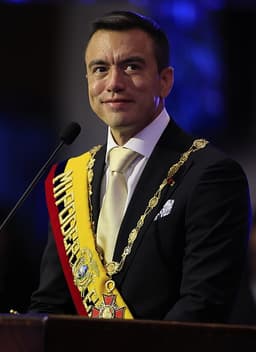
Daniel Noboa
Politician · Modern
40.6Total

Julius Caesar
General · Ancient
82.8Total
Basic Information
Born
1987
-100
Died
—
-44
Era
Modern
Ancient
Nationality
Ecuador
Roman Republic
Occupation
Politician
General
Civilization
Western
Western
Score Comparison
Military (10%)
50.0
88.0
Political (20%)
32.2
78.0
Influence (20%)
47.1
85.0
Legacy (20%)
35.8
82.0
Leadership (15%)
38.1
80.0
Strategy (15%)
43.4
85.0
TOTAL
40.6
82.8
Daniel Noboa — Complete Timeline
2023 AD
Elected President of EcuadorPolitical Action◆ Major
Daniel Noboa won the 2023 snap presidential election runoff against Luisa Gonz
ElectionYouthSnap Election
Impact: national
2024 AD
Declared internal armed conflict against drug cartelsPolitical Action◆ Major
In January 2024, following a series of violent attacks including a prison riot and the escape of a major drug lord, Noboa declared an 'internal armed conflict' against organized crime groups. He deployed the military and designated 22 gangs as terrorist organizations, escalating the war on drugs.
War on DrugsMilitaryOrganized Crime
Impact: nationaldestructive
Julius Caesar — Complete Timeline
58 BC
Gallic WarsWar◆ Major
Caesar, as proconsul of Gaul, launched a series of campaigns that conquered all of Gaul (modern France, Belgium, and parts of Switzerland). He fought numerous battles, including against the Helvetii, the Belgae, and the Gallic chieftain Vercingetorix. The wars brought immense wealth and a loyal army to Caesar.
Gallic WarsConquestRoman Expansion
Impact: regional
49 BC
Crossing the RubiconPolitical Action◆ Major
Caesar led Legio XIII across the Rubicon River into Italy, defying the Roman Senate's order to disband his army. This act triggered a civil war against Pompey and the Optimates, ultimately leading to Caesar's dictatorship and the end of the Roman Republic.
Roman Civil WarEnd of RepublicPower Struggle
Impact: global
48 BC
Battle of PharsalusWar◆ Major
Caesar's outnumbered army defeated the larger forces of Pompey the Great at Pharsalus in Greece. Caesar's tactical use of a reserve line to counter Pompey's cavalry charge proved decisive. Pompey fled to Egypt, where he was assassinated, leaving Caesar as the undisputed master of the Roman world.
Roman Civil WarBattleDecisive Victory
Impact: regional
44 BC
Appointment as Dictator for LifePolitical Action◆ Major
The Roman Senate appointed Caesar dictator perpetuo (dictator for life), granting him unprecedented personal power. This move concentrated military, legislative, and judicial authority in one person, effectively ending the Roman Republic's traditional system of checks and balances and alarming many senators.
DictatorshipEnd of RepublicPower Consolidation
Impact: regionaldestructive
Assassination on the Ides of MarchPolitical Action◆ Major
A group of Roman senators, led by Marcus Junius Brutus and Gaius Cassius Longinus, stabbed Caesar to death at a meeting of the Senate in the Theatre of Pompey. The assassination was intended to restore the Republic, but instead triggered another civil war that led to the rise of the Roman Empire.
AssassinationRoman PoliticsEnd of Republic
Impact: globaldestructive
Expert Analysis
daniel-noboa-vs-julius-caesar
# The Dictator and the Banana Heir
In January 2024, Daniel Noboa, a 37-year-old heir to a banana fortune, stood before the cameras in Quito and declared an “internal armed conflict” against Ecuador’s drug cartels. Half a world and two millennia away, on a March morning in 44 BCE, Julius Caesar fell to twenty-three dagger blows in the Roman Senate—a man who had once crossed the Rubicon and dared to remake the world. One rose through blood and ambition to become master of the Mediterranean; the other inherited a banana empire and stumbled into a presidency during a plague of violence. What separates these two figures, both thrust into power during moments of crisis, is not merely time but the very nature of how a leader is forged—and how history remembers.
Origins
Caesar was born into the twilight of the Roman Republic, a world of senatorial intrigue, civil wars, and a ruling class that bred ambition like a disease. His family, the Julii, claimed descent from the goddess Venus, but they were politically marginal. His father died when Caesar was sixteen, leaving him to navigate a treacherous landscape of alliances and debts. The young patrician learned early that survival meant charm, ruthlessness, and a willingness to borrow—from Crassus, from the people, from the future itself.
Daniel Noboa was born in 1987 into a very different kind of aristocracy: the banana oligarchy of Ecuador. His father, Álvaro Noboa, was one of the wealthiest men in the country, a five-time presidential candidate who never won. Young Daniel grew up in a world of private schools, American universities, and family boardrooms. He studied business at Harvard and public administration at Northwestern. His inheritance was not a goddess but a shipping company. Where Caesar’s Rome was a cauldron of ambition that demanded he fight for everything, Noboa’s Ecuador was a country where the family name opened doors—and where the real battles were fought not by legions but by lawyers and lobbyists.
Rise to Power
Caesar’s path was long and bloody. He served as a military tribune, then quaestor in Spain, where he wept before a statue of Alexander the Great, lamenting that at his age Alexander had already conquered the world. He built a reputation as a populist, a reformer, and a brilliant commander. The Gallic Wars (58–50 BCE) were not merely conquests but a masterclass in self-promotion: he wrote his own commentaries, sent dispatches to Rome, and forged a loyal army that would follow him anywhere. When the Senate ordered him to disband, he crossed the Rubicon—a river that became a metaphor for irreversible decision. He marched on Rome, defeated his rivals, and made himself dictator.
Noboa’s rise was compressed into months. In 2023, Ecuador’s president dissolved the National Assembly and called snap elections. Noboa, at 35, ran on a platform of security and jobs. He was not a seasoned politician but a fresh face in a country weary of corruption and violence. He won the runoff against Luisa González, an ally of former president Rafael Correa. There were no legions, no battles, no crossing of rivers—only a campaign, a vote, and a handover of power. He became the youngest president in Ecuador’s history, but his mandate was fragile, his country in chaos.
Leadership & Governance
Caesar governed as a revolutionary. He reformed the calendar, granted citizenship to provincials, initiated massive public works, and centralized power in his own hands. He was a military genius who understood that war was politics by other means—and that victory was meaningless without consolidation. He pardoned his enemies (some of whom would later kill him), packed the Senate with his supporters, and treated the Republic as a vessel to be reshaped. His reforms were bold, his ambition boundless. Yet his rule was also autocratic: he accepted the title “dictator for life,” a move that alarmed the old aristocracy and sealed his fate.
Noboa governs in a different key. His “internal armed conflict” declaration in January 2024 was a response to cartel violence that had turned Ecuador into a battlefield. He deployed the military, authorized raids, and promised to retake control of prisons and streets. But his power is constrained by a fractured congress, a weak state, and an economy dependent on oil and bananas. He is not a dictator but a crisis manager, trying to hold together a country that is falling apart. Where Caesar built an empire, Noboa is trying to prevent one—the empire of the cartels.
Triumph & Tragedy
Caesar’s greatest triumph was the conquest of Gaul—a campaign that added a vast territory to the Roman world and made him the richest and most powerful man in the Republic. His greatest tragedy was his assassination on the Ides of March, 44 BCE, at the hands of senators he had once pardoned. He died expecting to be crowned king, but instead became a martyr—and his name became a title.
Noboa’s greatest triumph, so far, is surviving his first year in office. His tragedy is that he inherited a country where the state has lost control of large swaths of territory, where violence is routine, and where popularity is fleeting. He has no Gaul to conquer, no civil war to win. His battles are fought in the shadows, not on battlefields. Whether he will be remembered as a reformer or a footnote depends on forces far beyond his control.
Character & Destiny
Caesar was arrogant, brilliant, and fatalistic. He believed in his own star. He took risks that would have destroyed lesser men—crossing the Rubicon, pardoning enemies, flaunting tradition—because he believed history was on his side. His character shaped his destiny: he could not stop, could not compromise, could not imagine a world where he was not the center. That same character led him to the Senate floor on that March morning, unarmed and unprotected.
Noboa is more cautious, more pragmatic. He is a businessman who became a politician, not a conqueror who became a ruler. He does not seem to believe in fate; he believes in strategy, in negotiation, in the careful management of risk. His character is suited to a world where power is diffuse, where victory is measured not in provinces but in approval ratings. He is not trying to change the world; he is trying to survive it.
Legacy
Caesar’s legacy is the Roman Empire. He did not live to see it, but his adoption of Octavian (the future Augustus) ensured that his name would be synonymous with imperial power. For two thousand years, “Caesar” has been a title—Kaiser, Tsar, Qaysar—a word that means ruler of the world. His writings, his reforms, his assassination, his myth: they are the bedrock of Western civilization.
Noboa’s legacy is unwritten. He is 37, with decades ahead of him (barring assassination or exile). He could be remembered as the president who restored order to Ecuador—or as a brief, failed experiment in youthful leadership. His scores, as of 2024, are modest: a military rating of 37.5, a political rating of 52.4, a total of 48.7. By contrast, Caesar’s scores are 88 in military, 78 in politics, and 83.3 overall. But history is not a spreadsheet. Caesar’s numbers were earned over a lifetime of war and reform; Noboa’s are still being written.
Conclusion
We compare these two not because they are alike, but because they illuminate the distance between eras. Caesar lived in a world where a single man could reshape civilization with a sword and a speech. Noboa lives in a world of global capital, fractured states, and cartels that operate like corporations. One was a force of nature; the other is a product of his environment. And yet both faced the same fundamental question: what does it mean to lead when the old order is collapsing? Caesar answered by building a new one on the ruins. Noboa is still searching for an answer. Perhaps that is the most honest legacy of all—the unfinished story of a young man trying to hold a country together, knowing that history will judge him not by his intentions, but by his outcome.
Rankings
🥇
Julius CaesarLeader
Mil: 88.0Pol: 78.0Inf: 85.0
82.8
🥈
Daniel Noboa
Mil: 50.0Pol: 32.2Inf: 47.1
40.6
+42.2 behind
How This Comparison Works
Algorithm
Each figure is scored on 6 dimensions (0—100 scale) based on structured historical data: Military (10%), Political (20%), Influence (20%), Legacy (20%), Leadership (15%), Strategy (15%). The weighted total produces the final ranking.
Data Sources
Scores are computed from structured sub-indicators in the database. Scale factors adjust for era (Ancient ×0.85, Modern ×1.0) and civilization size (Eastern ×1.05, Other ×0.80) to account for differences in population and military scale.
Maximum 3 Figures
Comparisons are limited to 2—3 figures to ensure readability and statistical meaningfulness.
Error Margins
±5 points per dimension — Sub-scores are derived from historical records with inherent uncertainty. Two figures within 5 points on a dimension should be considered roughly equivalent in that area.
Total Score Accuracy
±3 points overall — The weighted combination of 6 dimensions produces a total score with approximately ±3 points of uncertainty. Differences of less than 3 points are not statistically significant— the figures are effectively tied.
Known Limitations
- Historical records are incomplete and uneven across civilizations
- Figures from oral-tradition societies may be underrepresented
- Occupation labels can misclassify multi-role figures
- Scores measure capability and impact, not moral character
- Quantitative scoring is a comparison tool, not absolute truth
Capability Radar
Military (10%) — Battles & Warfare
Battles
30
95
Win Rate
31
92
Expansion
32
97
Political (20%) — Governance & Reform
Reform
20
90
Diplomacy
25
85
Economy
20
82
Influence (20%) — Cultural & Global Reach
Cultural
10
88
Global
10
94
Legacy (20%) — Historical Impact
Historical
10
95
Longevity
5
96
Leadership (15%) — Power & Stability
Tenure
15
75
Stability
10
60
Strategy (15%) — Tactics & Innovation
Strategy
41
94
Tactics
40
96
Reform
45
88
Similar Comparisons
Comments & Discussion
No comments yet. Be the first to share your thoughts!