Loading...
Daniel Salamanca vs Erich Honecker
Erich Honecker leads by 8.5 pts · 2 figures compared
…
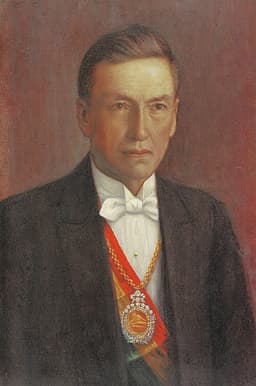
Daniel Salamanca
Politician · Modern
43.7Total

Erich Honecker
Politician · Modern
52.2Total
Basic Information
Born
1868
1912
Died
1935
1994
Era
Modern
Modern
Nationality
Bolivia
East Germany
Occupation
Politician
Politician
Civilization
Western
Western
Score Comparison
Military (10%)
36.6
49.9
Political (20%)
33.6
39.4
Influence (20%)
47.1
54.9
Legacy (20%)
38.3
49.2
Leadership (15%)
55.3
74.0
Strategy (15%)
53.5
41.7
TOTAL
43.7
52.2
Daniel Salamanca — Complete Timeline
1931 AD
Elected President of BoliviaPolitical Action◆ Major
Daniel Salamanca was elected president of Bolivia, taking office in 1931. His presidency was dominated by the Chaco War with Paraguay, which began in 1932.
PresidencyBolivia
Impact: national
1932 AD
Chaco War BeginsWar◆ Major
Under Salamanca's presidency, Bolivia entered the Chaco War against Paraguay over control of the Chaco Boreal region. The war was a major conflict that lasted until 1935, resulting in heavy casualties and territorial losses for Bolivia.
Chaco WarWar
Impact: regionaltragic
1934 AD
Overthrown in CoupPolitical Action◆ Major
Salamanca was overthrown by a military coup led by General Enrique Pe
CoupChaco War
Impact: nationaldestructive
Exiled to ChilePolitical Action
After his overthrow, Salamanca was exiled to Chile, where he lived until his death in 1935. His exile marked the end of his political career.
Exile
Impact: nationaltragic
Erich Honecker — Complete Timeline
1961 AD
Construction of the Berlin WallPolitical Action
As head of state, Honecker oversaw the construction of the Berlin Wall, a fortified barrier dividing East and West Berlin. The wall was built to stop the mass emigration of East Germans to the West and became a symbol of the Cold War.
Cold WarBerlin Wall
Impact: globaldestructive
1971 AD
Implementation of the 'Unity of Economic and Social Policy'Reform
Honecker introduced a policy focused on increasing consumer goods and social welfare to improve living standards in East Germany. While popular, this policy strained the economy and increased dependence on West German loans.
Economic policySocial welfare
Impact: nationalconstructive
Appointment as General Secretary of the SEDPolitical Action◆ Major
Honecker succeeded Walter Ulbricht as General Secretary of the Socialist Unity Party of Germany (SED), becoming the de facto leader of East Germany. He consolidated power and pursued a policy of hardline communism.
Communist leadership
Impact: national
1989 AD
Fall of the Berlin WallPolitical Action
Following mass protests and a mistaken announcement by a party official, the Berlin Wall fell. Honecker, who had refused to use force against demonstrators, was forced to resign shortly afterward. The event marked the beginning of the end for East Germany.
Cold WarGerman reunification
Impact: global
Expert Analysis
Origins
Daniel Salamanca (1869–1935) was born in Cochabamba, Bolivia, into a wealthy landowning family. He studied law and political science at the University of San Simón, later becoming a professor and a prominent member of the Republican Party. His early career included serving as a deputy and senator, building a reputation as an intellectual and orator.
Erich Honecker (1912–1994) was born in Neunkirchen, Germany, into a working-class mining family. He joined the Communist Party of Germany at a young age and was imprisoned by the Nazis for his political activities. After World War II, he rose through the ranks of the Socialist Unity Party (SED) in East Germany, becoming a protégé of Walter Ulbricht.
Rise to Power
Salamanca was elected president of Bolivia in 1931, inheriting a nation facing economic depression and territorial disputes. His presidency was quickly consumed by the Chaco War with Paraguay (1932–1935), which he aggressively pursued despite military unpreparedness. His insistence on war alienated military leaders and civilians.
Honecker's rise was more gradual. He became head of the Free German Youth (FDJ) in 1946 and a full member of the SED Politburo in 1958. In 1971, he succeeded Ulbricht as General Secretary, implementing a policy of détente with West Germany while maintaining strict control. His political score of 39.4 reflects his bureaucratic style, while Salamanca's 33.6 indicates his ineptitude in navigating political crises.
Leadership & Governance
Salamanca's leadership was characterized by micromanagement of the Chaco War, often overruling his generals. He refused to negotiate with Paraguay, insisting on total victory. His governance was chaotic; he frequently changed cabinet members and alienated key allies. His leadership score of 55.3 is modest, reflecting his determination but poor judgment.
Honecker governed East Germany with an iron grip, promoting the 'Unity of Economic and Social Policy' to boost consumer goods and welfare. While this improved living standards, it strained the economy. He oversaw the construction of the Berlin Wall in 1961 (as a key figure) and later its maintenance, suppressing dissent through the Stasi. His leadership score of 74.0 indicates more effective control, though his strategy score of 41.7 shows a lack of long-term vision.
Triumph & Tragedy
Salamanca's greatest triumph was his initial election and his unwavering commitment to Bolivian sovereignty over the Chaco. However, his tragedy was the disastrous war: Bolivia lost 60,000 lives and vast territory. He was overthrown in a 1934 coup and died in exile in Chile, a broken man. His influence score of 47.1 reflects his role in a national catastrophe.
Honecker's triumph was stabilizing East Germany and achieving international recognition through détente. He successfully built a socialist state that provided stability. His tragedy was the fall of the Berlin Wall in 1989, which he opposed violently but ultimately could not prevent. He died in exile in Chile, facing charges of human rights abuses. His legacy score of 49.2 is higher than Salamanca's 38.3.
Character & Destiny
Salamanca was stubborn, intellectual, and out of touch with military realities. His refusal to adapt doomed his presidency. Honecker was disciplined, pragmatic, but authoritarian. He believed in the socialist system until the end, but his inflexibility contributed to the regime's collapse.
Legacy
Salamanca is remembered in Bolivia as a failed war president; his name is associated with the Chaco War's futility. Honecker's legacy is more complex: he is reviled for human rights abuses but also credited with providing social stability. The Berlin Wall remains his symbol.
Conclusion
Erich Honecker had greater impact. His political control shaped East Germany for decades, and the fall of the Berlin Wall under his watch changed global history. Salamanca's impact was largely negative and confined to Bolivia. Honecker's total score of 52.2 vs Salamanca's 43.7 reflects his broader influence.
Rankings
🥇
Erich HoneckerLeader
Mil: 49.9Pol: 39.4Inf: 54.9
52.2
🥈
Daniel Salamanca
Mil: 36.6Pol: 33.6Inf: 47.1
43.7
+8.5 behind
How This Comparison Works
Algorithm
Each figure is scored on 6 dimensions (0—100 scale) based on structured historical data: Military (10%), Political (20%), Influence (20%), Legacy (20%), Leadership (15%), Strategy (15%). The weighted total produces the final ranking.
Data Sources
Scores are computed from structured sub-indicators in the database. Scale factors adjust for era (Ancient ×0.85, Modern ×1.0) and civilization size (Eastern ×1.05, Other ×0.80) to account for differences in population and military scale.
Maximum 3 Figures
Comparisons are limited to 2—3 figures to ensure readability and statistical meaningfulness.
Error Margins
±5 points per dimension — Sub-scores are derived from historical records with inherent uncertainty. Two figures within 5 points on a dimension should be considered roughly equivalent in that area.
Total Score Accuracy
±3 points overall — The weighted combination of 6 dimensions produces a total score with approximately ±3 points of uncertainty. Differences of less than 3 points are not statistically significant— the figures are effectively tied.
Known Limitations
- Historical records are incomplete and uneven across civilizations
- Figures from oral-tradition societies may be underrepresented
- Occupation labels can misclassify multi-role figures
- Scores measure capability and impact, not moral character
- Quantitative scoring is a comparison tool, not absolute truth
Capability Radar
Military (10%) — Battles & Warfare
Battles
5
28
Win Rate
5
33
Expansion
5
34
Political (20%) — Governance & Reform
Reform
30
40
Diplomacy
20
30
Economy
20
20
Influence (20%) — Cultural & Global Reach
Cultural
10
20
Global
10
40
Legacy (20%) — Historical Impact
Historical
20
55
Longevity
10
30
Leadership (15%) — Power & Stability
Tenure
40
60
Stability
10
25
Strategy (15%) — Tactics & Innovation
Strategy
5
36
Tactics
5
43
Reform
5
41
Similar Comparisons
Comments & Discussion
No comments yet. Be the first to share your thoughts!