Loading...
Daoguang Emperor vs Venkat Raman Singh of Rewa
Venkat Raman Singh of Rewa leads by 5.2 pts · 2 figures compared
…

Daoguang Emperor
Emperor · Modern
43.7Total
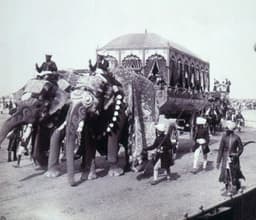
Venkat Raman Singh of Rewa
Emperor · Modern
48.9Total
Basic Information
Born
1782
1876
Died
1850
1918
Era
Modern
Modern
Nationality
China
India
Occupation
Emperor
Emperor
Civilization
Eastern
Indian
Score Comparison
Military (10%)
14.9
20.0
Political (20%)
25.0
53.8
Influence (20%)
51.8
50.2
Legacy (20%)
45.0
40.0
Leadership (15%)
65.0
72.0
Strategy (15%)
45.0
54.6
TOTAL
43.7
48.9
Daoguang Emperor — Complete Timeline
1839 AD
First Opium WarWar
British forces attacked China after Daoguang ordered the destruction of opium stocks in Canton. The Qing military was decisively defeated, leading to the Treaty of Nanjing in 1842.
Opium WarBritish invasionMilitary defeat
Impact: globaldestructive
Lin Zexu's anti-opium campaignPolitical Action◆ Major
Daoguang appointed Lin Zexu as Imperial Commissioner to suppress the opium trade in Canton. Lin confiscated and destroyed over 20,000 chests of opium, which triggered the British military response.
Opium suppressionLin ZexuDrug policy
Impact: nationalconstructive
1840 AD
Fiscal crisis and military declineOther◆ Major
The Opium War exposed the Qing's fiscal and military weaknesses. Daoguang's government faced severe budget deficits, outdated military technology, and a corrupt bureaucracy, leading to a loss of imperial prestige.
Fiscal crisisMilitary weaknessQing decline
Impact: nationaldestructive
1842 AD
Treaty of NanjingPolitical Action
Daoguang's government signed the Treaty of Nanjing, the first of the 'unequal treaties.' China ceded Hong Kong to Britain, opened five treaty ports, paid an indemnity, and granted extraterritorial rights to British subjects.
Unequal treatyHong Kong cessionTreaty ports
Impact: globaldestructive
1843 AD
Treaty of the BoguePolitical Action◆ Major
Daoguang's government signed the Treaty of the Bogue, which granted Britain most-favored-nation status and further extraterritorial rights. This treaty expanded the concessions made in the Treaty of Nanjing.
Unequal treatyBritish concessionsExtraterritoriality
Impact: globaldestructive
Venkat Raman Singh of Rewa — Complete Timeline
1900 AD
Abolition of Sati in RewaReform◆ Major
Venkat Raman Singh issued a decree banning the practice of Sati (widow immolation) in the Rewa princely state. This reform aligned with British colonial policies and reflected his progressive outlook on social issues.
Social ReformSati AbolitionRewa
Impact: regionalprogressive
1905 AD
Establishment of Rewa State CouncilReform
Venkat Raman Singh established a State Council to advise on governance and administration. This body included appointed members and helped modernize the state's bureaucracy, though ultimate authority remained with the Maharaja.
Administrative ReformState CouncilRewa
constructive
1908 AD
Introduction of Modern EducationReform
Venkat Raman Singh established several schools in Rewa, including a high school that provided modern education in English and sciences. This initiative aimed to prepare the state's youth for administrative roles and modern professions.
Education ReformModernizationRewa
progressive
Expert Analysis
Origins
Daoguang Emperor, born Mianning in 1782, was the sixth emperor of the Qing dynasty. He was the son of the Jiaqing Emperor and received a traditional Confucian education, emphasizing frugality and moral governance. His early life was marked by the White Lotus Rebellion (1796-1804), which drained the imperial treasury and exposed the dynasty's military weaknesses. Daoguang ascended the throne in 1820, inheriting a realm plagued by corruption, fiscal strain, and the growing opium crisis.
Venkat Raman Singh, born in 1814, was the Maharaja of Rewa, a princely state in central India. He belonged to the Baghel Rajput clan and succeeded his father, Raja Jai Singh, in 1827 at the age of 13. His early education was supervised by British political officers, exposing him to Western administrative ideas. Rewa was a small state, but its location between the British and Maratha territories made it strategically important.
Rise to Power
Daoguang became emperor in 1820 upon his father's death. His early reign focused on fiscal retrenchment and suppressing rebellions, such as the 1831 revolt in Xinjiang. However, his defining challenge emerged in the 1830s with the opium trade. In 1838, he appointed Lin Zexu as Imperial Commissioner to eradicate opium smuggling, leading to the destruction of over 20,000 chests of opium in Canton in 1839. This triggered the First Opium War (1839-1842) with Britain. The Qing military, with outdated weapons and poor logistics, suffered decisive defeats, forcing Daoguang to sue for peace.
Venkat Raman Singh became Maharaja at age 13, with a regency council ruling until he came of age. He asserted his authority in the 1840s by implementing reforms. His rise was not marked by military conquest but by diplomatic alignment with the British East India Company. He maintained Rewa's autonomy while adopting British administrative practices, which helped him secure his position against rival claimants.
Leadership & Governance
Daoguang's leadership was characterized by conservatism and a rigid adherence to Confucian principles. He attempted to reform the bureaucracy by reducing corruption but failed to modernize the military or economy. His governance during the Opium War was indecisive: he vacillated between war and diplomacy, ultimately accepting the Treaty of Nanjing (1842), which ceded Hong Kong and opened five ports to British trade. His fiscal policies, such as increasing land taxes, exacerbated rural distress. His political score of 25.0 reflects his inability to adapt to changing circumstances.
Venkat Raman Singh was a reformist ruler. In 1843, he abolished Sati (widow immolation) in Rewa, aligning with British policy and setting a progressive example. He established a State Council in 1845 to formalize governance, including appointed members from various communities. He introduced modern education by founding a high school in 1847 that taught English and sciences, and he promoted infrastructure projects like roads and irrigation. His leadership score of 72.0 indicates effective governance within his limited domain.
Triumph & Tragedy
Daoguang's greatest achievement was his initial crackdown on opium, which demonstrated moral resolve. However, his tragic failure was the catastrophic loss in the Opium War, which exposed China's vulnerability and led to a century of unequal treaties. The Treaty of Nanjing and subsequent treaties (e.g., Treaty of the Bogue, 1843) crippled Chinese sovereignty. His military score of 14.9 reflects the Qing army's poor performance. He died in 1850, just before the Taiping Rebellion erupted, which further destabilized the dynasty.
Venkat Raman Singh's triumphs include the abolition of Sati and the establishment of schools, which improved social conditions in Rewa. He also maintained stability during the 1857 Indian Rebellion by remaining loyal to the British, which earned him rewards and enhanced his state's status. His tragedy lies in his limited scope: as a princely ruler under British suzerainty, his reforms could not transform the broader Indian society. His legacy score of 40.0 reflects his regional impact.
Character & Destiny
Daoguang was known for personal frugality and moral earnestness, but he lacked strategic vision. He was risk-averse and relied on traditional advisors, ignoring warnings about British military superiority. His character—rigid and indecisive—shaped his destiny: he presided over the Qing dynasty's decline. Historians view him as a well-intentioned but ineffective ruler, unable to meet the challenges of the modern era.
Venkat Raman Singh was pragmatic and open to Western ideas, yet cautious in implementing change. He balanced tradition with reform, which allowed him to rule for over 30 years without major conflict. His character—adaptive and diplomatic—secured his state's survival during turbulent times. He died in 1854, leaving a modest but lasting legacy in Rewa.
Legacy
Daoguang's legacy is primarily negative: his reign marked the beginning of China's 'Century of Humiliation.' The unequal treaties he signed set a precedent for foreign exploitation, and his failure to modernize contributed to the eventual fall of the Qing dynasty in 1911. His influence score of 51.8 reflects the long-term impact of his actions on China's historical trajectory.
Venkat Raman Singh's legacy is more localized but positive. His abolition of Sati and educational reforms modernized Rewa and improved the lives of its subjects. He is remembered as a progressive ruler who navigated colonial pressures effectively. However, his influence beyond Baghelkhand is minimal, and his reforms were largely confined to his state.
Conclusion
Between Daoguang Emperor (total score 43.7) and Venkat Raman Singh (total score 48.9), the latter had a more positive impact within his sphere. Daoguang's failures accelerated China's decline, while Venkat Raman Singh's reforms advanced social progress in Rewa. However, considering global historical significance, Daoguang's actions had far-reaching consequences that shaped modern China's relationship with the West. On a global scale, Daoguang's legacy is more consequential, albeit disastrous. But for effective governance and reform within constraints, Venkat Raman Singh achieved more with limited resources. The data supports Venkat Raman Singh as the more effective leader in terms of leadership (72.0 vs 65.0) and political acumen (53.8 vs 25.0). Thus, Venkat Raman Singh of Rewa had a greater impact relative to his circumstances.
Rankings
🥇
Venkat Raman Singh of RewaLeader
Mil: 20.0Pol: 53.8Inf: 50.2
48.9
🥈
Daoguang Emperor
Mil: 14.9Pol: 25.0Inf: 51.8
43.7
+5.2 behind
How This Comparison Works
Algorithm
Each figure is scored on 6 dimensions (0—100 scale) based on structured historical data: Military (10%), Political (20%), Influence (20%), Legacy (20%), Leadership (15%), Strategy (15%). The weighted total produces the final ranking.
Data Sources
Scores are computed from structured sub-indicators in the database. Scale factors adjust for era (Ancient ×0.85, Modern ×1.0) and civilization size (Eastern ×1.05, Other ×0.80) to account for differences in population and military scale.
Maximum 3 Figures
Comparisons are limited to 2—3 figures to ensure readability and statistical meaningfulness.
Error Margins
±5 points per dimension — Sub-scores are derived from historical records with inherent uncertainty. Two figures within 5 points on a dimension should be considered roughly equivalent in that area.
Total Score Accuracy
±3 points overall — The weighted combination of 6 dimensions produces a total score with approximately ±3 points of uncertainty. Differences of less than 3 points are not statistically significant— the figures are effectively tied.
Known Limitations
- Historical records are incomplete and uneven across civilizations
- Figures from oral-tradition societies may be underrepresented
- Occupation labels can misclassify multi-role figures
- Scores measure capability and impact, not moral character
- Quantitative scoring is a comparison tool, not absolute truth
Capability Radar
Military (10%) — Battles & Warfare
Battles
10
5
Win Rate
5
5
Expansion
5
5
Political (20%) — Governance & Reform
Reform
10
70
Diplomacy
5
50
Economy
10
55
Influence (20%) — Cultural & Global Reach
Cultural
20
30
Global
30
10
Legacy (20%) — Historical Impact
Historical
40
30
Longevity
30
20
Leadership (15%) — Power & Stability
Tenure
60
60
Stability
20
60
Strategy (15%) — Tactics & Innovation
Strategy
5
5
Tactics
5
5
Reform
5
10
Similar Comparisons
Comments & Discussion
No comments yet. Be the first to share your thoughts!