Loading...
This comparison has not been analyzed yet.
One-time AI generation (~1 minute). Scores and timeline are already available below.
Daudi Cwa II vs Pratap Singh Gaekwad
Pratap Singh Gaekwad leads by 0.3 pts · 2 figures compared
…

Daudi Cwa II
Emperor · Modern
46.2Total
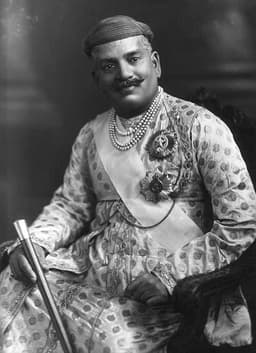
Pratap Singh Gaekwad
Emperor · Modern
46.5Total
Basic Information
Born
1896
1908
Died
1939
1968
Era
Modern
Modern
Nationality
Uganda
India
Occupation
Emperor
Emperor
Civilization
Other
Indian
Score Comparison
Military (10%)
20.0
39.3
Political (20%)
42.2
48.0
Influence (20%)
51.0
50.2
Legacy (20%)
39.2
37.5
Leadership (15%)
65.7
58.8
Strategy (15%)
54.3
46.5
TOTAL
46.2
46.5
Daudi Cwa II — Complete Timeline
1897 AD
Accession as Kabaka of BugandaPolitical Action◆ Major
Daudi Cwa II became Kabaka of Buganda as an infant after the deposition of his father Mwanga II. He was installed by the British, who ruled through a regency council, making him a ceremonial figurehead.
SuccessionBugandaColonialism
Impact: regional
1900 AD
Signed the Buganda Agreement of 1900Political Action
Daudi Cwa II, through his regents, signed the Buganda Agreement with the British. This treaty defined Buganda's borders, established land tenure systems, and formalized British overrule while preserving the kabaka's ceremonial role.
TreatyColonialismBuganda
Impact: regional
1914 AD
Assumed full powers as KabakaPolitical Action◆ Major
Daudi Cwa II reached adulthood and assumed full ruling powers as Kabaka, though still under British supervision. He worked within the colonial system, focusing on education and infrastructure development in Buganda.
RuleBugandaColonialism
Impact: regional
1920 AD
Promoted education and modernizationReform
Daudi Cwa II supported the establishment of schools and hospitals in Buganda, working with missionaries and the colonial administration. He encouraged Western education while maintaining Buganda's cultural traditions.
EducationModernizationBuganda
Impact: regionalconstructive
1939 AD
Death and successionPolitical Action◆ Major
Daudi Cwa II died after a long reign, succeeded by his son Mutesa II. His rule saw Buganda's integration into the British colonial system, setting the stage for future political struggles in Uganda.
DeathSuccessionBuganda
Impact: regional
Pratap Singh Gaekwad — Complete Timeline
1930 AD
Played First-Class Cricket for BarodaCultural
Pratap Singh Gaekwad played first-class cricket for Baroda in the Ranji Trophy. He was a capable batsman and later served as a cricket administrator, contributing to the sport's development in the region.
CricketRanji TrophyBaroda
Impact: regionalconstructive
1939 AD
Ascended the Throne of BarodaPolitical Action◆ Major
Pratap Singh Gaekwad became the Maharaja of Baroda at the age of 31, following the death of his father Sayajirao Gaekwad III. He inherited one of the wealthiest and most progressive princely states in India.
SuccessionPrincely StateBaroda
Impact: regional
1947 AD
Signed the Instrument of Accession to IndiaPolitical Action◆ Major
Pratap Singh Gaekwad signed the Instrument of Accession, merging the princely state of Baroda with the Dominion of India. This decision integrated Baroda into the Indian Union, ending its sovereignty.
AccessionIndian UnionBaroda
Impact: nationalconstructive
1956 AD
Appointed as Ambassador to FrancePolitical Action
After the merger, Pratap Singh Gaekwad served as India's Ambassador to France from 1956 to 1958. This diplomatic role marked his transition from a ruling prince to a public servant in independent India.
DiplomacyAmbassadorFrance
Impact: globalconstructive
This comparison has not been analyzed yet.
One-time AI generation (~1 minute). Scores and timeline are already available below.
Rankings
🥇
Pratap Singh GaekwadLeader
Mil: 39.3Pol: 48.0Inf: 50.2
46.5
🥈
Daudi Cwa II
Mil: 20.0Pol: 42.2Inf: 51.0
46.2
+0.3 behind
How This Comparison Works
Algorithm
Each figure is scored on 6 dimensions (0—100 scale) based on structured historical data: Military (10%), Political (20%), Influence (20%), Legacy (20%), Leadership (15%), Strategy (15%). The weighted total produces the final ranking.
Data Sources
Scores are computed from structured sub-indicators in the database. Scale factors adjust for era (Ancient ×0.85, Modern ×1.0) and civilization size (Eastern ×1.05, Other ×0.80) to account for differences in population and military scale.
Maximum 3 Figures
Comparisons are limited to 2—3 figures to ensure readability and statistical meaningfulness.
Error Margins
±5 points per dimension — Sub-scores are derived from historical records with inherent uncertainty. Two figures within 5 points on a dimension should be considered roughly equivalent in that area.
Total Score Accuracy
±3 points overall — The weighted combination of 6 dimensions produces a total score with approximately ±3 points of uncertainty. Differences of less than 3 points are not statistically significant— the figures are effectively tied.
Known Limitations
- Historical records are incomplete and uneven across civilizations
- Figures from oral-tradition societies may be underrepresented
- Occupation labels can misclassify multi-role figures
- Scores measure capability and impact, not moral character
- Quantitative scoring is a comparison tool, not absolute truth
Capability Radar
Military (10%) — Battles & Warfare
Battles
5
32
Win Rate
5
33
Expansion
5
35
Political (20%) — Governance & Reform
Reform
30
35
Diplomacy
35
40
Economy
20
30
Influence (20%) — Cultural & Global Reach
Cultural
30
20
Global
15
10
Legacy (20%) — Historical Impact
Historical
25
15
Longevity
20
10
Leadership (15%) — Power & Stability
Tenure
40
30
Stability
25
25
Strategy (15%) — Tactics & Innovation
Strategy
5
38
Tactics
5
39
Reform
5
45
Similar Comparisons
Comments & Discussion
No comments yet. Be the first to share your thoughts!