Loading...
David Ben-Gurion vs Jules Mazarin
David Ben-Gurion leads by 10.7 pts · 2 figures compared
…
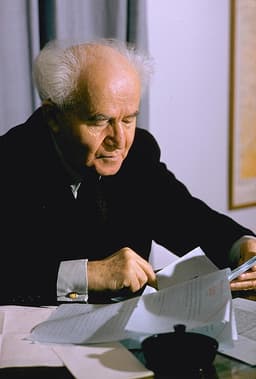
David Ben-Gurion
Politician · Modern
65.2Total

Jules Mazarin
Politician · Modern
54.5Total
Basic Information
Born
1886
1602
Died
1973
1661
Era
Modern
Modern
Nationality
Israel
France
Occupation
Politician
Politician
Civilization
Middle Eastern
Western
Score Comparison
Military (10%)
10.0
10.2
Political (20%)
78.0
70.0
Influence (20%)
68.0
55.0
Legacy (20%)
70.0
52.0
Leadership (15%)
79.8
79.8
Strategy (15%)
60.0
42.3
TOTAL
65.2
54.5
David Ben-Gurion — Complete Timeline
1948 AD
Declaration of the Establishment of the State of IsraelPolitical Action
Ben-Gurion read the Declaration of Independence in Tel Aviv, proclaiming the establishment of the State of Israel. He became its first prime minister, leading the provisional government during the ensuing 1948 Arab-Israeli War.
Founding of IsraelIndependenceZionism
Impact: globalconstructive
1956 AD
Operation Kadesh (Suez Crisis)War◆ Major
As prime minister, Ben-Gurion authorized Israel's invasion of Egypt's Sinai Peninsula in coordination with Britain and France. The operation aimed to regain control of the Suez Canal and end Egyptian blockade of Eilat, but international pressure forced withdrawal.
Suez CrisisSinai CampaignMilitary Action
Impact: regional
1963 AD
Resignation as Prime MinisterPolitical Action◆ Major
Ben-Gurion resigned as prime minister citing personal reasons and disagreements with his Mapai party colleagues, particularly over the Lavon Affair. He was succeeded by Levi Eshkol, ending his direct leadership of Israel.
ResignationPolitical TransitionLavon Affair
Impact: national
Jules Mazarin — Complete Timeline
1642 AD
Appointed Chief Minister of FrancePolitical Action◆ Major
Upon the death of Cardinal Richelieu, Mazarin was appointed as his successor as chief minister to King Louis XIII. He inherited the ongoing Thirty Years' War and the complex web of French domestic and foreign policy, becoming the de facto ruler of France.
SuccessionGovernmentThirty Years' War
Impact: national
1648 AD
Fronde Revolt BeginsWar◆ Major
The Parlement of Paris and nobles rebelled against Mazarin's centralizing policies and tax increases, sparking the Fronde civil wars. Mazarin was forced to flee Paris twice (1651 and 1652) as the revolt threatened the monarchy's authority.
Civil WarRebellionPolitical Crisis
Impact: nationaldestructive
Peace of Westphalia NegotiationsPolitical Action◆ Major
Mazarin oversaw French participation in the Peace of Westphalia negotiations that ended the Thirty Years' War. France gained territories including Alsace and confirmed its dominance in European affairs, though Mazarin's diplomatic maneuvering was criticized for not securing more gains.
TreatyDiplomacyTerritorial Gain
Impact: globalconstructive
1659 AD
Treaty of the PyreneesPolitical Action◆ Major
Mazarin negotiated the Treaty of the Pyrenees with Spain, ending the Franco-Spanish War (1635
TreatyDiplomacyRoyal Marriage
Impact: regionalconstructive
1661 AD
Death of Cardinal MazarinPolitical Action◆ Major
Mazarin died at Vincennes, leaving Louis XIV to assume personal rule. His death marked the end of the era of cardinal-ministers and the beginning of Louis XIV's absolute monarchy. Mazarin's vast art collection was bequeathed to the king.
DeathSuccessionEnd of Era
Impact: national
Expert Analysis
Origins
David Ben-Gurion was born in 1886 in Płońsk, Poland, then part of the Russian Empire. His father, Avigdor Grün, was a lawyer and a Zionist activist, which deeply influenced Ben-Gurion's early commitment to Jewish nationalism. He studied law in Warsaw but soon emigrated to Palestine in 1906, then under Ottoman rule. There, he worked as a farmer and journalist, immersing himself in the labor Zionist movement. In contrast, Jules Mazarin was born Giulio Raimondo Mazzarino in 1602 in Pescina, Italy. He came from a modest Sicilian family; his father was a steward for the Colonna family. Mazarin studied law in Rome and initially served in the papal army before entering the diplomatic service of Pope Urban VIII. His early career was marked by diplomatic missions, which brought him to the attention of Cardinal Richelieu.
Rise to Power
Ben-Gurion's rise began within the Zionist labor movement. He helped found the Ahdut HaAvoda party in 1919 and later became chairman of the Jewish Agency for Palestine in 1935, effectively the leader of the Jewish community. His political acumen was evident in navigating British Mandate policies and building institutions. The turning point came in 1947 when the UN proposed partition, and Ben-Gurion led the push for independence. He declared the State of Israel on May 14, 1948, becoming its first prime minister. Mazarin's ascent was more subtle. He entered French service as a diplomat, and Richelieu, impressed by his skills, recommended him to Louis XIII. Upon Richelieu's death in 1642, Mazarin succeeded him as chief minister. He quickly consolidated power, managing the regency of Anne of Austria after Louis XIII died in 1643. His rise was facilitated by his ability to maintain continuity in Richelieu's policies and his close relationship with the queen.
Leadership & Governance
Ben-Gurion's leadership style was autocratic and pragmatic. He centralized decision-making, often bypassing party structures. As prime minister, he focused on building state institutions: the Israel Defense Forces, the education system, and the absorption of mass immigration. His governance scored 79.8 in leadership, reflecting his ability to forge a nation from disparate groups. However, his political score of 78.0 indicates he was not always successful in maintaining coalition unity; he resigned in 1953 and again in 1963 due to internal party conflicts. Mazarin, with a leadership score of 79.8, governed through diplomacy and manipulation. He continued Richelieu's centralizing policies, but faced the Fronde revolts (1648–1653), where nobles and parlements rebelled. Mazarin was forced to flee Paris twice, but he ultimately prevailed, crushing the rebellion and strengthening royal authority. His political score of 70.0 reflects his success in weathering crises, though his methods were often seen as self-serving.
Triumph & Tragedy
Ben-Gurion's greatest triumph was the establishment of the State of Israel in 1948, a feat that secured a homeland for the Jewish people. He also led the country through the 1948 Arab–Israeli War and the 1956 Suez Crisis, expanding Israel's borders and prestige. However, his failures include the Lavon Affair (1954), a botched covert operation in Egypt that led to a political crisis and his eventual resignation. Additionally, his harsh stance against the Palestinian Arab minority and his failure to integrate Mizrahi Jews smoothly tarnished his legacy. Mazarin's triumphs include the Peace of Westphalia (1648), which ended the Thirty Years' War and expanded French territory, and the Treaty of the Pyrenees (1659), which established peace with Spain and set the stage for Louis XIV's dominance. However, his tragedy was the Fronde, which exposed the fragility of his regime and caused widespread suffering. He was forced into exile twice, and his reputation suffered for his immense personal wealth accumulation.
Character & Destiny
Ben-Gurion was a driven, visionary leader with a strong sense of destiny. He was known for his stubbornness and willingness to make unilateral decisions, as seen in his declaration of independence despite opposition. His character shaped Israel's early trajectory, but also caused friction with allies. He scored 60.0 in strategy, indicating that while he had a grand vision, his tactical decisions sometimes faltered. Mazarin was a cunning diplomat, patient and calculating. He was less charismatic than Richelieu but more flexible. His character allowed him to survive the Fronde, but his focus on power and wealth earned him enemies. Historians often see him as a consolidator rather than an innovator, with a strategy score of 42.3, reflecting his reactive rather than proactive approach.
Legacy
Ben-Gurion's legacy is immense: he is universally recognized as the founding father of Israel. His policies shaped Israeli society, including the emphasis on military strength, the absorption of Jewish immigrants, and the development of the Hebrew language. His political score of 78.0 and influence of 68.0 reflect his enduring impact. Israel today bears his imprint, though his failures regarding Palestinian rights continue to be debated. Mazarin's legacy is more mixed. He strengthened the French monarchy, paving the way for Louis XIV's absolutism. The Peace of Westphalia and Treaty of the Pyrenees established France as a major European power. However, his personal corruption and the Fronde weakened his reputation. His influence score of 55.0 and legacy of 52.0 suggest a significant but less transformative figure.
Conclusion
David Ben-Gurion had a greater impact than Jules Mazarin, both in terms of historical significance and the scope of his achievements. Ben-Gurion's total score of 65.2 against Mazarin's 54.5 reflects this. Ben-Gurion created a nation from scratch, a feat that continues to shape global politics. Mazarin, while effective in preserving and strengthening French power, operated within existing structures. Ben-Gurion's vision and leadership were more transformative, despite his flaws. Therefore, in the contest of founders versus consolidators, the founder wins.
Rankings
🥇
David Ben-GurionLeader
Mil: 10.0Pol: 78.0Inf: 68.0
65.2
🥈
Jules Mazarin
Mil: 10.2Pol: 70.0Inf: 55.0
54.5
+10.7 behind
How This Comparison Works
Algorithm
Each figure is scored on 6 dimensions (0—100 scale) based on structured historical data: Military (10%), Political (20%), Influence (20%), Legacy (20%), Leadership (15%), Strategy (15%). The weighted total produces the final ranking.
Data Sources
Scores are computed from structured sub-indicators in the database. Scale factors adjust for era (Ancient ×0.85, Modern ×1.0) and civilization size (Eastern ×1.05, Other ×0.80) to account for differences in population and military scale.
Maximum 3 Figures
Comparisons are limited to 2—3 figures to ensure readability and statistical meaningfulness.
Error Margins
±5 points per dimension — Sub-scores are derived from historical records with inherent uncertainty. Two figures within 5 points on a dimension should be considered roughly equivalent in that area.
Total Score Accuracy
±3 points overall — The weighted combination of 6 dimensions produces a total score with approximately ±3 points of uncertainty. Differences of less than 3 points are not statistically significant— the figures are effectively tied.
Known Limitations
- Historical records are incomplete and uneven across civilizations
- Figures from oral-tradition societies may be underrepresented
- Occupation labels can misclassify multi-role figures
- Scores measure capability and impact, not moral character
- Quantitative scoring is a comparison tool, not absolute truth
Capability Radar
Military (10%) — Battles & Warfare
Battles
30
15
Win Rate
65
20
Expansion
55
20
Political (20%) — Governance & Reform
Reform
85
70
Diplomacy
80
85
Economy
65
65
Influence (20%) — Cultural & Global Reach
Cultural
70
50
Global
80
65
Legacy (20%) — Historical Impact
Historical
85
70
Longevity
75
60
Leadership (15%) — Power & Stability
Tenure
70
75
Stability
60
55
Strategy (15%) — Tactics & Innovation
Strategy
60
30
Tactics
40
10
Reform
75
25
Similar Comparisons
Comments & Discussion
No comments yet. Be the first to share your thoughts!