Loading...
This comparison has not been analyzed yet.
One-time AI generation (~1 minute). Scores and timeline are already available below.
Decius vs King Mu of Zhou
King Mu of Zhou leads by 1.7 pts · 2 figures compared
…
Decius
Emperor · Ancient
43.1Total

King Mu of Zhou
Emperor · Ancient
44.8Total
Basic Information
Born
201
-980
Died
251
-922
Era
Ancient
Ancient
Nationality
Roman Empire
Zhou China
Occupation
Emperor
Emperor
Civilization
Western
Eastern
Score Comparison
Military (10%)
38.3
25.9
Political (20%)
37.9
35.1
Influence (20%)
46.3
54.9
Legacy (20%)
39.2
45.0
Leadership (15%)
41.5
55.3
Strategy (15%)
60.0
36.8
TOTAL
43.1
44.8
Decius — Complete Timeline
249 AD
Proclamation as Emperor and Defeat of Philip the ArabPolitical Action◆ Major
Decius, a Roman senator and general, was proclaimed emperor by the Danubian legions. He marched into Italy and defeated Philip the Arab at the Battle of Verona, where Philip was killed, securing Decius's position as sole emperor.
Imperial AccessionCivil WarBattle of Verona
Impact: global
250 AD
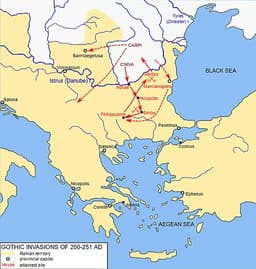
Campaign against the GothsWar
Decius led a military campaign against the Goths who had invaded the Danubian provinces. He initially achieved some successes, driving the Goths back, but the campaign was hampered by logistical issues and the plague.
Gothic WarDanube FrontierCampaign
Impact: regional
Edict of Decius (Decian Persecution)Political Action◆ Major
Decius issued an edict requiring all Roman citizens to perform a sacrifice to the Roman gods and obtain a certificate (libellus) proving compliance. This triggered the first empire-wide persecution of Christians, who refused to sacrifice, leading to widespread arrests, torture, and executions.
Christian PersecutionEdictReligious Policy
Impact: globaldestructive
251 AD
Death at the Battle of AbritusWar◆ Major
Decius and his son Herennius Etruscus were killed in battle against the Goths at Abritus (modern Bulgaria). They were ambushed in a swamp by the Gothic king Cniva, making Decius the first Roman emperor to die in battle against a foreign enemy.
Battle of AbritusGothic WarImperial Death
Impact: globaltragic
King Mu of Zhou — Complete Timeline
960 BC
Military Campaigns in the WestWar◆ Major
King Mu conducted extensive military campaigns against the Quanrong and other western tribes. These campaigns extended Zhou influence into the western regions and secured the borders.
Military ExpansionWestern TribesZhou Dynasty
Impact: regional
Journey to the Queen Mother of the WestCultural◆ Major
According to legend, King Mu traveled to the mythical Kunlun Mountains to meet the Queen Mother of the West. This journey became a famous tale in Chinese mythology, symbolizing the king's quest for immortality and exotic lands.
LegendMythologyTravel
Impact: national
950 BC
Reform of the Penal CodeReform
King Mu is credited with reforming the Zhou penal code, introducing more detailed punishments and fines. This reform aimed to make the legal system more systematic and less arbitrary.
Legal ReformPenal CodeZhou Dynasty
Impact: nationalconstructive
This comparison has not been analyzed yet.
One-time AI generation (~1 minute). Scores and timeline are already available below.
Rankings
🥇
King Mu of ZhouLeader
Mil: 25.9Pol: 35.1Inf: 54.9
44.8
🥈
Decius
Mil: 38.3Pol: 37.9Inf: 46.3
43.1
+1.7 behind
How This Comparison Works
Algorithm
Each figure is scored on 6 dimensions (0—100 scale) based on structured historical data: Military (10%), Political (20%), Influence (20%), Legacy (20%), Leadership (15%), Strategy (15%). The weighted total produces the final ranking.
Data Sources
Scores are computed from structured sub-indicators in the database. Scale factors adjust for era (Ancient ×0.85, Modern ×1.0) and civilization size (Eastern ×1.05, Other ×0.80) to account for differences in population and military scale.
Maximum 3 Figures
Comparisons are limited to 2—3 figures to ensure readability and statistical meaningfulness.
Error Margins
±5 points per dimension — Sub-scores are derived from historical records with inherent uncertainty. Two figures within 5 points on a dimension should be considered roughly equivalent in that area.
Total Score Accuracy
±3 points overall — The weighted combination of 6 dimensions produces a total score with approximately ±3 points of uncertainty. Differences of less than 3 points are not statistically significant— the figures are effectively tied.
Known Limitations
- Historical records are incomplete and uneven across civilizations
- Figures from oral-tradition societies may be underrepresented
- Occupation labels can misclassify multi-role figures
- Scores measure capability and impact, not moral character
- Quantitative scoring is a comparison tool, not absolute truth
Capability Radar
Military (10%) — Battles & Warfare
Battles
40
10
Win Rate
30
10
Expansion
20
10
Political (20%) — Governance & Reform
Reform
45
30
Diplomacy
30
30
Economy
25
30
Influence (20%) — Cultural & Global Reach
Cultural
20
40
Global
15
30
Legacy (20%) — Historical Impact
Historical
35
40
Longevity
20
40
Leadership (15%) — Power & Stability
Tenure
30
40
Stability
20
30
Strategy (15%) — Tactics & Innovation
Strategy
40
10
Tactics
35
10
Reform
50
10
Similar Comparisons
Comments & Discussion
No comments yet. Be the first to share your thoughts!