Loading...
Deng Xiaoping vs Thaksin Shinawatra
Deng Xiaoping leads by 15.3 pts · 2 figures compared
…
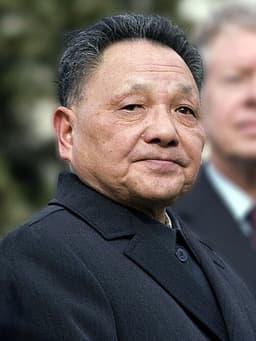
Deng Xiaoping
Politician · Modern
66.0Total
Thaksin Shinawatra
Politician · Modern
50.7Total
Basic Information
Born
1904
1949
Died
1997
—
Era
Modern
Modern
Nationality
China
Thailand
Occupation
Politician
Politician
Civilization
Eastern
Eastern
Score Comparison
Military (10%)
30.0
16.0
Political (20%)
90.0
55.0
Influence (20%)
68.0
60.0
Legacy (20%)
65.0
47.5
Leadership (15%)
78.0
74.0
Strategy (15%)
45.0
29.0
TOTAL
66.0
50.7
Deng Xiaoping — Complete Timeline
1978 AD
Third Plenum of the 11th Central CommitteePolitical Action
Deng Xiaoping consolidated power and announced the policy of Reform and Opening-Up. This meeting marked the end of Maoist class struggle as the national priority and shifted focus to economic modernization, initiating market-oriented reforms.
Economic ReformOpening-UpChina Modernization
Impact: globalconstructive
1980 AD
Establishment of Special Economic ZonesReform◆ Major
Deng Xiaoping approved the creation of Special Economic Zones in Shenzhen, Zhuhai, Shantou, and Xiamen. These zones offered tax incentives and market freedoms to attract foreign investment and technology, serving as experimental laboratories for capitalist practices within a socialist framework.
Economic ZonesForeign InvestmentMarket Reforms
Impact: nationalconstructive
1984 AD
Sino-British Joint Declaration on Hong KongPolitical Action◆ Major
Deng Xiaoping negotiated with British Prime Minister Margaret Thatcher to agree on the return of Hong Kong to Chinese sovereignty in 1997. The declaration established the 'One Country, Two Systems' principle, allowing Hong Kong to maintain its capitalist system for 50 years.
Hong KongDiplomacyOne Country Two Systems
Impact: globalconstructive
1989 AD
Tiananmen Square Protests CrackdownPolitical Action
Deng Xiaoping authorized the military to suppress pro-democracy protests in Tiananmen Square. The crackdown resulted in hundreds of civilian deaths and injuries, leading to international condemnation and a tightening of political control while economic reforms continued.
TiananmenSuppressionHuman Rights
Impact: globaldestructive
1992 AD
Southern Tour (Nanxun)Political Action◆ Major
Deng Xiaoping traveled to southern China to reaffirm the course of economic reform after conservative backlash. His speeches in Shenzhen and other cities revitalized market-oriented policies, accelerating foreign investment and pushing China toward a socialist market economy.
Economic ReformNanxunMarket Economy
Impact: nationalconstructive
Thaksin Shinawatra — Complete Timeline
2001 AD
Election as Prime MinisterPolitical Action◆ Major
Thaksin Shinawatra's Thai Rak Thai party won a landslide victory in the 2001 general election, making him Prime Minister. His populist policies, including universal healthcare and debt relief for farmers, gained widespread support.
ElectionPopulismThailand
Impact: nationalconstructive
2003 AD
War on Drugs campaignPolitical Action◆ Major
Thaksin launched a highly controversial anti-drug campaign that resulted in over 2,500 extrajudicial killings. The campaign was criticized by human rights groups but was popular among the public for reducing drug crime.
Human RightsDrug PolicyThailand
Impact: nationaldestructive
2006 AD
Overthrow in military coupPolitical Action
While attending the UN General Assembly in New York, Thaksin was overthrown by a military coup led by General Sonthi Boonyaratglin. The coup was justified by allegations of corruption, abuse of power, and disrespect to the monarchy.
CoupExileThailand
Impact: nationaldestructive
2008 AD
Conviction for abuse of powerPolitical Action◆ Major
Thaksin was convicted in absentia by the Thai Supreme Court for abuse of power in a land purchase case involving his wife. He was sentenced to two years in prison, remaining in self-exile to avoid serving the sentence.
CorruptionLegalThailand
Impact: nationaldestructive
Expert Analysis
Origins
Deng Xiaoping was born in 1904 in Guang'an, Sichuan, China, into a moderately wealthy landowning family. He studied in France and the Soviet Union, joining the Chinese Communist Party in the 1920s. His early military and political experience during the Long March and civil war shaped his pragmatic approach. Thaksin Shinawatra was born in 1949 in Chiang Mai, Thailand, into a wealthy Chinese-Thai family. He earned a PhD in criminal justice from Sam Houston State University in the US and built a telecommunications empire, Shin Corporation, before entering politics. Their vastly different backgrounds—Deng a revolutionary from a rural elite, Thaksin a business tycoon—set the stage for their contrasting paths.
Rise to Power
Deng rose through the CCP ranks but was purged twice during the Cultural Revolution. His comeback began after Mao's death in 1976, and by 1978 he outmaneuvered Maoist rivals to become the paramount leader. The Third Plenum of the 11th Central Committee in December 1978 was his turning point, launching Reform and Opening-Up. Thaksin's rise was faster: his Thai Rak Thai party won the 2001 election on a populist platform promising cheap healthcare, village funds, and debt relief. His approval soared, securing a landslide re-election in 2005. Deng's ascent took decades of survival; Thaksin's was meteoric but fragile.
Leadership & Governance
Deng's leadership style was pragmatic and authoritative. He decentralized economic decision-making, creating Special Economic Zones (SEZs) in Shenzhen, Zhuhai, Shantou, and Xiamen in 1980, offering tax breaks and market freedoms. He famously said, "It doesn't matter if a cat is black or white, as long as it catches mice." His political score of 90.0 reflects his ability to maintain party control while liberalizing the economy. Thaksin's governance was populist and centralizing. He introduced universal healthcare (the 30-baht scheme) and village development funds, but also cracked down on critics. His War on Drugs in 2003 led to over 2,500 extrajudicial killings. While Deng focused on systemic reform, Thaksin prioritized direct benefits to rural voters, scoring 55.0 in politics.
Triumph & Tragedy
Deng's greatest triumph was lifting hundreds of millions from poverty through market reforms, with China's GDP growing at 9% annually for decades. He also negotiated the return of Hong Kong via the 1984 Sino-British Joint Declaration. His tragedy was the Tiananmen Square crackdown in 1989, where he authorized military force, resulting in hundreds of deaths and international condemnation. Thaksin's triumph was his electoral success and popular policies that reduced rural poverty. His tragedy was the 2006 coup that overthrew him while he was at the UN, followed by corruption convictions and exile. Deng's actions reshaped a nation; Thaksin's legacy is marred by instability and a divided Thailand.
Character & Destiny
Deng was pragmatic, resilient, and strategic. His decision-making pattern was to test reforms locally before scaling up, a cautious yet bold approach. His character, shaped by surviving purges, made him ruthless when power was threatened. Thaksin was charismatic, ambitious, and risk-tolerant. His business background made him focus on results, but his disregard for checks and balances alienated elites. Deng died in 1997 as China's revered reformer; Thaksin lives in exile, his political influence persisting through proxy parties. Deng's destiny was to become the architect of modern China; Thaksin's to be a divisive figure whose legacy fuels ongoing conflict.
Legacy
Deng's legacy is immense: China's economic transformation, the rise of SEZs, and the concept of "socialism with Chinese characteristics" that endures today. His influence score of 68.0 reflects how his policies continue to shape global economics. Thaksin's legacy is mixed: his populist model inspired similar movements in Thailand and beyond, but his tenure also deepened political polarization, leading to years of instability. His legacy score of 47.5 indicates a contested impact. Deng changed China's trajectory permanently; Thaksin's changes were significant but reversible after his ouster.
Conclusion
Deng Xiaoping had a greater impact than Thaksin Shinawatra. Deng's total score of 66.0 versus Thaksin's 50.7 reflects this. Deng transformed the world's most populous nation through systemic economic reforms that lifted a billion people from poverty, while Thaksin's achievements were limited to a single country and undermined by his authoritarian tendencies. Deng's legacy is institutional and enduring; Thaksin's is personal and contested. In the scale of history, Deng's reforms altered global power dynamics, whereas Thaksin's story remains a cautionary tale of populism's limits.
Rankings
🥇
Deng XiaopingLeader
Mil: 30.0Pol: 90.0Inf: 68.0
66.0
🥈
Thaksin Shinawatra
Mil: 16.0Pol: 55.0Inf: 60.0
50.7
+15.3 behind
How This Comparison Works
Algorithm
Each figure is scored on 6 dimensions (0—100 scale) based on structured historical data: Military (10%), Political (20%), Influence (20%), Legacy (20%), Leadership (15%), Strategy (15%). The weighted total produces the final ranking.
Data Sources
Scores are computed from structured sub-indicators in the database. Scale factors adjust for era (Ancient ×0.85, Modern ×1.0) and civilization size (Eastern ×1.05, Other ×0.80) to account for differences in population and military scale.
Maximum 3 Figures
Comparisons are limited to 2—3 figures to ensure readability and statistical meaningfulness.
Error Margins
±5 points per dimension — Sub-scores are derived from historical records with inherent uncertainty. Two figures within 5 points on a dimension should be considered roughly equivalent in that area.
Total Score Accuracy
±3 points overall — The weighted combination of 6 dimensions produces a total score with approximately ±3 points of uncertainty. Differences of less than 3 points are not statistically significant— the figures are effectively tied.
Known Limitations
- Historical records are incomplete and uneven across civilizations
- Figures from oral-tradition societies may be underrepresented
- Occupation labels can misclassify multi-role figures
- Scores measure capability and impact, not moral character
- Quantitative scoring is a comparison tool, not absolute truth
Capability Radar
Military (10%) — Battles & Warfare
Battles
36
12
Win Rate
37
17
Expansion
41
21
Political (20%) — Governance & Reform
Reform
95
70
Diplomacy
80
55
Economy
95
75
Influence (20%) — Cultural & Global Reach
Cultural
70
50
Global
90
50
Legacy (20%) — Historical Impact
Historical
90
55
Longevity
85
40
Leadership (15%) — Power & Stability
Tenure
85
60
Stability
75
30
Strategy (15%) — Tactics & Innovation
Strategy
47
23
Tactics
48
29
Reform
49
32
Similar Comparisons
Comments & Discussion
No comments yet. Be the first to share your thoughts!