Loading...
Domingo Faustino Sarmiento vs Klemens von Metternich
Domingo Faustino Sarmiento leads by 4.7 pts · 2 figures compared
…
Domingo Faustino Sarmiento
Politician · Modern
62.2Total

Klemens von Metternich
Politician · Modern
57.5Total
Basic Information
Born
1811
1773
Died
1888
1859
Era
Modern
Modern
Nationality
Argentina
Austria
Occupation
Politician
Politician
Civilization
Western
Western
Score Comparison
Military (10%)
36.6
36.6
Political (20%)
70.0
62.7
Influence (20%)
65.0
68.0
Legacy (20%)
65.0
40.0
Leadership (15%)
68.0
80.7
Strategy (15%)
53.0
53.0
TOTAL
62.2
57.5
Domingo Faustino Sarmiento — Complete Timeline
1845 AD
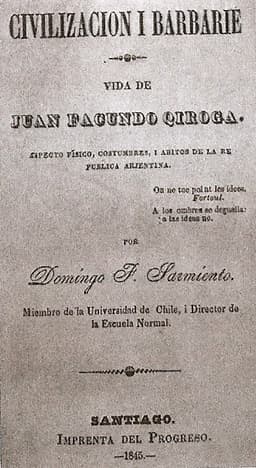
Published 'Facundo: Civilization and Barbarism'Cultural◆ Major
Sarmiento published 'Facundo', a seminal work analyzing Argentine society through the figure of caudillo Facundo Quiroga. The book contrasted civilization (urban, European) with barbarism (rural, gaucho), influencing Latin American thought.
LiteraturePolitical ThoughtArgentina
Impact: regional
1868 AD
Elected President of ArgentinaPolitical Action
Sarmiento was elected President of Argentina, serving from 1868 to 1874. His presidency focused on education, infrastructure, and modernization, continuing the policies of Bartolom
PresidencyElectionArgentina
Impact: nationalconstructive
1869 AD
Expanded public education systemReform◆ Major
Sarmiento's government built hundreds of schools, established teacher training colleges, and promoted compulsory primary education. The number of students in public schools increased from 30,000 to 100,000 during his term.
EducationReformLiteracy
Impact: nationalprogressive
1871 AD
Founded the National Observatory of ArgentinaInvention
Sarmiento founded the National Observatory in C
ScienceAstronomyEducation
Impact: nationalconstructive
Klemens von Metternich — Complete Timeline
1815 AD
Congress of ViennaPolitical Action
Metternich hosted and dominated the Congress of Vienna, which redrew the map of Europe after Napoleon's defeat. He established a conservative order based on legitimacy, balance of power, and suppression of liberal nationalism.
CongressDiplomacyRestoration
Impact: globalconstructive
Formation of the Holy AlliancePolitical Action◆ Major
Metternich helped create the Holy Alliance between Austria, Prussia, and Russia. This alliance committed the monarchs to rule according to Christian principles and became a tool for suppressing revolutions across Europe.
AllianceConservatismMonarchy
Impact: regional
1819 AD
Carlsbad DecreesPolitical Action◆ Major
Metternich orchestrated the Carlsbad Decrees, a set of repressive measures in the German Confederation. They imposed censorship, dissolved student fraternities, and placed universities under surveillance to suppress liberal and nationalist ideas.
RepressionCensorshipGerman Confederation
Impact: regionaldestructive
1820 AD
Troppau ProtocolPolitical Action◆ Major
Metternich convened the Congress of Troppau, which issued the Troppau Protocol. This declared the right of great powers to intervene militarily in states threatened by revolution, justifying Austrian intervention in Italy.
InterventionCongressRevolution
Impact: regionaldestructive
1848 AD
Revolutions of 1848 and Fall of MetternichPolitical Action
The outbreak of revolutions in Vienna forced Metternich to resign and flee to England. His conservative system collapsed as liberal and nationalist uprisings swept across Europe, ending his 39-year dominance of Austrian politics.
RevolutionResignationExile
Impact: regionaldestructive
Expert Analysis
Origins
Domingo Faustino Sarmiento was born on February 15, 1811, in San Juan, Argentina, into a modest family of mixed Spanish and indigenous ancestry. His father was a soldier, and his mother a housewife; poverty marked his early years. Sarmiento was largely self-taught, devouring books from his uncle's library and later teaching himself English and French. He became a teacher and journalist, influenced by European Enlightenment ideas.
Klemens von Metternich was born on May 15, 1773, in Coblenz, into the ancient House of Metternich, part of the German high nobility. He studied law and diplomacy at the University of Strasbourg and later at Mainz. His aristocratic background and connections allowed him to enter Austrian diplomatic service in 1801, serving as ambassador to Dresden, Berlin, and Paris.
Rise to Power
Sarmiento's rise began with his exile to Chile in 1831 due to his opposition to the Argentine caudillo Juan Manuel de Rosas. In Chile, he gained recognition as a journalist and educator, founding the Normal School for teachers. His 1845 book 'Facundo: Civilization and Barbarism' attacked Rosas and analyzed Argentine society, propelling him to fame. Returning to Argentina, he served as governor of San Juan (1862-1864) and then as President of Argentina from 1868 to 1874.
Metternich's rise was rapid due to his diplomatic skills. As Austrian ambassador to Paris (1806-1809), he negotiated the Treaty of Paris in 1810. He became Foreign Minister of Austria in 1809, at age 36, and hosted the Congress of Vienna in 1814-1815, where he dominated the redrawing of Europe's borders and established a conservative order. He served as Chancellor from 1821 until his fall in 1848.
Leadership & Governance
Sarmiento's leadership focused on modernization through education. He built over 800 schools, increased student enrollment from 30,000 to 110,000, and established teacher training colleges. He promoted immigration, built railroads, and founded the National Observatory. His slogan "To govern is to populate" reflected his belief in European immigration to civilize Argentina. However, his policies marginalized indigenous and gaucho populations, leading to conflicts.
Metternich's governance was based on conservatism and suppression of liberal and nationalist movements. He orchestrated the Carlsbad Decrees (1819), which imposed press censorship and dissolved student fraternities. He convened congresses at Troppau (1820) and Verona (1822) to legitimize intervention against revolutions. His system relied on censorship, secret police, and the Holy Alliance with Prussia and Russia. He scored 80.7 in leadership, reflecting his control, but his inflexibility led to collapse in 1848.
Triumph & Tragedy
Sarmiento's greatest success was transforming Argentina's education system: the number of students tripled during his presidency, and literacy rates rose. His book 'Facundo' remains a classic of Latin American literature. However, his tragedy was his failure to integrate Argentina's diverse population peacefully; his policies led to the War of the Triple Alliance (1864-1870) and the Conquest of the Desert (1870s), which devastated indigenous communities.
Metternich's triumph was the Congress of Vienna, which maintained peace in Europe for nearly 40 years. His conservative order suppressed revolutions and preserved the Austrian Empire's dominance. His tragedy was his inability to adapt; the Revolutions of 1848 forced him to resign and flee to England. His system collapsed, and he died in 1859, largely forgotten.
Character & Destiny
Sarmiento was a passionate, idealistic reformer with a rigid belief in civilization versus barbarism. His self-made background drove his obsession with education, but his dogmatism alienated many. He scored 68.0 in leadership and 65.0 in influence, reflecting his ability to inspire but also his polarizing nature.
Metternich was pragmatic, cunning, and aristocratic. He believed in stability and order above all, but his lack of flexibility made him a symbol of repression. His leadership score of 80.7 indicates his mastery of diplomacy, but his legacy score of 40.0 shows his negative long-term impact.
Legacy
Sarmiento's legacy endures in Argentina's education system: he is called "the father of education." His ideas influenced later reformers. He scored 65.0 in legacy, with schools and institutions named after him. However, his controversial views on race and culture continue to spark debate.
Metternich's legacy is mixed: he is remembered as a symbol of reactionary conservatism. His diplomatic methods influenced later statesmen, but his system's collapse discredited his ideas. He scored 40.0 in legacy, the lowest among the two.
Conclusion
Sarmiento had a greater impact because his educational reforms created lasting institutions and improved millions of lives. Despite his flaws, his vision of a modern Argentina through education gave him a higher total score (62.2 vs 57.5). Metternich's order was temporary and repressive; his fall revealed its fragility. While Metternich's diplomatic skill was superior (leadership 80.7), Sarmiento's influence on a nation's development was more profound and enduring.
Rankings
🥇
Domingo Faustino SarmientoLeader
Mil: 36.6Pol: 70.0Inf: 65.0
62.2
🥈
Klemens von Metternich
Mil: 36.6Pol: 62.7Inf: 68.0
57.5
+4.7 behind
How This Comparison Works
Algorithm
Each figure is scored on 6 dimensions (0—100 scale) based on structured historical data: Military (10%), Political (20%), Influence (20%), Legacy (20%), Leadership (15%), Strategy (15%). The weighted total produces the final ranking.
Data Sources
Scores are computed from structured sub-indicators in the database. Scale factors adjust for era (Ancient ×0.85, Modern ×1.0) and civilization size (Eastern ×1.05, Other ×0.80) to account for differences in population and military scale.
Maximum 3 Figures
Comparisons are limited to 2—3 figures to ensure readability and statistical meaningfulness.
Error Margins
±5 points per dimension — Sub-scores are derived from historical records with inherent uncertainty. Two figures within 5 points on a dimension should be considered roughly equivalent in that area.
Total Score Accuracy
±3 points overall — The weighted combination of 6 dimensions produces a total score with approximately ±3 points of uncertainty. Differences of less than 3 points are not statistically significant— the figures are effectively tied.
Known Limitations
- Historical records are incomplete and uneven across civilizations
- Figures from oral-tradition societies may be underrepresented
- Occupation labels can misclassify multi-role figures
- Scores measure capability and impact, not moral character
- Quantitative scoring is a comparison tool, not absolute truth
Capability Radar
Military (10%) — Battles & Warfare
Battles
5
5
Win Rate
5
5
Expansion
5
5
Political (20%) — Governance & Reform
Reform
85
80
Diplomacy
60
95
Economy
70
60
Influence (20%) — Cultural & Global Reach
Cultural
75
60
Global
65
75
Legacy (20%) — Historical Impact
Historical
80
85
Longevity
75
70
Leadership (15%) — Power & Stability
Tenure
55
85
Stability
50
85
Strategy (15%) — Tactics & Innovation
Strategy
5
10
Tactics
5
5
Reform
10
5
Similar Comparisons
Comments & Discussion
No comments yet. Be the first to share your thoughts!