Loading...
This comparison has not been analyzed yet.
One-time AI generation (~1 minute). Scores and timeline are already available below.
Domingo Faustino Sarmiento vs Maximilien Robespierre
Maximilien Robespierre leads by 1.0 pts · 2 figures compared
…
Domingo Faustino Sarmiento
Politician · Modern
62.2Total

Maximilien Robespierre
Politician · Modern
63.2Total
Basic Information
Born
1811
1758
Died
1888
1794
Era
Modern
Modern
Nationality
Argentina
France
Occupation
Politician
Politician
Civilization
Western
Western
Score Comparison
Military (10%)
36.6
11.7
Political (20%)
70.0
68.0
Influence (20%)
65.0
82.0
Legacy (20%)
65.0
72.0
Leadership (15%)
68.0
67.0
Strategy (15%)
53.0
32.7
TOTAL
62.2
63.2
Domingo Faustino Sarmiento — Complete Timeline
1845 AD
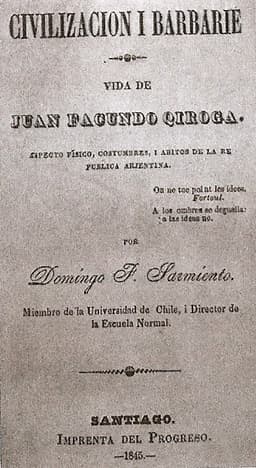
Published 'Facundo: Civilization and Barbarism'Cultural◆ Major
Sarmiento published 'Facundo', a seminal work analyzing Argentine society through the figure of caudillo Facundo Quiroga. The book contrasted civilization (urban, European) with barbarism (rural, gaucho), influencing Latin American thought.
LiteraturePolitical ThoughtArgentina
Impact: regional
1868 AD
Elected President of ArgentinaPolitical Action
Sarmiento was elected President of Argentina, serving from 1868 to 1874. His presidency focused on education, infrastructure, and modernization, continuing the policies of Bartolom
PresidencyElectionArgentina
Impact: nationalconstructive
1869 AD
Expanded public education systemReform◆ Major
Sarmiento's government built hundreds of schools, established teacher training colleges, and promoted compulsory primary education. The number of students in public schools increased from 30,000 to 100,000 during his term.
EducationReformLiteracy
Impact: nationalprogressive
1871 AD
Founded the National Observatory of ArgentinaInvention
Sarmiento founded the National Observatory in C
ScienceAstronomyEducation
Impact: nationalconstructive
Maximilien Robespierre — Complete Timeline
1789 AD
Election to the Estates-GeneralPolitical Action◆ Major
Robespierre was elected as a deputy of the Third Estate for Artois to the Estates-General. He quickly became a leading voice for radical reforms, advocating for universal male suffrage and the rights of the common people.
French RevolutionEstates-GeneralThird Estate
Impact: nationalprogressive
1793 AD
Establishment of the Reign of TerrorPolitical Action
As a leading member of the Committee of Public Safety, Robespierre oversaw the Reign of Terror, a period of mass executions of perceived enemies of the revolution. Over 16,000 people were guillotined, including former allies like Danton.
Reign of TerrorCommittee of Public SafetyGuillotine
Impact: nationaldestructive
1794 AD
Abolition of Slavery in French ColoniesReform◆ Major
Robespierre and the National Convention voted to abolish slavery in all French colonies, a landmark decree influenced by the Haitian Revolution. This was the first abolition of slavery by a major European power, though later reversed by Napoleon.
AbolitionSlaveryFrench Colonies
Impact: globalprogressive
Cult of the Supreme BeingCultural◆ Major
Robespierre inaugurated the Cult of the Supreme Being as a state religion, replacing Catholicism and atheism. The festival in Paris promoted deism and civic virtue, but was criticized as an attempt to impose his personal beliefs.
ReligionDeismFrench Revolution
Impact: national
Execution of Maximilien RobespierrePolitical Action
Robespierre was arrested and executed by guillotine without trial after the Thermidorian Reaction. His death ended the Reign of Terror and marked a conservative turn in the French Revolution.
Thermidorian ReactionExecutionEnd of Terror
Impact: nationaltragic
This comparison has not been analyzed yet.
One-time AI generation (~1 minute). Scores and timeline are already available below.
Rankings
🥇
Maximilien RobespierreLeader
Mil: 11.7Pol: 68.0Inf: 82.0
63.2
🥈
Domingo Faustino Sarmiento
Mil: 36.6Pol: 70.0Inf: 65.0
62.2
+1.0 behind
How This Comparison Works
Algorithm
Each figure is scored on 6 dimensions (0—100 scale) based on structured historical data: Military (10%), Political (20%), Influence (20%), Legacy (20%), Leadership (15%), Strategy (15%). The weighted total produces the final ranking.
Data Sources
Scores are computed from structured sub-indicators in the database. Scale factors adjust for era (Ancient ×0.85, Modern ×1.0) and civilization size (Eastern ×1.05, Other ×0.80) to account for differences in population and military scale.
Maximum 3 Figures
Comparisons are limited to 2—3 figures to ensure readability and statistical meaningfulness.
Error Margins
±5 points per dimension — Sub-scores are derived from historical records with inherent uncertainty. Two figures within 5 points on a dimension should be considered roughly equivalent in that area.
Total Score Accuracy
±3 points overall — The weighted combination of 6 dimensions produces a total score with approximately ±3 points of uncertainty. Differences of less than 3 points are not statistically significant— the figures are effectively tied.
Known Limitations
- Historical records are incomplete and uneven across civilizations
- Figures from oral-tradition societies may be underrepresented
- Occupation labels can misclassify multi-role figures
- Scores measure capability and impact, not moral character
- Quantitative scoring is a comparison tool, not absolute truth
Capability Radar
Military (10%) — Battles & Warfare
Battles
5
22
Win Rate
5
24
Expansion
5
28
Political (20%) — Governance & Reform
Reform
85
85
Diplomacy
60
40
Economy
70
30
Influence (20%) — Cultural & Global Reach
Cultural
75
70
Global
65
70
Legacy (20%) — Historical Impact
Historical
80
85
Longevity
75
75
Leadership (15%) — Power & Stability
Tenure
55
60
Stability
50
10
Strategy (15%) — Tactics & Innovation
Strategy
5
29
Tactics
5
34
Reform
10
40
Similar Comparisons
Comments & Discussion
No comments yet. Be the first to share your thoughts!