Loading...
Donald Trump vs Fernando Henrique Cardoso
Fernando Henrique Cardoso leads by 12.2 pts · 2 figures compared
…
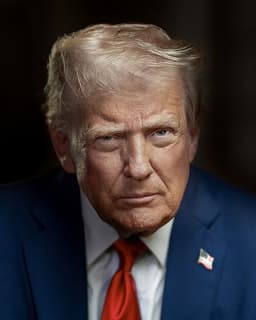
Donald Trump
Politician · Modern
49.4Total

Fernando Henrique Cardoso
Politician · Modern
61.6Total
Basic Information
Born
1946
1931
Died
—
—
Era
Modern
Modern
Nationality
United States
Brazil
Occupation
Politician
Politician
Civilization
Western
Western
Score Comparison
Military (10%)
10.0
50.0
Political (20%)
48.0
82.0
Influence (20%)
55.0
61.0
Legacy (20%)
50.0
52.0
Leadership (15%)
74.0
80.0
Strategy (15%)
38.6
40.8
TOTAL
49.4
61.6
Donald Trump — Complete Timeline
2016 AD
Election as 45th President of the United StatesPolitical Action
Trump won the 2016 presidential election against Hillary Clinton, receiving 304 electoral votes to Clinton's 227. His victory was considered a major political upset, driven by support from white working-class voters in key swing states.
US ElectionPresidencyPolitical Upset
Impact: global
2017 AD
Withdrawal from the Paris Climate AgreementPolitical Action◆ Major
Trump announced the US withdrawal from the Paris Agreement, a global accord to combat climate change. The decision isolated the US from international climate efforts and was criticized by environmental groups and allies.
Climate ChangeInternational AgreementEnvironment
Impact: globaldestructive
2019 AD
Impeachment by the House of RepresentativesPolitical Action◆ Major
The House of Representatives impeached Trump on charges of abuse of power and obstruction of Congress related to his request that Ukraine investigate Joe Biden. He was acquitted by the Senate in February 2020.
ImpeachmentUkraine ScandalConstitutional Crisis
Impact: nationaldestructive
2021 AD
January 6 Capitol AttackPolitical Action
Following Trump's false claims of election fraud, a mob of his supporters stormed the US Capitol to disrupt the certification of Joe Biden's electoral victory. The attack resulted in deaths, injuries, and a second impeachment of Trump.
Capitol RiotElection FraudInsurrection
Impact: nationaldestructive
Fernando Henrique Cardoso — Complete Timeline
1993 AD
Appointed Minister of FinancePolitical Action◆ Major
Fernando Henrique Cardoso was appointed Minister of Finance by President Itamar Franco in May 1993. He was tasked with stabilizing Brazil's economy, which was suffering from hyperinflation.
Finance MinistryEconomic PolicyBrazil
Impact: nationalconstructive
1994 AD
Implemented the Plano RealReform
Cardoso led the implementation of the Plano Real (Real Plan) in 1994, a comprehensive economic stabilization program. It introduced a new currency, the real, and successfully ended hyperinflation, bringing price stability to Brazil.
Economic StabilizationPlano RealBrazil
Impact: nationalconstructive
Elected President of BrazilPolitical Action◆ Major
Cardoso was elected president of Brazil in 1994 as the candidate of the Brazilian Social Democracy Party (PSDB). He assumed office on January 1, 1995, with a mandate to continue economic reforms.
PresidencyElectionBrazil
Impact: nationalconstructive
1995 AD
Privatized State-Owned EnterprisesReform◆ Major
Cardoso's government privatized several state-owned enterprises, including the mining company Vale do Rio Doce and the telecommunications system Telebr
PrivatizationEconomic ReformBrazil
Impact: national
Created the Bolsa Escola ProgramReform◆ Major
Cardoso created the Bolsa Escola (School Grant) program in 1995, a conditional cash transfer that provided payments to poor families in exchange for keeping their children in school. This program later evolved into Bolsa Fam
Social PolicyEducationBrazil
Impact: nationalprogressive
1998 AD
Re-elected President of BrazilPolitical Action◆ Major
Cardoso was re-elected president in 1998, winning in the first round. His second term focused on fiscal austerity, privatization, and social programs, though economic growth remained modest.
Re-electionEconomic ReformBrazil
Impact: nationalconstructive
Expert Analysis
Origins
Donald John Trump was born on June 14, 1946, in Queens, New York, to Fred Trump, a successful real estate developer, and Mary Anne MacLeod. He attended the New York Military Academy and later the Wharton School of the University of Pennsylvania, graduating with a degree in economics in 1968. Trump joined his father's business and expanded into Manhattan real estate, becoming a prominent figure through high-profile projects like Trump Tower. His formative experiences included a settlement with the Justice Department over housing discrimination and multiple business bankruptcies, which shaped his combative style.
Fernando Henrique Cardoso was born on June 18, 1931, in Rio de Janeiro, Brazil, to a military family. His father was a general, and his mother was a teacher. Cardoso studied sociology at the University of São Paulo, earning a PhD. He became a prominent academic, known for his dependency theory, and was forced into exile by Brazil's military dictatorship in the 1960s. His time abroad, including at the University of Cambridge, broadened his perspective on development and democracy.
Rise to Power
Trump's rise to political prominence began with his 2016 presidential campaign, which capitalized on economic anxiety and anti-immigration sentiment. He defeated 16 Republican primary opponents and then Hillary Clinton in the general election, winning the Electoral College 304 to 227 despite losing the popular vote by 2.9 million. Key turning points included the release of the Access Hollywood tape, which did not derail his campaign, and the FBI's reopening of the Clinton email investigation days before the election.
Cardoso rose to power through intellectual and political channels. He served as Minister of Foreign Relations (1992-1993) and then Minister of Finance (1993-1994) under President Itamar Franco. In 1994, he led the implementation of the Plano Real, a stabilization plan that ended hyperinflation. His success as finance minister propelled him to victory in the 1994 presidential election, winning in the first round with 54% of the vote.
Leadership & Governance
Trump's leadership style was transactional and confrontational. He governed through executive orders, bypassing Congress on issues like immigration (travel ban, border wall funding) and environmental regulation (Paris Agreement withdrawal). His tax cuts (2017 Tax Cuts and Jobs Act) reduced corporate rates from 35% to 21%, but increased the deficit by $1.9 trillion over ten years. He appointed three Supreme Court justices (Gorsuch, Kavanaugh, Barrett), shifting the court rightward. His management of the COVID-19 pandemic was criticized for downplaying the virus and promoting unproven treatments.
Cardoso governed as a center-left sociologist who implemented neoliberal reforms. He privatized state-owned enterprises including Vale do Rio Doce and Telebrás, raising $78 billion. He reformed the constitution to allow re-election and foreign investment. His administration created the Bolsa Família precursor (Bolsa Escola) and expanded basic education. He maintained fiscal discipline, reducing inflation from 2,477% in 1993 to 1.7% in 1998. Cardoso scored 82.0 in political skill compared to Trump's 48.0, reflecting his ability to build coalitions and pass reforms.
Triumph & Tragedy
Trump's greatest success was the 2017 tax cuts and deregulation, which contributed to pre-pandemic economic growth (3.0% GDP in 2018). His Operation Warp Speed accelerated COVID-19 vaccine development. His greatest failure was the January 6 Capitol attack, which resulted in five deaths and his second impeachment for incitement of insurrection. He was acquitted by the Senate (57-43, short of the 67 needed). His false claims of election fraud undermined democratic trust.
Cardoso's triumph was the Plano Real, which ended decades of hyperinflation and stabilized the Brazilian economy. His privatization program modernized infrastructure. His failure was the 1999 currency crisis, which forced a devaluation of the real and a $41.5 billion IMF bailout. His social programs reduced extreme poverty from 20% to 15%, but inequality remained high. Cardoso's political score of 82.0 reflects his success in passing 36 constitutional amendments.
Character & Destiny
Trump's character is defined by narcissism, impulsiveness, and a refusal to admit error. He scores 38.6 in strategy, reflecting his chaotic decision-making. His destiny was shaped by his media celebrity and ability to tap into populist anger. Historians rank him as one of the least effective presidents (e.g., C-SPAN 2021 survey: 41st out of 44).
Cardoso is characterized by intellectual rigor and pragmatism. He scores 80.0 in leadership, higher than Trump's 74.0, due to his ability to implement a coherent reform agenda. His destiny was to lead Brazil through a transformative period, but his legacy is mixed due to slow growth and corruption scandals in his coalition.
Legacy
Trump's legacy includes a more conservative judiciary, a polarized electorate, and a weakened multilateral system. His influence score of 55.0 reflects his enduring impact on the Republican Party, which has adopted his populist rhetoric. The Paris Agreement withdrawal (reversed by Biden) and Iran nuclear deal withdrawal were reversed. His legacy score is 50.0, average for a single-term president.
Cardoso's legacy is the stabilization of the Brazilian economy and the foundation for social programs later expanded by Lula. His privatization and fiscal reforms are credited with modernizing Brazil. His legacy score of 52.0 is slightly above average, but his influence score of 61.0 is higher than Trump's 55.0, due to the global impact of his dependency theory and the Plano Real as a model for inflation control.
Conclusion
Fernando Henrique Cardoso had a greater impact than Donald Trump, as reflected in his higher total score of 61.6 compared to Trump's 49.4. Cardoso's Plano Real permanently altered Brazil's economic trajectory, while Trump's policies were largely reversed or left a deeply divided nation. Cardoso's political skill (82.0 vs. 48.0) and leadership (80.0 vs. 74.0) demonstrate a more effective governance. Although Trump's influence on American populism is significant, his legacy is negative and less durable. Cardoso's stabilization of the Brazilian economy remains a landmark achievement in modern Latin American history.
Rankings
🥇
Fernando Henrique CardosoLeader
Mil: 50.0Pol: 82.0Inf: 61.0
61.6
🥈
Donald Trump
Mil: 10.0Pol: 48.0Inf: 55.0
49.4
+12.2 behind
How This Comparison Works
Algorithm
Each figure is scored on 6 dimensions (0—100 scale) based on structured historical data: Military (10%), Political (20%), Influence (20%), Legacy (20%), Leadership (15%), Strategy (15%). The weighted total produces the final ranking.
Data Sources
Scores are computed from structured sub-indicators in the database. Scale factors adjust for era (Ancient ×0.85, Modern ×1.0) and civilization size (Eastern ×1.05, Other ×0.80) to account for differences in population and military scale.
Maximum 3 Figures
Comparisons are limited to 2—3 figures to ensure readability and statistical meaningfulness.
Error Margins
±5 points per dimension — Sub-scores are derived from historical records with inherent uncertainty. Two figures within 5 points on a dimension should be considered roughly equivalent in that area.
Total Score Accuracy
±3 points overall — The weighted combination of 6 dimensions produces a total score with approximately ±3 points of uncertainty. Differences of less than 3 points are not statistically significant— the figures are effectively tied.
Known Limitations
- Historical records are incomplete and uneven across civilizations
- Figures from oral-tradition societies may be underrepresented
- Occupation labels can misclassify multi-role figures
- Scores measure capability and impact, not moral character
- Quantitative scoring is a comparison tool, not absolute truth
Capability Radar
Military (10%) — Battles & Warfare
Battles
0
31
Win Rate
0
30
Expansion
0
34
Political (20%) — Governance & Reform
Reform
40
85
Diplomacy
35
75
Economy
45
90
Influence (20%) — Cultural & Global Reach
Cultural
60
40
Global
60
55
Legacy (20%) — Historical Impact
Historical
55
60
Longevity
40
50
Leadership (15%) — Power & Stability
Tenure
55
65
Stability
30
70
Strategy (15%) — Tactics & Innovation
Strategy
0
38
Tactics
0
38
Reform
5
41
Similar Comparisons
Comments & Discussion
No comments yet. Be the first to share your thoughts!