Loading...
Donald Trump vs Xi Jinping
Xi Jinping leads by 8.6 pts · 2 figures compared
…
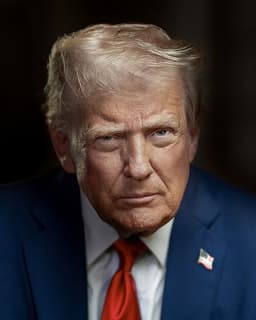
Donald Trump
Politician · Modern
49.4Total
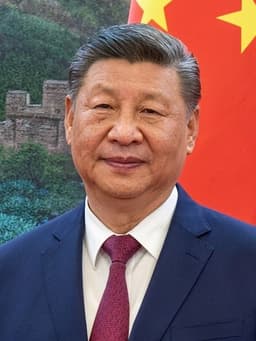
Xi Jinping
Politician · Modern
58.0Total
Basic Information
Born
1946
1953
Died
—
—
Era
Modern
Modern
Nationality
United States
China
Occupation
Politician
Politician
Civilization
Western
Eastern
Score Comparison
Military (10%)
10.0
10.0
Political (20%)
48.0
70.3
Influence (20%)
55.0
65.0
Legacy (20%)
50.0
52.0
Leadership (15%)
74.0
75.0
Strategy (15%)
38.6
60.0
TOTAL
49.4
58.0
Donald Trump — Complete Timeline
2016 AD
Election as 45th President of the United StatesPolitical Action
Trump won the 2016 presidential election against Hillary Clinton, receiving 304 electoral votes to Clinton's 227. His victory was considered a major political upset, driven by support from white working-class voters in key swing states.
US ElectionPresidencyPolitical Upset
Impact: global
2017 AD
Withdrawal from the Paris Climate AgreementPolitical Action◆ Major
Trump announced the US withdrawal from the Paris Agreement, a global accord to combat climate change. The decision isolated the US from international climate efforts and was criticized by environmental groups and allies.
Climate ChangeInternational AgreementEnvironment
Impact: globaldestructive
2019 AD
Impeachment by the House of RepresentativesPolitical Action◆ Major
The House of Representatives impeached Trump on charges of abuse of power and obstruction of Congress related to his request that Ukraine investigate Joe Biden. He was acquitted by the Senate in February 2020.
ImpeachmentUkraine ScandalConstitutional Crisis
Impact: nationaldestructive
2021 AD
January 6 Capitol AttackPolitical Action
Following Trump's false claims of election fraud, a mob of his supporters stormed the US Capitol to disrupt the certification of Joe Biden's electoral victory. The attack resulted in deaths, injuries, and a second impeachment of Trump.
Capitol RiotElection FraudInsurrection
Impact: nationaldestructive
Xi Jinping — Complete Timeline
2012 AD
Launched the Anti-Corruption CampaignReform◆ Major
Xi initiated a sweeping anti-corruption campaign targeting officials at all levels. The campaign led to the investigation and punishment of millions of party members, including high-ranking figures like Zhou Yongkang and Bo Xilai. It consolidated Xi's authority and reshaped the party's internal discipline.
Anti-CorruptionPolitical Purge
Impact: nationalconstructive
Elected General Secretary of the Communist Party of ChinaPolitical Action
Xi Jinping was elected General Secretary of the CPC Central Committee at the 18th National Congress. This positioned him as the paramount leader of China, succeeding Hu Jintao. The event marked the beginning of his consolidation of power and the launch of major policy initiatives.
Leadership TransitionCPC Congress
Impact: global
2013 AD
Announced the Belt and Road InitiativePolitical Action◆ Major
Xi unveiled the Belt and Road Initiative (BRI) during visits to Kazakhstan and Indonesia. The BRI is a massive infrastructure and economic development project spanning Asia, Europe, and Africa. It aims to enhance connectivity and trade, but has also drawn criticism for debt-trap diplomacy and geopolitical expansion.
InfrastructureForeign PolicyEconomic Strategy
Impact: global
2018 AD
Abolished Presidential Term LimitsPolitical Action
The National People's Congress approved a constitutional amendment removing the two-term limit for the presidency. This allowed Xi to remain in office indefinitely. Critics viewed it as a consolidation of authoritarian rule, while supporters argued it ensured stability and continuity.
Constitutional AmendmentPower Consolidation
Impact: nationaldestructive
2020 AD
Implemented the Hong Kong National Security LawPolitical Action◆ Major
In response to the 2019 Hong Kong protests, Beijing imposed a national security law on Hong Kong. The law criminalized secession, subversion, terrorism, and collusion with foreign forces. It led to the arrest of pro-democracy activists and the dissolution of opposition groups, significantly curtailing Hong Kong's autonomy.
Hong KongNational SecurityAutonomy
Impact: regionaldestructive
Launched the COVID-19 Zero-COVID PolicyPolitical Action◆ Major
Xi's government implemented a strict zero-COVID strategy involving mass testing, lockdowns, and quarantine. The policy initially controlled the virus but later caused economic disruption and public discontent. It was abruptly abandoned in late 2022 after widespread protests.
Public HealthPandemic Response
Impact: national
2022 AD
Met with President Joe Biden at the G20 SummitPolitical Action
Xi held his first in-person meeting with U.S. President Joe Biden on the sidelines of the G20 summit in Bali. The meeting aimed to manage tensions over Taiwan, trade, and human rights. Both sides agreed to resume cooperation on climate change and other issues.
DiplomacyUS-China Relations
Impact: global
Expert Analysis
**The Strongman and the Showman: Two Paths to Power**
On a November night in 2016, Donald Trump stood before a cheering crowd in New York, his face a mask of disbelief, as the electoral map turned red. Half a world away, in a Great Hall of the People in Beijing, Xi Jinping sat beneath a giant red star, his expression unreadable, as a sea of delegates rose to applaud his every word. One man had crashed through the gates of power on a wave of populist rage; the other had climbed the long, silent staircase of a party machine. Their nations, their methods, their very definitions of leadership could not be more different. Yet both emerged in the same era, both promised to restore greatness, and both left their countries — and the world — forever changed.
**Origins**
Donald Trump was born in 1946 into the gilded certainty of Queens, New York. His father, Fred Trump, was a real estate developer who taught him that life was a series of deals, that the world was divided into winners and losers, and that the only sin was weakness. Young Donald was sent to military school for discipline, then to Wharton for polish, but he never quite shed the brawler’s instinct. His America was one of skyscrapers, tabloid headlines, and the unshakable belief that a man could bend reality through sheer force of will.
Xi Jinping, born in 1953, entered a world of revolutionary fire and feudal memory. His father, Xi Zhongxun, was a Communist Party veteran who fell from grace during the Cultural Revolution, sending the family into years of rural exile. Young Xi labored in the mud of Liangjiahe, a peasant among peasants, learning the language of poverty and patience. Where Trump was forged in the crucible of competition, Xi was tempered in the furnace of survival. He learned that the Party was a family, but also a knife — and that loyalty, above all, was the currency of power.
**Rise to Power**
Trump’s ascent was a demolition derby. He had no political experience, no party loyalty, no policy depth. He simply declared himself the voice of a forgotten America, and millions believed him. In 2016, he defeated a field of seasoned Republicans and then Hillary Clinton, the ultimate insider, by breaking every rule. He used Twitter as a battering ram, turned rallies into revival meetings, and treated the presidency as the ultimate hostile takeover. His victory was not a coronation but a coup d'état of the ballot box.
Xi’s rise was the opposite: a slow, patient accumulation of influence. From the provinces of Fujian to Zhejiang to Shanghai, he built a network of allies, a record of competence, and a reputation for discipline. When Hu Jintao stepped down in 2012, Xi was not the flashiest candidate — but he was the safest. His election as General Secretary marked not a break from the past, but a consolidation of it. Within months, he launched an anti-corruption campaign that stunned the nation. Tens of thousands of officials were purged, including a former security chief and a Politburo member. It was a message: the Party was not a debating society; it was a weapon, and Xi was now its wielder.
**Leadership & Governance**
Trump governed like a reality show host: chaotic, improvisational, and deeply personal. He withdrew from the Paris Climate Agreement in 2017, not because he had a better plan, but because the deal offended his sense of national pride. He slashed regulations, cut taxes, and appointed conservative judges — but his style was all drama. He fired aides on television, feuded with allies, and treated intelligence briefings as optional. His leadership was a constant campaign, a perpetual performance. When the pandemic struck in 2020, he could not pivot from showman to statesman; he downplayed the virus, promoted unproven cures, and turned mask-wearing into a culture war.
Xi governs like a generalissimo: methodical, long-term, and ruthlessly strategic. He launched the Belt and Road Initiative in 2013, a trillion-dollar infrastructure project that wove Chinese influence across Asia, Africa, and Europe. He imposed the Hong Kong National Security Law in 2020, crushing the pro-democracy movement with a legal hammer. He abolished presidential term limits in 2018, ensuring he could rule indefinitely. And during the pandemic, he locked down Wuhan, built hospitals in days, and enforced a zero-COVID policy that saved lives but crushed livelihoods. Xi’s governance was not about popularity; it was about control — control of the Party, the state, and the narrative.
**Triumph & Tragedy**
Trump’s greatest triumph was his 2016 victory — a moment of pure, improbable glory. His greatest tragedy was January 6, 2021, when a mob of his supporters stormed the Capitol, five people died, and the world watched American democracy tremble. It was the culmination of his false claims of election fraud, a lie that shattered trust in the system he had sworn to protect. He was impeached twice, but acquitted both times. He left office in disgrace, yet his grip on the Republican Party never loosened.
Xi’s greatest triumph is his consolidation of power — a feat unmatched since Mao. He has reshaped the Party, the military, and the economy in his image. His greatest tragedy is the cost of that control. The zero-COVID policy, while initially effective, eventually led to protests in 2022 — the largest since Tiananmen. The anti-corruption campaign, while popular, also became a tool to eliminate rivals. The Hong Kong National Security Law restored order, but at the price of the city’s soul. Xi has achieved stability, but at the price of freedom.
**Character & Destiny**
Trump is a creature of impulse. He trusts his gut, not his advisors, and his gut is often wrong. He is thin-skinned, vindictive, and incapable of admitting error. Yet he is also fearless, relentless, and attuned to the anger of the forgotten. His character made him a revolutionary, but also a liability. He could not govern because he could not stop campaigning.
Xi is a creature of calculation. He trusts the system he has mastered, and he bends it to his will. He is patient, disciplined, and ruthless. He does not rage; he plans. His character made him a consolidator, but also a dictator. He could not inspire because he could not tolerate dissent.
**Legacy**
Trump’s legacy is a question mark. He remade the Republican Party, normalized political violence, and proved that democracy could be gamed by a demagogue. His supporters see a patriot; his critics see a threat. History will judge him as a symptom of a deeper disease — the decay of American institutions, the rise of populism, the fragility of norms.
Xi’s legacy is already written in stone. He has centralized power more than any Chinese leader since Mao, expanded China’s global reach, and crushed internal dissent. His supporters see a strongman; his critics see a tyrant. History will judge him as the architect of a new Chinese century — but also as the man who closed the door on reform.
**Conclusion**
Two leaders, two nations, two visions of power. Trump rose on the wreckage of trust; Xi rose on the machinery of control. One was a hurricane, the other a glacier. One shattered norms; the other codified them. Both promised to make their countries great again, and both did — but greatness, in the end, is a mirror. It shows not what a leader achieves, but what a people are willing to endure. And in that mirror, the face of America is still arguing with itself, while the face of China has fallen silent.
Rankings
🥇
Xi JinpingLeader
Mil: 10.0Pol: 70.3Inf: 65.0
58.0
🥈
Donald Trump
Mil: 10.0Pol: 48.0Inf: 55.0
49.4
+8.6 behind
How This Comparison Works
Algorithm
Each figure is scored on 6 dimensions (0—100 scale) based on structured historical data: Military (10%), Political (20%), Influence (20%), Legacy (20%), Leadership (15%), Strategy (15%). The weighted total produces the final ranking.
Data Sources
Scores are computed from structured sub-indicators in the database. Scale factors adjust for era (Ancient ×0.85, Modern ×1.0) and civilization size (Eastern ×1.05, Other ×0.80) to account for differences in population and military scale.
Maximum 3 Figures
Comparisons are limited to 2—3 figures to ensure readability and statistical meaningfulness.
Error Margins
±5 points per dimension — Sub-scores are derived from historical records with inherent uncertainty. Two figures within 5 points on a dimension should be considered roughly equivalent in that area.
Total Score Accuracy
±3 points overall — The weighted combination of 6 dimensions produces a total score with approximately ±3 points of uncertainty. Differences of less than 3 points are not statistically significant— the figures are effectively tied.
Known Limitations
- Historical records are incomplete and uneven across civilizations
- Figures from oral-tradition societies may be underrepresented
- Occupation labels can misclassify multi-role figures
- Scores measure capability and impact, not moral character
- Quantitative scoring is a comparison tool, not absolute truth
Capability Radar
Military (10%) — Battles & Warfare
Battles
0
0
Win Rate
0
0
Expansion
0
60
Political (20%) — Governance & Reform
Reform
40
80
Diplomacy
35
75
Economy
45
85
Influence (20%) — Cultural & Global Reach
Cultural
60
65
Global
60
75
Legacy (20%) — Historical Impact
Historical
55
70
Longevity
40
60
Leadership (15%) — Power & Stability
Tenure
55
85
Stability
30
80
Strategy (15%) — Tactics & Innovation
Strategy
0
0
Tactics
0
0
Reform
5
75
Similar Comparisons
Comments & Discussion
MAGAsteel6/19/2026
Trump’s economic disruption is overrated versus Xi’s structural consolidation. One crashed trade norms for short-term gains; the other engineered a long-term tech ecosystem.
玉玺锋芒6/19/2026
比较两人根本不合适。数据统计忽略了治国方略的根本性差异。特朗普靠推特治国,习近平用五年规划定天下。量化评分只是数字游戏。