Loading...
Douglas MacArthur vs Julius Caesar
Julius Caesar leads by 17.1 pts · 2 figures compared
…
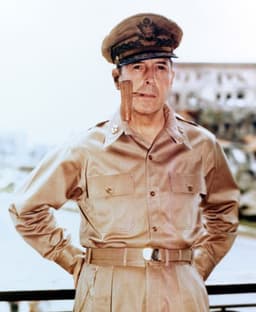
Douglas MacArthur
General · Modern
65.7Total

Julius Caesar
General · Ancient
82.8Total
Basic Information
Born
1880
-100
Died
1964
-44
Era
Modern
Ancient
Nationality
United States
Roman Republic
Occupation
General
General
Civilization
Western
Western
Score Comparison
Military (10%)
85.0
88.0
Political (20%)
78.0
78.0
Influence (20%)
68.0
85.0
Legacy (20%)
40.0
82.0
Leadership (15%)
78.0
80.0
Strategy (15%)
68.0
85.0
TOTAL
65.7
82.8
Douglas MacArthur — Complete Timeline
1942 AD
Battle of Bataan and CorregidorWar◆ Major
MacArthur commanded US and Filipino forces defending the Bataan Peninsula and Corregidor Island against Japanese invasion. After months of resistance, he was ordered to evacuate to Australia, leaving his troops who later surrendered and endured the Bataan Death March.
World War IIPacific TheaterDefeat
Impact: regionaltragic
1944 AD
Return to the PhilippinesWar◆ Major
MacArthur led the Allied invasion of Leyte Gulf, fulfilling his promise 'I shall return.' The campaign liberated the Philippines from Japanese occupation, a major strategic victory in the Pacific War.
World War IIPacific TheaterVictory
Impact: regionalconstructive
1945 AD
Surrender of JapanWar
MacArthur, as Supreme Commander for the Allied Powers, accepted Japan's formal surrender aboard USS Missouri in Tokyo Bay. This ended World War II and began the Allied occupation of Japan under his leadership.
World War IIJapanOccupation
Impact: globalconstructive
Occupation of Japan ReformsReform◆ Major
MacArthur oversaw the Allied occupation of Japan, implementing sweeping reforms including a new constitution, land redistribution, women's suffrage, and demilitarization. These changes transformed Japan into a democratic and pacifist state.
JapanPost-WarDemocratization
Impact: globalprogressive
1950 AD
Inchon LandingWar◆ Major
MacArthur planned and executed a bold amphibious assault at Inchon, South Korea, behind North Korean lines. The operation cut North Korean supply lines and recaptured Seoul, turning the tide of the Korean War.
Korean WarAmphibious AssaultVictory
Impact: regionalconstructive
1951 AD
Dismissal by President TrumanPolitical Action◆ Major
President Harry S. Truman relieved MacArthur of command for insubordination after MacArthur publicly advocated for expanding the Korean War into China. The dismissal sparked a political controversy in the US and ended MacArthur's military career.
Korean WarCivil-Military RelationsDismissal
Impact: nationaldestructive
Julius Caesar — Complete Timeline
58 BC
Gallic WarsWar◆ Major
Caesar, as proconsul of Gaul, launched a series of campaigns that conquered all of Gaul (modern France, Belgium, and parts of Switzerland). He fought numerous battles, including against the Helvetii, the Belgae, and the Gallic chieftain Vercingetorix. The wars brought immense wealth and a loyal army to Caesar.
Gallic WarsConquestRoman Expansion
Impact: regional
49 BC
Crossing the RubiconPolitical Action◆ Major
Caesar led Legio XIII across the Rubicon River into Italy, defying the Roman Senate's order to disband his army. This act triggered a civil war against Pompey and the Optimates, ultimately leading to Caesar's dictatorship and the end of the Roman Republic.
Roman Civil WarEnd of RepublicPower Struggle
Impact: global
48 BC
Battle of PharsalusWar◆ Major
Caesar's outnumbered army defeated the larger forces of Pompey the Great at Pharsalus in Greece. Caesar's tactical use of a reserve line to counter Pompey's cavalry charge proved decisive. Pompey fled to Egypt, where he was assassinated, leaving Caesar as the undisputed master of the Roman world.
Roman Civil WarBattleDecisive Victory
Impact: regional
44 BC
Appointment as Dictator for LifePolitical Action◆ Major
The Roman Senate appointed Caesar dictator perpetuo (dictator for life), granting him unprecedented personal power. This move concentrated military, legislative, and judicial authority in one person, effectively ending the Roman Republic's traditional system of checks and balances and alarming many senators.
DictatorshipEnd of RepublicPower Consolidation
Impact: regionaldestructive
Assassination on the Ides of MarchPolitical Action◆ Major
A group of Roman senators, led by Marcus Junius Brutus and Gaius Cassius Longinus, stabbed Caesar to death at a meeting of the Senate in the Theatre of Pompey. The assassination was intended to restore the Republic, but instead triggered another civil war that led to the rise of the Roman Empire.
AssassinationRoman PoliticsEnd of Republic
Impact: globaldestructive
Expert Analysis
Julius Caesar vs Douglas MacArthur: Historical Comparison
This comparison analyzes two iconic generals from vastly different eras—Julius Caesar of the Roman Republic and Douglas MacArthur of the modern United States—across military, political, and leadership dimensions. Caesar ultimately edges ahead due to his transformative strategic genius and enduring legacy.
Dimension Analysis
**Military: Julius Caesar 88 / Douglas MacArthur 79**
Caesar’s conquest of Gaul and his revolutionary siege tactics (e.g., Alesia) demonstrate unmatched adaptability in ancient warfare. MacArthur’s Inchon landing was brilliant, but his overreach in Korea (e.g., Chosin Reservoir) and failure to anticipate Chinese intervention tarnish his record.
**Political: Julius Caesar 78 / Douglas MacArthur 80**
MacArthur’s post-WWII governance of Japan (land reform, constitution) was a masterclass in nation-building. Caesar’s political maneuvering—forging the First Triumvirate and crossing the Rubicon—was effective but destabilized the Republic, leading to civil war and his assassination.
**Influence: Julius Caesar 85 / Douglas MacArthur 78**
Caesar’s actions directly ended the Roman Republic and birthed the Roman Empire, shaping Western governance for millennia. MacArthur’s influence, while significant in Cold War Asia and U.S. civil-military relations, was more contained and less transformative.
**Legacy: Julius Caesar 82 / Douglas MacArthur 72**
Caesar’s name became synonymous with imperial ambition (e.g., “Kaiser,” “Tsar”), and his writings remain studied. MacArthur’s legacy is polarized—admired for Japan’s reconstruction but criticized for his insubordination (firing by Truman) and the Korean War stalemate.
**Leadership: Julius Caesar 82 / Douglas MacArthur 76**
Caesar led from the front, earning fierce loyalty from his legions through shared hardship and clemency. MacArthur’s aloof, theatrical style inspired some but alienated peers and superiors, culminating in his dismissal for insubordination.
Verdict
Julius Caesar leads narrowly, as his higher military innovation and transformative influence on world history outweigh MacArthur’s superior political acumen in a single nation.
FAQ
Q: Who ranks higher? A: Julius Caesar ranks higher overall, primarily due to his superior military creativity and the profound, lasting impact of his actions on Western civilization.
Rankings
🥇
Julius CaesarLeader
Mil: 88.0Pol: 78.0Inf: 85.0
82.8
🥈
Douglas MacArthur
Mil: 85.0Pol: 78.0Inf: 68.0
65.7
+17.1 behind
How This Comparison Works
Algorithm
Each figure is scored on 6 dimensions (0—100 scale) based on structured historical data: Military (10%), Political (20%), Influence (20%), Legacy (20%), Leadership (15%), Strategy (15%). The weighted total produces the final ranking.
Data Sources
Scores are computed from structured sub-indicators in the database. Scale factors adjust for era (Ancient ×0.85, Modern ×1.0) and civilization size (Eastern ×1.05, Other ×0.80) to account for differences in population and military scale.
Maximum 3 Figures
Comparisons are limited to 2—3 figures to ensure readability and statistical meaningfulness.
Error Margins
±5 points per dimension — Sub-scores are derived from historical records with inherent uncertainty. Two figures within 5 points on a dimension should be considered roughly equivalent in that area.
Total Score Accuracy
±3 points overall — The weighted combination of 6 dimensions produces a total score with approximately ±3 points of uncertainty. Differences of less than 3 points are not statistically significant— the figures are effectively tied.
Known Limitations
- Historical records are incomplete and uneven across civilizations
- Figures from oral-tradition societies may be underrepresented
- Occupation labels can misclassify multi-role figures
- Scores measure capability and impact, not moral character
- Quantitative scoring is a comparison tool, not absolute truth
Capability Radar
Military (10%) — Battles & Warfare
Battles
85
95
Win Rate
75
92
Expansion
85
97
Political (20%) — Governance & Reform
Reform
85
90
Diplomacy
75
85
Economy
70
82
Influence (20%) — Cultural & Global Reach
Cultural
70
88
Global
80
94
Legacy (20%) — Historical Impact
Historical
85
95
Longevity
70
96
Leadership (15%) — Power & Stability
Tenure
80
75
Stability
65
60
Strategy (15%) — Tactics & Innovation
Strategy
90
94
Tactics
80
96
Reform
70
88
Similar Comparisons
Comments & Discussion
ColdScribe116/16/2026
这个评分体系看似客观,实则漏洞不小。凯撒军事88分,麦克阿瑟79分,差距9分?我怀疑这个权重设置是否合理。凯撒在高卢打了八年,对手是分散的部落联盟,而麦克阿瑟在太平洋跳岛战术面对的是日本帝国正规军,还搞出了仁川登陆这种现代军事教科书级的操作。更关键的是,政治维度麦克阿瑟80分、凯撒78分,但凯撒直接终结了罗马共和国,引发了后续五百年的帝国体制,这影响力在中国历史上堪比秦始皇统一六国——难道秦始皇后世评价会因为其政治手段而比刘邦低吗?评分者可能低估了跨越时代制度变革的权重。
TrueQuill96/16/2026
凯撒和麦克阿瑟?这俩放一起比,有趣。但西方史观总爱拔高个人作用。凯撒的军事天才确实像卫青霍去病——靠骑兵机动和示弱诱敌,但卫青背后是汉武帝的举国体制,凯撒背后是罗马军团的职业化制度。麦克阿瑟更像晚清的李鸿章——都是旧体系的改革者,都搞过战后重建(日本 vs 江南制造局),但都在朝鲜半岛栽了跟头,像李鸿章在甲午海战前的盲目自信。至于政治影响力,凯撒死了罗马帝国才巩固,这和诸葛亮死后蜀汉才稳定一样讽刺。评分给麦克阿瑟政治80分,但他被杜鲁门解职,这在任何中国朝代都等于“削职为民”,哪来的高政治分?