Loading...
This comparison has not been analyzed yet.
One-time AI generation (~1 minute). Scores and timeline are already available below.
Dragutin Dimitrijevic vs Zia-ul-Haq
Zia-ul-Haq leads by 10.0 pts · 2 figures compared
…
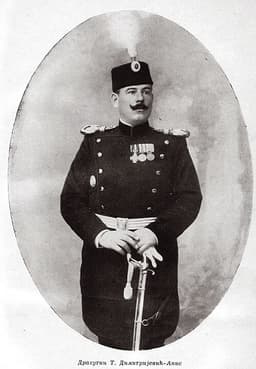
Dragutin Dimitrijevic
General · Modern
42.8Total

Zia-ul-Haq
General · Modern
52.8Total
Basic Information
Born
1876
1924
Died
1917
—
Era
Modern
Modern
Nationality
Serbia
Pakistan
Occupation
General
General
Civilization
Western
Indian
Score Comparison
Military (10%)
50.0
25.9
Political (20%)
32.2
68.0
Influence (20%)
51.0
55.0
Legacy (20%)
45.0
49.2
Leadership (15%)
34.6
64.0
Strategy (15%)
38.3
43.3
TOTAL
42.8
52.8
Dragutin Dimitrijevic — Complete Timeline
1903 AD
May Coup of 1903Political Action
Dimitrijevic, as a junior officer, participated in the conspiracy that assassinated King Aleksandar Obrenovic and Queen Draga. The coup brought the Karadjordjevic dynasty to power and ended the Obrenovic rule in Serbia.
CoupAssassinationSerbian Politics
Impact: nationaldestructive
1911 AD
Formation of the Black HandPolitical Action◆ Major
Dimitrijevic co-founded the secret military society 'Unification or Death' (Black Hand). The organization aimed to unite all Serbs through revolutionary action, using terrorist methods to achieve its goals.
Secret SocietyNationalismTerrorism
Impact: regionaldestructive
1914 AD
Involvement in the Assassination of Archduke Franz FerdinandPolitical Action
Dimitrijevic, as head of Serbian military intelligence, allegedly provided weapons and training to the assassins who killed Archduke Franz Ferdinand in Sarajevo. This event triggered the July Crisis and the outbreak of World War I.
World War IAssassinationTrigger Event
Impact: globaldestructive
1917 AD
Trial and Execution by Serbian GovernmentPolitical Action◆ Major
Dimitrijevic was arrested, tried by a Serbian military court in Thessaloniki, and executed by firing squad. The trial was politically motivated, aimed at removing the Black Hand's influence from the Serbian army and government.
ExecutionPolitical PurgeWorld War I
Impact: nationaltragic
Zia-ul-Haq — Complete Timeline
1977 AD
Seized Power in a Military CoupPolitical Action
General Zia-ul-Haq led a military coup that overthrew Prime Minister Zulfikar Ali Bhutto. Zia imposed martial law, suspended the constitution, and arrested Bhutto. The coup ended Pakistan's democratic experiment and began over a decade of military rule.
CoupMartial Law
Impact: nationaldestructive
1979 AD
Supported the Afghan Mujahideen Against the Soviet UnionWar◆ Major
Zia's government became a key ally of the U.S. in supporting Afghan mujahideen fighters against the Soviet invasion of Afghanistan. Pakistan provided training, arms, and sanctuary. This policy strengthened the military's role and later contributed to the rise of militant groups.
Afghan WarProxy War
Impact: regional
Introduced Islamization PoliciesReform◆ Major
Zia implemented a series of Islamization measures, including the introduction of Hudood Ordinances, Islamic courts, and compulsory zakat. He also enforced strict Islamic dress codes and media censorship. These policies reshaped Pakistan's legal and social fabric, increasing sectarian tensions.
IslamizationLegal Reform
Impact: nationaldestructive
Executed Zulfikar Ali BhuttoPolitical Action◆ Major
Zia ordered the execution of former Prime Minister Zulfikar Ali Bhutto after a controversial murder trial. Bhutto was hanged despite international appeals for clemency. The execution deepened political polarization and created a lasting legacy of enmity between the military and the PPP.
ExecutionPolitical Repression
Impact: nationaltragic
1984 AD
Held a Referendum on His PresidencyPolitical Action
Zia held a controversial referendum asking voters to endorse his Islamization policies and his continuation as president. The referendum was widely criticized as a sham, with official results claiming over 97% approval. It allowed Zia to extend his rule without elections.
ReferendumAuthoritarianism
Impact: nationaldestructive
1988 AD
Died in a Plane CrashOther
Zia-ul-Haq died in a mysterious plane crash near Bahawalpur along with several senior generals and the U.S. ambassador. The cause of the crash remains disputed, with theories ranging from sabotage to mechanical failure. His death ended military rule and led to democratic elections.
DeathMystery
Impact: nationaltragic
This comparison has not been analyzed yet.
One-time AI generation (~1 minute). Scores and timeline are already available below.
Rankings
🥇
Zia-ul-HaqLeader
Mil: 25.9Pol: 68.0Inf: 55.0
52.8
🥈
Dragutin Dimitrijevic
Mil: 50.0Pol: 32.2Inf: 51.0
42.8
+10.0 behind
How This Comparison Works
Algorithm
Each figure is scored on 6 dimensions (0—100 scale) based on structured historical data: Military (10%), Political (20%), Influence (20%), Legacy (20%), Leadership (15%), Strategy (15%). The weighted total produces the final ranking.
Data Sources
Scores are computed from structured sub-indicators in the database. Scale factors adjust for era (Ancient ×0.85, Modern ×1.0) and civilization size (Eastern ×1.05, Other ×0.80) to account for differences in population and military scale.
Maximum 3 Figures
Comparisons are limited to 2—3 figures to ensure readability and statistical meaningfulness.
Error Margins
±5 points per dimension — Sub-scores are derived from historical records with inherent uncertainty. Two figures within 5 points on a dimension should be considered roughly equivalent in that area.
Total Score Accuracy
±3 points overall — The weighted combination of 6 dimensions produces a total score with approximately ±3 points of uncertainty. Differences of less than 3 points are not statistically significant— the figures are effectively tied.
Known Limitations
- Historical records are incomplete and uneven across civilizations
- Figures from oral-tradition societies may be underrepresented
- Occupation labels can misclassify multi-role figures
- Scores measure capability and impact, not moral character
- Quantitative scoring is a comparison tool, not absolute truth
Capability Radar
Military (10%) — Battles & Warfare
Battles
20
10
Win Rate
15
15
Expansion
5
5
Political (20%) — Governance & Reform
Reform
20
70
Diplomacy
25
50
Economy
5
30
Influence (20%) — Cultural & Global Reach
Cultural
20
60
Global
15
45
Legacy (20%) — Historical Impact
Historical
35
55
Longevity
25
40
Leadership (15%) — Power & Stability
Tenure
15
55
Stability
5
20
Strategy (15%) — Tactics & Innovation
Strategy
30
25
Tactics
25
20
Reform
10
60
Similar Comparisons
Comments & Discussion
No comments yet. Be the first to share your thoughts!