Loading...
This comparison has not been analyzed yet.
One-time AI generation (~1 minute). Scores and timeline are already available below.
Du Yuming vs Nguyen Cao Ky
Nguyen Cao Ky leads by 4.2 pts · 2 figures compared
…
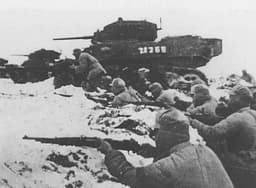
Du Yuming
General · Modern
44.8Total
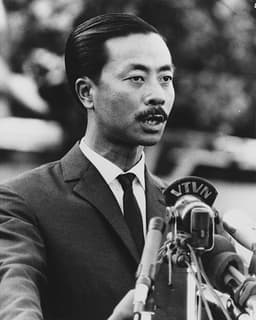
Nguyen Cao Ky
General · Modern
49.0Total
Basic Information
Born
1904
1930
Died
1981
—
Era
Modern
Modern
Nationality
China
Vietnam
Occupation
General
General
Civilization
Eastern
Eastern
Score Comparison
Military (10%)
40.0
45.0
Political (20%)
30.8
39.4
Influence (20%)
49.4
50.2
Legacy (20%)
40.8
40.0
Leadership (15%)
50.7
67.0
Strategy (15%)
60.0
60.0
TOTAL
44.8
49.0
Du Yuming — Complete Timeline
1939 AD
Commanded the KMT Forces in the Battle of Kunlun PassWar◆ Major
Du Yuming commanded the 5th Corps in the Battle of Kunlun Pass against Japanese forces. His troops achieved a tactical victory, recapturing the pass. The battle was one of the few KMT successes in the early phase of the Second Sino-Japanese War.
Second Sino-Japanese WarBattle
Impact: regionalconstructive
1948 AD
Surrendered to the Communists in ManchuriaWar
Du Yuming, as commander of KMT forces in Manchuria, was captured by the People's Liberation Army during the Liaoshen Campaign. He surrendered after his army was encircled and defeated. His capture was a major blow to the KMT in the civil war.
Chinese Civil WarSurrender
Impact: national
1959 AD
Released from Prison and RehabilitatedPolitical Action◆ Major
Du Yuming was released from a Communist prison after being granted a special pardon. He was later appointed to a symbolic post in the Chinese People's Political Consultative Conference. His rehabilitation was part of the CCP's policy toward former KMT officials.
RehabilitationPardon
Impact: nationalconstructive
Nguyen Cao Ky — Complete Timeline
1963 AD
Commander of South Vietnamese Air ForcePolitical Action◆ Major
Nguyen Cao Ky was appointed commander of the Republic of Vietnam Air Force. He led the air force during the Buddhist crisis and participated in the coup that overthrew President Ngo Dinh Diem.
Air ForceCoupDiem
Impact: national
1965 AD
Appointed Prime MinisterPolitical Action◆ Major
Nguyen Cao Ky became Prime Minister of South Vietnam, leading a military junta. His government intensified the war against the Viet Cong and North Vietnam, with strong US support.
Prime MinisterMilitary juntaVietnam War
Impact: national
1967 AD
Conflict with President ThieuPolitical Action
Nguyen Cao Ky ran for president but lost to Nguyen Van Thieu, becoming vice president. The two leaders had a tense relationship, with Ky later accusing Thieu of corruption and mismanagement of the war.
ElectionThieuRivalry
Impact: nationaldestructive
1975 AD
Exile after fall of SaigonPolitical Action◆ Major
Nguyen Cao Ky fled South Vietnam as Saigon fell to North Vietnamese forces. He settled in the United States, where he became a critic of the communist government and later returned to Vietnam for visits.
ExileFall of SaigonVietnam War
Impact: nationaltragic
This comparison has not been analyzed yet.
One-time AI generation (~1 minute). Scores and timeline are already available below.
Rankings
🥇
Nguyen Cao KyLeader
Mil: 45.0Pol: 39.4Inf: 50.2
49.0
🥈
Du Yuming
Mil: 40.0Pol: 30.8Inf: 49.4
44.8
+4.2 behind
How This Comparison Works
Algorithm
Each figure is scored on 6 dimensions (0—100 scale) based on structured historical data: Military (10%), Political (20%), Influence (20%), Legacy (20%), Leadership (15%), Strategy (15%). The weighted total produces the final ranking.
Data Sources
Scores are computed from structured sub-indicators in the database. Scale factors adjust for era (Ancient ×0.85, Modern ×1.0) and civilization size (Eastern ×1.05, Other ×0.80) to account for differences in population and military scale.
Maximum 3 Figures
Comparisons are limited to 2—3 figures to ensure readability and statistical meaningfulness.
Error Margins
±5 points per dimension — Sub-scores are derived from historical records with inherent uncertainty. Two figures within 5 points on a dimension should be considered roughly equivalent in that area.
Total Score Accuracy
±3 points overall — The weighted combination of 6 dimensions produces a total score with approximately ±3 points of uncertainty. Differences of less than 3 points are not statistically significant— the figures are effectively tied.
Known Limitations
- Historical records are incomplete and uneven across civilizations
- Figures from oral-tradition societies may be underrepresented
- Occupation labels can misclassify multi-role figures
- Scores measure capability and impact, not moral character
- Quantitative scoring is a comparison tool, not absolute truth
Capability Radar
Military (10%) — Battles & Warfare
Battles
45
30
Win Rate
30
35
Expansion
25
10
Political (20%) — Governance & Reform
Reform
10
20
Diplomacy
20
25
Economy
15
15
Influence (20%) — Cultural & Global Reach
Cultural
15
15
Global
10
15
Legacy (20%) — Historical Impact
Historical
25
20
Longevity
10
10
Leadership (15%) — Power & Stability
Tenure
35
40
Stability
15
10
Strategy (15%) — Tactics & Innovation
Strategy
40
30
Tactics
55
40
Reform
20
25
Similar Comparisons
Comments & Discussion
No comments yet. Be the first to share your thoughts!