Loading...
This comparison has not been analyzed yet.
One-time AI generation (~1 minute). Scores and timeline are already available below.
Duleep Singh vs Guled Abdi
Duleep Singh leads by 9.1 pts · 2 figures compared
…

Duleep Singh
Emperor · Modern
53.8Total
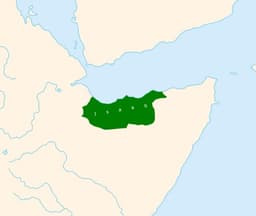
Guled Abdi
Emperor · Modern
44.7Total
Basic Information
Born
1838
1750
Died
1893
1808
Era
Modern
Modern
Nationality
India
Somalia
Occupation
Emperor
Emperor
Civilization
Indian
Other
Score Comparison
Military (10%)
45.8
50.0
Political (20%)
75.1
35.1
Influence (20%)
48.6
48.6
Legacy (20%)
37.5
39.2
Leadership (15%)
74.1
58.8
Strategy (15%)
53.0
36.8
TOTAL
53.8
44.7
Duleep Singh — Complete Timeline
1846 AD
Signing of the Treaty of LahorePolitical Action◆ Major
Duleep Singh, as a child Maharaja, signed the Treaty of Lahore under British pressure. The treaty ceded Kashmir, Hazara, and other territories to the British, and reduced the Sikh Empire to a British protectorate.
TreatyBritish EmpireSikh Empire
Impact: regionaldestructive
1854 AD
Exile to EnglandPolitical Action◆ Major
Duleep Singh was exiled to England by the British East India Company after the annexation of Punjab. He was placed under the guardianship of Sir John Login, converted to Christianity, and became a ward of the British Crown.
ExileBritish EmpireSikh Empire
Impact: nationaltragic
1864 AD
Return to SikhismCultural
Duleep Singh reconverted to Sikhism in a ceremony in England, rejecting Christianity. This act was a personal rebellion against his British guardians and a reassertion of his Sikh identity, though he remained in exile.
Religious ConversionSikhismIdentity
Impact: nationalconstructive
1886 AD
Attempt to Return to IndiaPolitical Action
Duleep Singh attempted to return to India to reclaim his throne, but was arrested by the British in Aden. He was prevented from entering India and forced to return to England, ending his hopes of restoration.
Return AttemptBritish EmpireExile
Impact: nationaltragic
Guled Abdi — Complete Timeline
1750 AD
Foundation of the Isaaq SultanatePolitical Action◆ Major
Guled Abdi established the Isaaq Sultanate, becoming its first sultan. This event created a centralized political entity for the Isaaq clan in the Horn of Africa, consolidating their territory and influence in the region.
FoundingSultanateIsaaq
Impact: regionalconstructive
1760 AD
Consolidation of Isaaq TerritoryWar
Guled Abdi led military campaigns to expand and secure the Isaaq Sultanate's borders, subjugating rival clans and establishing control over key trade routes in the region. This solidified the sultanate's power base.
ExpansionMilitary CampaignIsaaq
Impact: regional
This comparison has not been analyzed yet.
One-time AI generation (~1 minute). Scores and timeline are already available below.
Rankings
🥇
Duleep SinghLeader
Mil: 45.8Pol: 75.1Inf: 48.6
53.8
🥈
Guled Abdi
Mil: 50.0Pol: 35.1Inf: 48.6
44.7
+9.1 behind
How This Comparison Works
Algorithm
Each figure is scored on 6 dimensions (0—100 scale) based on structured historical data: Military (10%), Political (20%), Influence (20%), Legacy (20%), Leadership (15%), Strategy (15%). The weighted total produces the final ranking.
Data Sources
Scores are computed from structured sub-indicators in the database. Scale factors adjust for era (Ancient ×0.85, Modern ×1.0) and civilization size (Eastern ×1.05, Other ×0.80) to account for differences in population and military scale.
Maximum 3 Figures
Comparisons are limited to 2—3 figures to ensure readability and statistical meaningfulness.
Error Margins
±5 points per dimension — Sub-scores are derived from historical records with inherent uncertainty. Two figures within 5 points on a dimension should be considered roughly equivalent in that area.
Total Score Accuracy
±3 points overall — The weighted combination of 6 dimensions produces a total score with approximately ±3 points of uncertainty. Differences of less than 3 points are not statistically significant— the figures are effectively tied.
Known Limitations
- Historical records are incomplete and uneven across civilizations
- Figures from oral-tradition societies may be underrepresented
- Occupation labels can misclassify multi-role figures
- Scores measure capability and impact, not moral character
- Quantitative scoring is a comparison tool, not absolute truth
Capability Radar
Military (10%) — Battles & Warfare
Battles
29
15
Win Rate
34
20
Expansion
33
25
Political (20%) — Governance & Reform
Reform
72
25
Diplomacy
77
30
Economy
80
20
Influence (20%) — Cultural & Global Reach
Cultural
10
20
Global
10
10
Legacy (20%) — Historical Impact
Historical
15
25
Longevity
10
20
Leadership (15%) — Power & Stability
Tenure
69
30
Stability
82
25
Strategy (15%) — Tactics & Innovation
Strategy
39
20
Tactics
41
15
Reform
46
10
Similar Comparisons
Comments & Discussion
No comments yet. Be the first to share your thoughts!