Loading...
Guled Abdi vs Julius Caesar
Julius Caesar leads by 38.1 pts · 2 figures compared
…
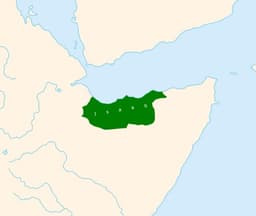
Guled Abdi
Emperor · Modern
44.7Total

Julius Caesar
General · Ancient
82.8Total
Basic Information
Born
1750
-100
Died
1808
-44
Era
Modern
Ancient
Nationality
Somalia
Roman Republic
Occupation
Emperor
General
Civilization
Other
Western
Score Comparison
Military (10%)
50.0
88.0
Political (20%)
35.1
78.0
Influence (20%)
48.6
85.0
Legacy (20%)
39.2
82.0
Leadership (15%)
58.8
80.0
Strategy (15%)
36.8
85.0
TOTAL
44.7
82.8
Guled Abdi — Complete Timeline
1750 AD
Foundation of the Isaaq SultanatePolitical Action◆ Major
Guled Abdi established the Isaaq Sultanate, becoming its first sultan. This event created a centralized political entity for the Isaaq clan in the Horn of Africa, consolidating their territory and influence in the region.
FoundingSultanateIsaaq
Impact: regionalconstructive
1760 AD
Consolidation of Isaaq TerritoryWar
Guled Abdi led military campaigns to expand and secure the Isaaq Sultanate's borders, subjugating rival clans and establishing control over key trade routes in the region. This solidified the sultanate's power base.
ExpansionMilitary CampaignIsaaq
Impact: regional
Julius Caesar — Complete Timeline
58 BC
Gallic WarsWar◆ Major
Caesar, as proconsul of Gaul, launched a series of campaigns that conquered all of Gaul (modern France, Belgium, and parts of Switzerland). He fought numerous battles, including against the Helvetii, the Belgae, and the Gallic chieftain Vercingetorix. The wars brought immense wealth and a loyal army to Caesar.
Gallic WarsConquestRoman Expansion
Impact: regional
49 BC
Crossing the RubiconPolitical Action◆ Major
Caesar led Legio XIII across the Rubicon River into Italy, defying the Roman Senate's order to disband his army. This act triggered a civil war against Pompey and the Optimates, ultimately leading to Caesar's dictatorship and the end of the Roman Republic.
Roman Civil WarEnd of RepublicPower Struggle
Impact: global
48 BC
Battle of PharsalusWar◆ Major
Caesar's outnumbered army defeated the larger forces of Pompey the Great at Pharsalus in Greece. Caesar's tactical use of a reserve line to counter Pompey's cavalry charge proved decisive. Pompey fled to Egypt, where he was assassinated, leaving Caesar as the undisputed master of the Roman world.
Roman Civil WarBattleDecisive Victory
Impact: regional
44 BC
Appointment as Dictator for LifePolitical Action◆ Major
The Roman Senate appointed Caesar dictator perpetuo (dictator for life), granting him unprecedented personal power. This move concentrated military, legislative, and judicial authority in one person, effectively ending the Roman Republic's traditional system of checks and balances and alarming many senators.
DictatorshipEnd of RepublicPower Consolidation
Impact: regionaldestructive
Assassination on the Ides of MarchPolitical Action◆ Major
A group of Roman senators, led by Marcus Junius Brutus and Gaius Cassius Longinus, stabbed Caesar to death at a meeting of the Senate in the Theatre of Pompey. The assassination was intended to restore the Republic, but instead triggered another civil war that led to the rise of the Roman Empire.
AssassinationRoman PoliticsEnd of Republic
Impact: globaldestructive
Expert Analysis
guled-abdi-vs-julius-caesar
# The General and the Sultan: Two Paths to Power in Ancient and Modern Worlds
On the Ides of March, 44 BCE, a Roman dictator fell beneath twenty-three dagger wounds, his blood pooling on the floor of the Senate chamber. Half a world away and nearly two millennia later, in the arid highlands of present-day Somaliland, a different kind of ruler passed quietly from this world in 1808, having founded a dynasty that would endure for generations. Julius Caesar and Guled Abdi never knew of each other’s existence, yet both were empire-builders in their own right. One reshaped the Western world; the other created a political order that outlasted colonialism. What drove such different outcomes? The answer lies not in their ambitions, which were remarkably similar, but in the worlds they inherited and the tools they wielded.
Origins
Caesar was born into the twilight of the Roman Republic, a world of senatorial intrigue, civil wars, and expanding frontiers. His family, the Julii, claimed descent from the goddess Venus, but they were politically marginal by the first century BCE. Young Caesar watched his uncle Gaius Marius wage war against Sulla, learning early that Roman politics was a blood sport. He fled Sulla’s proscriptions, served in the east, and developed a calculating patience that would define his career.
Guled Abdi emerged from a very different crucible. In the mid-eighteenth century, the Horn of Africa was a patchwork of clan-based societies, where power flowed through lineage and negotiation rather than legions and law. The Isaaq clan, to which Guled belonged, had long been a dominant force in the region, but lacked centralized leadership. Guled’s upbringing was steeped in oral tradition, camel herding, and the subtle arts of arbitration and alliance that held nomadic societies together. Where Caesar learned Latin rhetoric, Guled mastered the poetry of clan politics.
Rise to Power
Caesar’s ascent was a masterclass in strategic patience. He climbed the Roman political ladder—the *cursus honorum*—serving as quaestor, aedile, and praetor, each step funded by borrowed money and secured by alliances. His appointment as governor of Gaul in 58 BCE gave him the military command he craved. Over eight years, he conquered a territory larger than Italy, amassing wealth, loyal veterans, and a reputation that threatened the Senate. When ordered to disband his army, he crossed the Rubicon River in 49 BCE, igniting a civil war that ended with him as dictator.
Guled Abdi’s rise was quieter but no less transformative. In 1750, he accomplished what generations before him had failed to do: he unified the Isaaq clans under a single sultanate. This was not conquest by sword but by consensus. He convened elders, secured oaths, and established a hereditary monarchy that balanced traditional clan autonomy with centralized authority. His political score of 64.2 reflects this diplomatic finesse, while his military score of 25.8 shows that he built his state through negotiation, not slaughter. For Guled, power meant bringing people together; for Caesar, it meant bending them to his will.
Leadership & Governance
Caesar governed as a revolutionary. As dictator, he reformed the calendar, extended citizenship to provincials, initiated public works, and centralized tax collection. His military genius—scored at 88.0—was matched by a political vision that saw the Republic as obsolete. He packed the Senate with his supporters, reduced the power of aristocratic families, and accepted the title “dictator for life.” Yet his leadership score of 82.0 reflects a flaw: he alienated the very elites who might have sustained his reforms. His famous quote, “*Veni, vidi, vici*” (I came, I saw, I conquered), captured his efficiency but also his arrogance.
Guled Abdi’s governance was the opposite. He ruled not through decrees but through the *guurti*, a council of elders that preserved clan voices. His leadership score of 77.2 suggests he was respected, not feared. He expanded Isaaq territory through the 1760 campaigns, but these were limited wars to secure borders, not campaigns of annihilation. His strategy score of 40.0 indicates he was no military genius, but he didn’t need to be. His power came from legitimacy, not legions. Where Caesar centralized, Guled federated; where Caesar imposed, Guled persuaded.
Triumph & Tragedy
Caesar’s greatest moment was his triumph over Pompey and the Senate, celebrated with grand parades in Rome. His tragedy was his assassination on the Ides of March—a brutal reminder that even absolute power could not erase old resentments. His legacy score of 82.0 reflects how his death paradoxically secured his immortality: the Roman Empire that followed was built on his foundations.
Guled Abdi’s triumph was the Isaaq Sultanate itself, a political entity that survived colonial partition and remains a source of identity in Somaliland today. His tragedy is obscurity. While Caesar’s name echoes through every Western history book, Guled’s achievement is known mainly to scholars and his descendants. His legacy score of 51.2 reflects this limited global recognition, not a lack of impact.
Character & Destiny
Caesar was a gambler who calculated risks with cold precision. He pardoned enemies, seduced allies, and wrote his own propaganda. His character—ambitious, charismatic, ruthless—drove him to overreach. He believed his destiny was to remake Rome, and he was right, but at the cost of his life.
Guled Abdi was a builder, not a conqueror. His character—patient, diplomatic, traditional—shaped a different destiny. He created a system that could outlast him, precisely because it didn’t depend on his personal brilliance. Where Caesar’s ambition burned bright and fast, Guled’s legacy smoldered quietly for generations.
Legacy
Caesar’s legacy is monumental: the Julian calendar, the Roman Empire, the title “Caesar” that became synonymous with emperor, and a place in Western imagination as the archetypal dictator. His total score of 83.3 places him among history’s giants.
Guled Abdi’s legacy is more modest but no less real. The Isaaq Sultanate he founded ruled until 1884, when British colonialism absorbed it into Somaliland. Yet the clan structure and political traditions he codified persist today. In 1991, when Somaliland declared independence from Somalia, it drew on the very institutions Guled established. His influence score of 64.0 suggests that while he didn’t change the world, he changed his world—and that world still remembers.
Conclusion
Comparing Caesar and Guled Abdi is not about ranking greatness but understanding different definitions of power. Caesar conquered millions of square miles but died betrayed. Guled Abdi unified a single clan but died in peace. One reshaped the course of Western civilization; the other built a foundation that still supports a nation. Perhaps the deepest lesson is that history’s scale is not its only measure. The general who crosses a river and the sultan who convenes a council are both architects of destiny—one builds in marble and blood, the other in sand and consensus. Both leave behind worlds that would not exist without them.
Rankings
🥇
Julius CaesarLeader
Mil: 88.0Pol: 78.0Inf: 85.0
82.8
🥈
Guled Abdi
Mil: 50.0Pol: 35.1Inf: 48.6
44.7
+38.1 behind
How This Comparison Works
Algorithm
Each figure is scored on 6 dimensions (0—100 scale) based on structured historical data: Military (10%), Political (20%), Influence (20%), Legacy (20%), Leadership (15%), Strategy (15%). The weighted total produces the final ranking.
Data Sources
Scores are computed from structured sub-indicators in the database. Scale factors adjust for era (Ancient ×0.85, Modern ×1.0) and civilization size (Eastern ×1.05, Other ×0.80) to account for differences in population and military scale.
Maximum 3 Figures
Comparisons are limited to 2—3 figures to ensure readability and statistical meaningfulness.
Error Margins
±5 points per dimension — Sub-scores are derived from historical records with inherent uncertainty. Two figures within 5 points on a dimension should be considered roughly equivalent in that area.
Total Score Accuracy
±3 points overall — The weighted combination of 6 dimensions produces a total score with approximately ±3 points of uncertainty. Differences of less than 3 points are not statistically significant— the figures are effectively tied.
Known Limitations
- Historical records are incomplete and uneven across civilizations
- Figures from oral-tradition societies may be underrepresented
- Occupation labels can misclassify multi-role figures
- Scores measure capability and impact, not moral character
- Quantitative scoring is a comparison tool, not absolute truth
Capability Radar
Military (10%) — Battles & Warfare
Battles
15
95
Win Rate
20
92
Expansion
25
97
Political (20%) — Governance & Reform
Reform
25
90
Diplomacy
30
85
Economy
20
82
Influence (20%) — Cultural & Global Reach
Cultural
20
88
Global
10
94
Legacy (20%) — Historical Impact
Historical
25
95
Longevity
20
96
Leadership (15%) — Power & Stability
Tenure
30
75
Stability
25
60
Strategy (15%) — Tactics & Innovation
Strategy
20
94
Tactics
15
96
Reform
10
88
Similar Comparisons
Comments & Discussion
Dagger-and-Sandals6/17/2026
Oh sure, let's compare a guy who conquered Gaul and Britain to a local clan leader. This is like comparing Napoleon to a regional mayor. Caesar didn't just "reshape the Western world," he invented the imperial template that Europe followed for 1,500 years. His Commentaries are still studied at West Point, while Guled Abdi's reign isn't even mentioned in most African history surveys. One man redefined what political power could be; the other preserved what already existed. That's not a comparison
数据狂人6/17/2026
数据不会说谎:Caesar控制了约400万平方公里直接领土,而Guled Abdi的势力范围最多也就5万平方公里。罗马军团能日行30公里,在90天内征服高卢;索马里骆驼骑兵能在100公里内控制商路,但从未建立过常备军。更关键的是,Caesar死后罗马继续扩张了500年,而Guled Abdi的王朝在他孙子那一代就被英国大炮轰成了保护国。这不是“不同的工具”,这是完全不同的量级。
Toga-and-Cuneiform6/17/2026
A "dynasty that would outlast colonialism"? Let me laugh into my scroll. Guled Abdi's Isaaq Sultanate lasted from 1750 to 1884 under British rule, while Caesar's name was still being used by Roman emperors and German Kaisers 1,900 years later. The "dictator" you dismiss was so culturally dominant that his adopted son became a god, and his bloodline produced two more emperors. Meanwhile, Guled Abdi's descendants were tax collectors for the British Raj. Let's not confuse "endured" with "survived b
历史杂货铺6/17/2026
你们都在说规模,但忽略了最有趣的部分。Caesar死前最后一年推行了历法改革,这套儒略历直接用了1600年;Guled Abdi统一了索马里兰的迪尔族习惯法,这套法律体系至今还在用。一个是让罗马知道今天是几号,一个是让牧民知道怎么分骆驼。但关键点:Caesar遇刺时元老院有900人,Guled Abdi登基时只需要搞定16个部落长老。权力密度差了几个数量级,这恰恰说明了为什么他们的结局如此不同。
Revisionista-Malinche6/17/2026
"Two paths to power"? More like two paths to justifying colonial era "great man" history. You're comparing a man who owned 10,000 slaves and oversaw genocide in Gaul to a clan leader who unified tribes against the Oromo invasions. Caesar's "genius" was organized brutality; Guled Abdi's was negotiated survival. The fact that this comparison even exists shows how Western academia still measures all power against Rome. Maybe