Loading...
This comparison has not been analyzed yet.
One-time AI generation (~1 minute). Scores and timeline are already available below.
Edmund Allenby vs Maharana Pratap
Edmund Allenby leads by 6.8 pts · 2 figures compared
…

Edmund Allenby
General · Modern
60.6Total
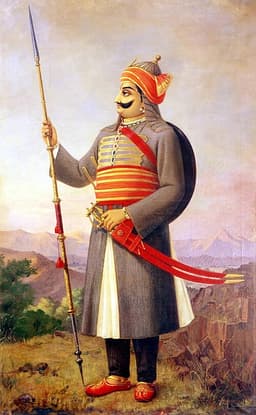
Maharana Pratap
General · Modern
53.8Total
Basic Information
Born
1861
1540
Died
1936
1597
Era
Modern
Modern
Nationality
Great Britain
India
Occupation
General
General
Civilization
Western
Indian
Score Comparison
Military (10%)
78.0
55.0
Political (20%)
53.8
39.4
Influence (20%)
55.0
55.0
Legacy (20%)
55.0
55.0
Leadership (15%)
70.0
64.0
Strategy (15%)
67.2
52.5
TOTAL
60.6
53.8
Edmund Allenby — Complete Timeline
1917 AD
Capture of JerusalemWar◆ Major
Allenby led the Egyptian Expeditionary Force in the capture of Jerusalem from the Ottoman Empire. He entered the city on foot on 11 December 1917, respecting the holy sites. This was the first Christian control of Jerusalem since the Crusades and a major Allied propaganda victory.
World War IMiddle EastJerusalem
Impact: globalconstructive
Third Battle of GazaWar◆ Major
Allenby took command of the Egyptian Expeditionary Force and immediately reorganized it. He launched the Third Battle of Gaza, a combined infantry and cavalry assault that broke the Ottoman defensive line. This victory opened the way for the advance into Palestine and the capture of Jerusalem.
World War IMiddle EastGaza
Impact: regionalconstructive
1918 AD
Battle of MegiddoWar
Allenby commanded the Egyptian Expeditionary Force at the Battle of Megiddo. His forces launched a surprise offensive that broke the Ottoman lines in Palestine. The battle resulted in the destruction of three Ottoman armies and led to the capture of Damascus and Aleppo.
World War IMiddle EastOttoman Empire
Impact: regionalconstructive
Maharana Pratap — Complete Timeline
1572 AD
Refusal to submit to AkbarPolitical Action◆ Major
Maharana Pratap refused to accept Mughal suzerainty under Emperor Akbar, unlike other Rajput rulers. He rejected diplomatic overtures and military pressure. This defiance made him a symbol of Rajput independence and resistance.
DefianceMughal EmpireRajput Pride
Impact: regional
1576 AD
Battle of HaldighatiWar
Maharana Pratap led Rajput forces against the Mughal army under Man Singh of Amber at Haldighati. The battle was indecisive, with both sides claiming victory. Pratap retreated to the hills and continued guerrilla resistance against the Mughals.
Mughal-Rajput WarGuerrilla WarfareResistance
Impact: regional
1585 AD
Recapture of Chittorgarh FortWar◆ Major
Maharana Pratap recaptured the Chittorgarh Fort from the Mughals after a prolonged guerrilla campaign. The fort had been lost to Akbar in 1568. Pratap's forces held the fort temporarily, but it was later abandoned due to Mughal pressure.
VictoryFort RecaptureGuerrilla Campaign
Impact: regionalconstructive
Establishment of new capital at ChavandPolitical Action◆ Major
Maharana Pratap established his new capital at Chavand in the Aravalli hills after losing Chittorgarh. The capital served as a base for his resistance against the Mughals. It remained the capital of Mewar until his death.
Capital EstablishmentResistanceMewar
Impact: regionalconstructive
This comparison has not been analyzed yet.
One-time AI generation (~1 minute). Scores and timeline are already available below.
Rankings
🥇
Edmund AllenbyLeader
Mil: 78.0Pol: 53.8Inf: 55.0
60.6
🥈
Maharana Pratap
Mil: 55.0Pol: 39.4Inf: 55.0
53.8
+6.8 behind
How This Comparison Works
Algorithm
Each figure is scored on 6 dimensions (0—100 scale) based on structured historical data: Military (10%), Political (20%), Influence (20%), Legacy (20%), Leadership (15%), Strategy (15%). The weighted total produces the final ranking.
Data Sources
Scores are computed from structured sub-indicators in the database. Scale factors adjust for era (Ancient ×0.85, Modern ×1.0) and civilization size (Eastern ×1.05, Other ×0.80) to account for differences in population and military scale.
Maximum 3 Figures
Comparisons are limited to 2—3 figures to ensure readability and statistical meaningfulness.
Error Margins
±5 points per dimension — Sub-scores are derived from historical records with inherent uncertainty. Two figures within 5 points on a dimension should be considered roughly equivalent in that area.
Total Score Accuracy
±3 points overall — The weighted combination of 6 dimensions produces a total score with approximately ±3 points of uncertainty. Differences of less than 3 points are not statistically significant— the figures are effectively tied.
Known Limitations
- Historical records are incomplete and uneven across civilizations
- Figures from oral-tradition societies may be underrepresented
- Occupation labels can misclassify multi-role figures
- Scores measure capability and impact, not moral character
- Quantitative scoring is a comparison tool, not absolute truth
Capability Radar
Military (10%) — Battles & Warfare
Battles
75
55
Win Rate
80
60
Expansion
70
20
Political (20%) — Governance & Reform
Reform
50
20
Diplomacy
65
35
Economy
45
20
Influence (20%) — Cultural & Global Reach
Cultural
55
65
Global
65
40
Legacy (20%) — Historical Impact
Historical
70
70
Longevity
60
65
Leadership (15%) — Power & Stability
Tenure
55
45
Stability
60
30
Strategy (15%) — Tactics & Innovation
Strategy
82
60
Tactics
78
65
Reform
60
30
Similar Comparisons
Comments & Discussion
No comments yet. Be the first to share your thoughts!