Loading...
Maharana Pratap vs Napoleon Bonaparte
Napoleon Bonaparte leads by 17.1 pts · 2 figures compared
…
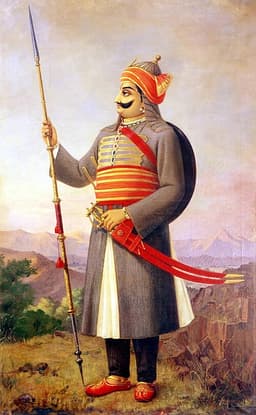
Maharana Pratap
General · Modern
53.8Total

Napoleon Bonaparte
General · Modern
70.9Total
Basic Information
Born
1540
1769
Died
1597
1821
Era
Modern
Modern
Nationality
India
France
Occupation
General
General
Civilization
Indian
Western
Score Comparison
Military (10%)
55.0
94.0
Political (20%)
39.4
72.0
Influence (20%)
55.0
40.0
Legacy (20%)
55.0
80.0
Leadership (15%)
64.0
78.0
Strategy (15%)
52.5
90.0
TOTAL
53.8
70.9
Maharana Pratap — Complete Timeline
1572 AD
Refusal to submit to AkbarPolitical Action◆ Major
Maharana Pratap refused to accept Mughal suzerainty under Emperor Akbar, unlike other Rajput rulers. He rejected diplomatic overtures and military pressure. This defiance made him a symbol of Rajput independence and resistance.
DefianceMughal EmpireRajput Pride
Impact: regional
1576 AD
Battle of HaldighatiWar
Maharana Pratap led Rajput forces against the Mughal army under Man Singh of Amber at Haldighati. The battle was indecisive, with both sides claiming victory. Pratap retreated to the hills and continued guerrilla resistance against the Mughals.
Mughal-Rajput WarGuerrilla WarfareResistance
Impact: regional
1585 AD
Recapture of Chittorgarh FortWar◆ Major
Maharana Pratap recaptured the Chittorgarh Fort from the Mughals after a prolonged guerrilla campaign. The fort had been lost to Akbar in 1568. Pratap's forces held the fort temporarily, but it was later abandoned due to Mughal pressure.
VictoryFort RecaptureGuerrilla Campaign
Impact: regionalconstructive
Establishment of new capital at ChavandPolitical Action◆ Major
Maharana Pratap established his new capital at Chavand in the Aravalli hills after losing Chittorgarh. The capital served as a base for his resistance against the Mughals. It remained the capital of Mewar until his death.
Capital EstablishmentResistanceMewar
Impact: regionalconstructive
Napoleon Bonaparte — Complete Timeline
1799 AD
Coup of 18 BrumaireOther◆ Major
Napoleon Bonaparte, with support from his brother Lucien and key political figures, overthrew the Directory in a bloodless coup. He established the Consulate with himself as First Consul, effectively becoming the ruler of France. This event ended the French Revolution's most unstable period.
French RevolutionCoupRise to Power
Impact: regional
1804 AD
Promulgation of the Napoleonic CodeOther◆ Major
Napoleon enacted the Civil Code of the French, known as the Napoleonic Code, a comprehensive set of laws that replaced the fragmented feudal legal systems. The code established legal equality, protected property rights, and secularized law. It became the basis for legal systems in many European and world countries.
Legal ReformNapoleonic CodeCivil Law
Impact: globalconstructive
1805 AD
Battle of AusterlitzWar◆ Major
Napoleon's Grande Arm
Napoleonic WarsBattleDecisive Victory
Impact: global
1812 AD
Invasion of RussiaWar◆ Major
Napoleon led the Grande Arm
Napoleonic WarsInvasionDisaster
Impact: globaldestructive
1815 AD
Battle of WaterlooWar◆ Major
Napoleon's French army was defeated by the combined forces of the Duke of Wellington's Anglo-Allied army and Gebhard Leberecht von Bl
Napoleonic WarsBattleFinal Defeat
Impact: globaldestructive
Expert Analysis
maharana-pratap-vs-napoleon-bonaparte
# The Emperor and the Rebel: Napoleon and Maharana Pratap
On a June morning in 1815, Napoleon Bonaparte surveyed the muddy fields near Waterloo, his Grande Armée arrayed for what would be his final gamble. Twenty thousand men would die that day, and an empire spanning from Madrid to Warsaw would crumble. Two centuries earlier and half a world away, another warrior-king, Maharana Pratap, rode into the narrow pass of Haldighati on his horse Chetak, facing not a single climactic battle but the grinding reality of guerrilla warfare against an empire that seemed as vast as the Mughal horizon itself. Both men fought against overwhelming odds. One built an empire and lost it; the other lost everything except his honor, and in doing so, built a legend. What drove these two commanders down such different paths?
Origins
Napoleon was born in 1769 on the island of Corsica, a place recently annexed by France, into a minor noble family of Italian origin. His childhood was marked by resentment of French authority and a fierce ambition to rise above his station. He was small, quick-tempered, and brilliant at mathematics and history. The French Revolution shattered the old order just as he was coming of age, creating a world where talent, not birth, could propel a man to the top. He was a child of chaos, and chaos was his element.
Maharana Pratap was born in 1540 in the fortress of Kumbhalgarh, the eldest son of the Sisodia dynasty of Mewar. His world was one of Rajput honor codes, clan loyalties, and the unyielding geography of the Aravalli hills. Unlike Napoleon, who stepped onto a stage cleared by revolution, Pratap inherited a kingdom already under siege. The Mughal emperor Akbar had conquered most of Rajasthan through a combination of military might and diplomatic marriage alliances, absorbing Rajput rulers into his imperial system. Pratap’s father had been forced to flee Chittorgarh, the symbolic heart of Mewar. The young prince grew up knowing that his legacy was not to conquer but to resist.
Rise to Power
Napoleon’s ascent was meteoric. In 1793, at age 24, he drove the British out of Toulon with a brilliant artillery plan. By 1796, he was commanding the Army of Italy, where he won six battles in a year and forced Austria to the peace table. His Italian campaign was a masterclass in speed, deception, and the ruthless concentration of force. In 1799, he returned from Egypt to a France desperate for order, staged a coup, and made himself First Consul. By 1804, he crowned himself Emperor. Every step was a calculated risk, every victory a stepping stone. His genius was not just military: he understood that power in revolutionary France had to be seized, not waited for.
Maharana Pratap became ruler of Mewar in 1572, at age 32, after the death of his father. He inherited a kingdom that had already lost its capital. Akbar sent a series of diplomatic missions, offering Pratap the same terms that had pacified other Rajput kings: recognition of Mughal suzerainty in exchange for autonomy and wealth. Pratap refused. The famous exchange with the Mughal envoy is telling: when asked why he would not submit like the others, he is said to have replied, “I will not bow my head to anyone but God.” His rise was not a conquest of others but a refusal to submit. His path was one of defiance, not ambition.
Leadership & Governance
Napoleon governed with the energy he brought to battle. He reformed France’s legal system with the Napoleonic Code, creating a uniform set of laws that enshrined equality before the law, property rights, and secular administration. He reorganized education, established the Bank of France, and built roads and canals. His rule was efficient, centralized, and modern. But it was also autocratic. He suppressed dissent, censored the press, and placed his family on thrones across Europe. His military genius was inseparable from his political ambition: he fought not to defend France but to dominate Europe.
Maharana Pratap governed from the hills, not the palace. After losing Chittorgarh, he established a new capital at Chavand in 1585, deep in the Aravalli range. His rule was defined by guerrilla warfare: hit-and-run attacks on Mughal supply lines, ambushes in mountain passes, and the slow, patient work of rebuilding a shattered kingdom. He had no code to write, no empire to administer. His leadership was personal, tribal, and symbolic. He ate simple food, slept on the ground, and shared the hardships of his men. His political wisdom was not in building institutions but in maintaining the morale of a people who had lost everything.
Triumph & Tragedy
Napoleon’s greatest moment was Austerlitz in 1805, where he crushed the combined armies of Russia and Austria in a battle so perfect it became a textbook example of military art. His tragedy was the invasion of Russia in 1812, a campaign that destroyed his Grande Armée and broke the myth of his invincibility. He was exiled to Elba, returned for a hundred days, and was finally defeated at Waterloo in 1815. His death in exile on Saint Helena in 1821 was lonely and bitter.
Maharana Pratap’s greatest moment was the Battle of Haldighati in 1576. It was not a clear victory: both sides claimed success, and Pratap was wounded and forced to retreat. But he survived, and survival was triumph. His tragedy was that he never recaptured Chittorgarh, never restored Mewar to its former glory. He died in 1597 at age 56, still a fugitive king in his own land. Yet his son Amar Singh continued the resistance, and in 1616, the Mughals finally recognized Mewar’s autonomy. The war that Pratap began outlasted him.
Character & Destiny
Napoleon was a man of relentless will, convinced that he was the instrument of history. “Impossible is a word to be found only in the dictionary of fools,” he once said. His ambition was boundless, and his confidence in his own genius was absolute. This made him unstoppable in victory but incapable of compromise in defeat. He could not share power, could not retreat, could not accept limits. His character drove him to conquer Europe, and his character drove him to lose it.
Maharana Pratap was a man of stubborn honor. He could have submitted, as others did, and lived in comfort. He chose poverty and resistance. His refusal to compromise was not strategic wisdom—it cost him his kingdom, his family, and nearly his life. But it was a choice rooted in a code of honor that valued dignity above survival. He was not a political genius; he was a moral one. His destiny was not to win but to endure.
Legacy
Napoleon is remembered as one of the greatest military commanders in history, a reformer who modernized Europe, and a cautionary tale about the dangers of unchecked ambition. His name is on battlefields, codes of law, and the very idea of the modern state. He shaped the nineteenth century.
Maharana Pratap is remembered as a symbol of resistance, a king who would not bow. In Rajasthan, his name is spoken with reverence. He is the hero of folk songs, the subject of paintings, the embodiment of Rajput pride. His legacy is not in territory or institutions but in identity. He gave his people a story to tell themselves.
Conclusion
Two men, two worlds, two kinds of greatness. Napoleon built an empire and lost it; Pratap lost a kingdom and built a legend. One shaped the world through conquest, the other through refusal. Their lives remind us that history measures success in many currencies: power, legacy, honor, memory. Napoleon’s shadow stretches across the maps of Europe. Pratap’s shadow falls on the hills of Mewar, where children still hear the story of the king who would not kneel. Both shadows, in their own way, are long.
Rankings
🥇
Napoleon BonaparteLeader
Mil: 94.0Pol: 72.0Inf: 40.0
70.9
🥈
Maharana Pratap
Mil: 55.0Pol: 39.4Inf: 55.0
53.8
+17.1 behind
How This Comparison Works
Algorithm
Each figure is scored on 6 dimensions (0—100 scale) based on structured historical data: Military (10%), Political (20%), Influence (20%), Legacy (20%), Leadership (15%), Strategy (15%). The weighted total produces the final ranking.
Data Sources
Scores are computed from structured sub-indicators in the database. Scale factors adjust for era (Ancient ×0.85, Modern ×1.0) and civilization size (Eastern ×1.05, Other ×0.80) to account for differences in population and military scale.
Maximum 3 Figures
Comparisons are limited to 2—3 figures to ensure readability and statistical meaningfulness.
Error Margins
±5 points per dimension — Sub-scores are derived from historical records with inherent uncertainty. Two figures within 5 points on a dimension should be considered roughly equivalent in that area.
Total Score Accuracy
±3 points overall — The weighted combination of 6 dimensions produces a total score with approximately ±3 points of uncertainty. Differences of less than 3 points are not statistically significant— the figures are effectively tied.
Known Limitations
- Historical records are incomplete and uneven across civilizations
- Figures from oral-tradition societies may be underrepresented
- Occupation labels can misclassify multi-role figures
- Scores measure capability and impact, not moral character
- Quantitative scoring is a comparison tool, not absolute truth
Capability Radar
Military (10%) — Battles & Warfare
Battles
55
95
Win Rate
60
90
Expansion
20
95
Political (20%) — Governance & Reform
Reform
20
95
Diplomacy
35
80
Economy
20
85
Influence (20%) — Cultural & Global Reach
Cultural
65
85
Global
40
90
Legacy (20%) — Historical Impact
Historical
70
95
Longevity
65
90
Leadership (15%) — Power & Stability
Tenure
45
85
Stability
30
70
Strategy (15%) — Tactics & Innovation
Strategy
60
95
Tactics
65
98
Reform
30
92
Similar Comparisons
Comments & Discussion
Chakravyuh Strategist6/17/2026
Waterloo was a catastrophic mismatch of logistics vs. genius—Napoleon had 72,000 men and 246 guns against Wellington's 68,000 with 156 pieces, but Blücher's 48,000 Prussians arriving by dusk sealed it. Pratap's Haldighati was a tactical draw with 20,000 Rajputs vs 80,000 Mughals, yet he fought on for 25 years in the Aravallis. Napoleon lost in a day because his system crumbled—Pratap won for centuries because his kingdom became a ghost.
数据学者刀客6/17/2026
拿什么比?拿破仑打了几十场战役,数据从奥斯特里茨到博罗季诺全有案可查,平均每战伤亡率12%,而普拉塔普的哈尔迪加蒂之战,双方宣称的数字差了三倍,谁知道真实兵力是多少?Mughal记录说20万Rajputs死了15000,但Rajput民谣说只有3000。拿破仑的数据是欧洲官僚的墨水,普拉塔普的是沙漠里的诗——我信哪个?后者连个像样的军需官都没留。
Fortress & Field Duality6/17/2026
Compare a chess player to a boxer. Napoleon mastered the "battle of annihilation"—Austerlitz in 1805, where he crushed 85,000 Austro-Russians with 73,000 men, losing only 9,000 to their 27,000. Pratap never won a single set-piece battle after Haldighati—his "victory" was outrunning Akbar's 200,000-strong army in the desert for decades. One built a pyramid of corpses for an empire, the other survived by turning his kingdom into a thorn. Both legends, but radically different definitions of victory
少林与凯旋门6/17/2026
拿破仑打了53场大战,死了50万人,最后被关在大西洋的岛上了此残生。普拉塔普呢?他死在自己领地的洞里,身边是家人,连敌人都尊重他。Akbar的宰相Abul Fazl写他"宁死不屈",而拿破仑的滑铁卢败后,曾向英国人写信求饶,求他们别杀他。一个向敌人低头求命的皇帝,跟一个啃树皮都不投降的王——你是要传奇的奥斯特里茨,还是一个脚踏实地的灵魂?
Revisionist's Lens6/17/2026
Stop romanticizing Pratap as some underdog—he was a landed aristocrat who started with 8 major forts and lost 7 to Akbar within a decade. Napoleon rose from Corsican minor nobility to crown himself Emperor, rewriting European borders with the Civil Code. Pratap's "guerrilla war" was mostly fleeing—his own horse died from exhaustion. Napoleon's cavalry at Eylau