Loading...
Eduard Shevardnadze vs Marcelo Rebelo de Sousa
Eduard Shevardnadze leads by 3.9 pts · 2 figures compared
…
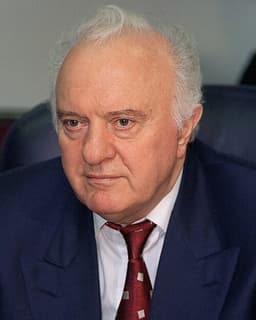
Eduard Shevardnadze
Politician · Modern
57.7Total

Marcelo Rebelo de Sousa
Politician · Modern
53.8Total
Basic Information
Born
1928
1948
Died
—
—
Era
Modern
Modern
Nationality
Georgia
Portugal
Occupation
Politician
Politician
Civilization
Western
Western
Score Comparison
Military (10%)
50.0
50.0
Political (20%)
70.0
68.0
Influence (20%)
55.0
53.3
Legacy (20%)
56.0
40.8
Leadership (15%)
68.0
72.0
Strategy (15%)
42.1
42.8
TOTAL
57.7
53.8
Eduard Shevardnadze — Complete Timeline
1985 AD
Appointed Soviet Foreign MinisterPolitical Action◆ Major
Mikhail Gorbachev appointed Shevardnadze as Soviet Foreign Minister. Shevardnadze played a key role in shaping the 'New Thinking' foreign policy, which emphasized de-escalation of the Cold War, arms reduction agreements, and improved relations with the West.
Cold WarSoviet UnionDiplomacy
Impact: globalconstructive
1987 AD
Signed the Intermediate-Range Nuclear Forces TreatyPolitical Action
Shevardnadze, as Soviet Foreign Minister, signed the INF Treaty with U.S. Secretary of State George Shultz. The treaty eliminated an entire class of nuclear missiles (500-5,500 km range) from Europe, marking a major step in ending the Cold War.
Nuclear Arms ControlCold WarTreaty
Impact: globalconstructive
1990 AD
Resigned as Soviet Foreign MinisterPolitical Action◆ Major
Shevardnadze resigned as Soviet Foreign Minister, warning of an impending dictatorship under Gorbachev. His resignation was a dramatic protest against the conservative backlash and the slow pace of reforms, highlighting the internal crisis of the Soviet Union.
Soviet UnionResignationPolitical Crisis
Impact: nationaltragic
1992 AD
Elected Chairman of the Georgian ParliamentPolitical Action◆ Major
After the ouster of President Zviad Gamsakhurdia, Shevardnadze returned to Georgia and was elected Chairman of the Parliament, effectively becoming the head of state. He was tasked with stabilizing the country amid civil war and economic collapse.
GeorgiaPost-SovietLeadership
Impact: national
1995 AD
Survived Assassination AttemptPolitical Action◆ Major
Shevardnadze survived a car bomb assassination attempt in Tbilisi. The attack, which killed several people, was widely attributed to opponents of his policies. It underscored the violent political struggles in post-Soviet Georgia.
Assassination AttemptGeorgiaViolence
Impact: nationaltragic
2003 AD
Rose RevolutionPolitical Action
Shevardnadze was forced to resign as President of Georgia following the Rose Revolution, a peaceful protest against disputed parliamentary elections. The revolution, led by Mikheil Saakashvili, ended Shevardnadze's rule and ushered in a new pro-Western government.
RevolutionGeorgiaRegime Change
Impact: national
Marcelo Rebelo de Sousa — Complete Timeline
2015 AD
Constitutional Role in Government FormationPolitical Action◆ Major
As president-elect, Marcelo Rebelo de Sousa played a key role in forming a government after the 2015 election. He appointed Ant
GovernmentConstitutionDemocracy
Impact: nationalconstructive
2016 AD
Elected President of PortugalPolitical Action◆ Major
Marcelo Rebelo de Sousa won the Portuguese presidential election with 52% of the vote. He succeeded An
ElectionPresidency
Impact: nationalconstructive
2020 AD
COVID-19 Pandemic ResponsePolitical Action◆ Major
Marcelo Rebelo de Sousa used his presidential powers to declare states of emergency during the COVID-19 pandemic. He supported the government's lockdown measures and gave regular addresses to the nation, promoting unity.
PandemicLeadershipCrisis
Impact: nationalconstructive
2021 AD
Re-election as PresidentPolitical Action◆ Major
Marcelo Rebelo de Sousa was re-elected with 60.7% of the vote in the first round. His victory reflected broad public support for his consensual style and handling of the COVID-19 pandemic.
ElectionRe-election
Impact: nationalconstructive
Expert Analysis
Origins
Eduard Shevardnadze was born on January 25, 1928, in Mamati, Georgia, into a peasant family. He joined the Communist Party and rose through the ranks, serving as First Secretary of the Georgian Communist Party from 1972 to 1985. His early career focused on combating corruption, which earned him a reputation as a reformer. Marcelo Rebelo de Sousa was born on December 12, 1948, in Lisbon, Portugal, into a prominent political family. His father was a minister under the Estado Novo regime. He studied law at the University of Lisbon and became a professor, journalist, and political commentator. His academic background shaped his analytical approach to politics.
Rise to Power
Shevardnadze's rise accelerated when Mikhail Gorbachev appointed him Soviet Foreign Minister in 1985, scoring 70.0 in political acumen. He became the architect of 'New Thinking' foreign policy, which prioritized de-escalation with the West. His key turning point was signing the Intermediate-Range Nuclear Forces Treaty in 1987 with U.S. Secretary of State George Shultz, eliminating an entire class of nuclear weapons. After the Soviet collapse, he returned to Georgia and was elected Chairman of Parliament in 1992, later becoming President in 1995. Rebelo de Sousa's rise was more gradual. He entered politics as a member of the Social Democratic Party, serving as a minister in the 1980s and as party leader. His breakthrough came in the 2016 presidential election, winning 52% of the vote as an independent. His consensual style, scoring 72.0 in leadership, helped him navigate Portugal's coalition politics.
Leadership & Governance
Shevardnadze's leadership combined reformist ideals with pragmatic governance. As Soviet Foreign Minister, he pursued arms control and détente, but his domestic governance in Georgia was marred by corruption and economic stagnation. He scored 42.1 in strategy, reflecting his inability to consolidate democratic reforms. Rebelo de Sousa, by contrast, excels in consensus-building. He uses his presidency to mediate between parties, as seen in his role in forming the government after the 2015 election by appointing António Costa as Prime Minister. His COVID-19 response, declaring states of emergency, scored well in leadership but his influence remains constrained by Portugal's semi-presidential system.
Triumph & Tragedy
Shevardnadze's greatest triumph was the INF Treaty, a landmark in arms control that reduced Cold War tensions. He also played a crucial role in German reunification. However, his tragedy was the Rose Revolution in 2003, where he was forced to resign due to disputed elections and public protests. His failure to build transparent institutions led to his downfall. Rebelo de Sousa's triumphs include his re-election with 60.7% of the vote, a testament to his popularity. He effectively managed the constitutional crisis during the pandemic. His tragedy is limited: his legacy is tied to a stable but unremarkable presidency, scoring 40.8 in legacy. He has not faced major crises, but his impact is less transformative.
Character & Destiny
Shevardnadze was a pragmatic reformer, willing to take risks for peace. His decision to resign as Soviet Foreign Minister in 1990, warning of dictatorship, showed moral conviction. However, his tolerance of corruption in Georgia tarnished his image. Historical assessments view him as a transitional figure who dismantled the Soviet system but failed to build a new one. Rebelo de Sousa is a cautious consensus-seeker, using his academic background to analyze situations. His character fits Portugal's stable democracy, where moderation is valued. He avoids confrontation, which limits his transformative potential.
Legacy
Shevardnadze's legacy is global: he helped end the Cold War, with the INF Treaty serving as a model for arms control. In Georgia, he is remembered as the father of independence but also as a leader who allowed cronyism. His overall score of 57.7 reflects his mixed impact. Rebelo de Sousa's legacy is national: he strengthened Portugal's democratic institutions through his consensual style. However, his influence is modest compared to Shevardnadze's world-altering actions. His score of 53.8 indicates a competent but less impactful career.
Conclusion
While Rebelo de Sousa excels in leadership within a stable democracy, Shevardnadze's influence on global history is far greater. Shevardnadze scored 57.7 overall to Rebelo de Sousa's 53.8, but the gap in legacy is wider: Shevardnadze's actions reshaped international relations, while Rebelo de Sousa maintained the status quo. Therefore, Eduard Shevardnadze had a more significant impact on world history.
Rankings
🥇
Eduard ShevardnadzeLeader
Mil: 50.0Pol: 70.0Inf: 55.0
57.7
🥈
Marcelo Rebelo de Sousa
Mil: 50.0Pol: 68.0Inf: 53.3
53.8
+3.9 behind
How This Comparison Works
Algorithm
Each figure is scored on 6 dimensions (0—100 scale) based on structured historical data: Military (10%), Political (20%), Influence (20%), Legacy (20%), Leadership (15%), Strategy (15%). The weighted total produces the final ranking.
Data Sources
Scores are computed from structured sub-indicators in the database. Scale factors adjust for era (Ancient ×0.85, Modern ×1.0) and civilization size (Eastern ×1.05, Other ×0.80) to account for differences in population and military scale.
Maximum 3 Figures
Comparisons are limited to 2—3 figures to ensure readability and statistical meaningfulness.
Error Margins
±5 points per dimension — Sub-scores are derived from historical records with inherent uncertainty. Two figures within 5 points on a dimension should be considered roughly equivalent in that area.
Total Score Accuracy
±3 points overall — The weighted combination of 6 dimensions produces a total score with approximately ±3 points of uncertainty. Differences of less than 3 points are not statistically significant— the figures are effectively tied.
Known Limitations
- Historical records are incomplete and uneven across civilizations
- Figures from oral-tradition societies may be underrepresented
- Occupation labels can misclassify multi-role figures
- Scores measure capability and impact, not moral character
- Quantitative scoring is a comparison tool, not absolute truth
Capability Radar
Military (10%) — Battles & Warfare
Battles
26
28
Win Rate
31
32
Expansion
36
35
Political (20%) — Governance & Reform
Reform
80
45
Diplomacy
85
55
Economy
40
50
Influence (20%) — Cultural & Global Reach
Cultural
40
30
Global
65
30
Legacy (20%) — Historical Impact
Historical
70
25
Longevity
50
20
Leadership (15%) — Power & Stability
Tenure
75
60
Stability
30
60
Strategy (15%) — Tactics & Innovation
Strategy
35
39
Tactics
40
39
Reform
46
45
Similar Comparisons
Comments & Discussion
No comments yet. Be the first to share your thoughts!