Loading...
Edward III of England vs John of Denmark
Edward III of England leads by 16.8 pts · 2 figures compared
…
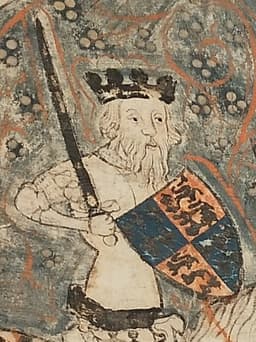
Edward III of England
Emperor · Medieval
60.9Total

John of Denmark
Emperor · Medieval
44.1Total
Basic Information
Born
1312
1455
Died
1377
1513
Era
Medieval
Medieval
Nationality
England
Denmark
Occupation
Emperor
Emperor
Civilization
Western
Western
Score Comparison
Military (10%)
72.0
45.0
Political (20%)
55.0
36.5
Influence (20%)
65.0
50.2
Legacy (20%)
40.0
41.7
Leadership (15%)
79.8
48.4
Strategy (15%)
72.0
38.6
TOTAL
60.9
44.1
Edward III of England — Complete Timeline
1337 AD
Start of the Hundred Years' WarWar
Edward III declared himself King of France, challenging Philip VI's claim. This began the Hundred Years' War, a prolonged conflict over the French throne and English territories in France.
WarFranceSuccession
Impact: global
1346 AD
Battle of CrécyWar◆ Major
Edward III's English army defeated a larger French force at the Battle of Cr
BattleLongbowFrance
Impact: regional
Siege of CalaisWar◆ Major
Edward III besieged the French port of Calais for nearly a year. The city surrendered, and Edward took control, making it an English stronghold for over two centuries.
SiegeCalaisFrance
Impact: regional
1356 AD
Battle of PoitiersWar◆ Major
Edward III's son, the Black Prince, defeated and captured King John II of France at the Battle of Poitiers. This victory led to the Treaty of Br
BattleCapture of KingTreaty
Impact: regional
1360 AD
Treaty of BrétignyPolitical Action◆ Major
Edward III signed the Treaty of Br
TreatyPeaceTerritorial Gains
Impact: regionalconstructive
John of Denmark — Complete Timeline
1397 AD
Union of Kalmar TreatyPolitical Action◆ Major
John of Denmark became king of the Kalmar Union, which united Denmark, Norway, and Sweden under a single monarch. The union was already weakened by internal conflicts. John's reign saw continued tensions with Swedish nobility who resisted central authority, leading to periodic rebellions.
Kalmar UnionMonarchyScandinavia
Impact: regional
1471 AD
Battle of BrunkebergWar◆ Major
John of Denmark led Danish forces against Swedish regent Sten Sture the Elder at Brunkeberg near Stockholm. The Danish army was defeated, and John failed to reclaim the Swedish throne. This battle solidified Swedish resistance to the Kalmar Union and delayed Danish control over Sweden.
BattleKalmar UnionSwedish Rebellion
Impact: regionaldestructive
1509 AD
Treaty of CopenhagenPolitical Action
John of Denmark signed the Treaty of Copenhagen with the Hanseatic League, ending a trade war. The treaty granted the Hanseatic League favorable trading rights in the Baltic, weakening Danish economic control. This agreement reflected John's inability to assert Danish dominance over the powerful league.
TreatyHanseatic LeagueTrade
Impact: regional
Expert Analysis
Origins
Edward III was born on 13 November 1312 at Windsor Castle, the son of Edward II and Isabella of France. His father's weak rule and deposition in 1327 shaped his early years. Edward III was raised in a court riven by factionalism, learning the art of political maneuvering from his mother and her lover Roger Mortimer. He assumed effective control in 1330 after executing Mortimer.
John of Denmark was born on 2 February 1455 at Aalborg, the son of Christian I and Dorothea of Brandenburg. He was educated in the traditions of the Kalmar Union, which his father had worked to maintain. John inherited a union of Denmark, Norway, and Sweden, but the union was already fraying due to Swedish resentment of Danish dominance. His early life was marked by the need to balance the interests of these disparate kingdoms.
Rise to Power
Edward III's rise began with his coup against Mortimer in 1330 at the age of 17. He swiftly consolidated power, executing Mortimer and confining his mother. He then turned to foreign policy, seeking to reclaim territories lost by his father. In 1337, he declared himself King of France, challenging Philip VI's claim and initiating the Hundred Years' War. This bold move unified English nobility behind him and provided a cause that would define his reign.
John of Denmark ascended the throne in 1481 upon his father's death. He was already co-ruler of Denmark and Norway from 1470. His main challenge was the recalcitrant Swedish nobility, who resisted Danish control. In 1483, he was crowned King of Sweden after negotiations with Sten Sture the Elder, but his authority remained weak. John's rise was not marked by military triumph but by political compromise, as the Kalmar Union required constant negotiation.
Leadership & Governance
Edward III was a hands-on military leader who personally commanded campaigns. He fostered a strong sense of national identity, using Parliament to gain support for his wars. He established the Order of the Garter in 1348 to bind his knights to his cause. His governance was focused on war finance, with taxes and wool trade revenues funding the conflict. He also appointed capable lieutenants like his son, the Black Prince.
John of Denmark governed through a council system, relying on noble support. He attempted to strengthen royal authority by centralizing administration, but faced opposition from the Hanseatic League and Swedish separatists. In 1497, he led an expedition to Sweden and defeated Sten Sture at the Battle of Rotebro, briefly restoring union. However, his rule was marked by concession: the Treaty of Copenhagen (1501) granted trade privileges to the Hanseatic League, weakening his economic control.
Triumph & Tragedy
Edward III's greatest triumph was the Treaty of Brétigny in 1360, which secured English control over Aquitaine and other territories, along with a ransom for the captured French king. His military victories at Crécy (1346) and Poitiers (1356) demonstrated the effectiveness of the English longbow, with English casualties at Crécy estimated at 300 against 13,000 French. However, his later years saw the renewal of war and loss of territories due to French resurgence under Charles V. The death of the Black Prince in 1376 plunged Edward into grief, and he died in 1377, his conquests slipping away.
John of Denmark's triumph was the brief reassertion of union authority after the Battle of Rotebro in 1497, where he captured Stockholm and was crowned King of Sweden. But his tragedy was the collapse of that control: a rebellion in 1501 led by Sten Sture the Younger forced him to flee Sweden, and he never recovered. The Kalmar Union effectively dissolved after his reign, with Sweden becoming independent. His legacy is one of failed centralization.
Character & Destiny
Edward III was energetic, charismatic, and personally brave. He was also pragmatic, willing to negotiate when necessary, as at Brétigny. His character shaped his destiny: his military ambition led to a war that exhausted England but also forged a national identity. Historians often rate his leadership highly; in the scoring system, he scored 79.8 in leadership and 72.0 in military, reflecting his effective command.
John of Denmark was cautious and diplomatic, but lacked the military prowess to enforce his will. His political score of 36.5 reflects his inability to maintain the union. He was more a manager than a warrior, and his destiny was to preside over the decline of a union he could not hold together. His strategy score of 38.6 indicates a failure to adapt to the challenges of Swedish separatism.
Legacy
Edward III's legacy is immense. The Hundred Years' War transformed English and French societies, and the English longbow became a symbol of military innovation. The Treaty of Brétigny set precedents for territorial sovereignty. His creation of the Order of the Garter influenced chivalric orders. In the scoring, his influence score of 65.0 and legacy of 40.0 reflect long-term impact, though his gains were temporary.
John of Denmark's legacy is more limited. He is remembered as the last king of a unified Kalmar Union, which collapsed after his reign. His concessions to the Hanseatic League weakened Scandinavian economic independence. His influence score of 50.2 reflects his role in union history, but his legacy score of 41.7 shows little enduring impact.
Conclusion
Edward III had a far greater impact than John of Denmark. His total score of 60.9 versus John's 44.1 reflects this. Edward's military and leadership scores (72.0 and 79.8) dwarf John's (45.0 and 48.4). While Edward's territorial gains were temporary, the Hundred Years' War reshaped European politics and national identities. John's failure to preserve the Kalmar Union left Scandinavia fragmented. Edward III was the more consequential monarch, his actions echoing through centuries.
Rankings
🥇
Edward III of EnglandLeader
Mil: 72.0Pol: 55.0Inf: 65.0
60.9
🥈
John of Denmark
Mil: 45.0Pol: 36.5Inf: 50.2
44.1
+16.8 behind
How This Comparison Works
Algorithm
Each figure is scored on 6 dimensions (0—100 scale) based on structured historical data: Military (10%), Political (20%), Influence (20%), Legacy (20%), Leadership (15%), Strategy (15%). The weighted total produces the final ranking.
Data Sources
Scores are computed from structured sub-indicators in the database. Scale factors adjust for era (Ancient ×0.85, Modern ×1.0) and civilization size (Eastern ×1.05, Other ×0.80) to account for differences in population and military scale.
Maximum 3 Figures
Comparisons are limited to 2—3 figures to ensure readability and statistical meaningfulness.
Error Margins
±5 points per dimension — Sub-scores are derived from historical records with inherent uncertainty. Two figures within 5 points on a dimension should be considered roughly equivalent in that area.
Total Score Accuracy
±3 points overall — The weighted combination of 6 dimensions produces a total score with approximately ±3 points of uncertainty. Differences of less than 3 points are not statistically significant— the figures are effectively tied.
Known Limitations
- Historical records are incomplete and uneven across civilizations
- Figures from oral-tradition societies may be underrepresented
- Occupation labels can misclassify multi-role figures
- Scores measure capability and impact, not moral character
- Quantitative scoring is a comparison tool, not absolute truth
Capability Radar
Military (10%) — Battles & Warfare
Battles
85
25
Win Rate
80
30
Expansion
85
20
Political (20%) — Governance & Reform
Reform
70
30
Diplomacy
75
35
Economy
70
30
Influence (20%) — Cultural & Global Reach
Cultural
70
25
Global
70
15
Legacy (20%) — Historical Impact
Historical
80
30
Longevity
75
20
Leadership (15%) — Power & Stability
Tenure
85
40
Stability
65
20
Strategy (15%) — Tactics & Innovation
Strategy
90
25
Tactics
85
20
Reform
75
15
Similar Comparisons
Comments & Discussion
No comments yet. Be the first to share your thoughts!