Loading...
Edward VI of England vs George III
George III leads by 8.4 pts · 2 figures compared
…
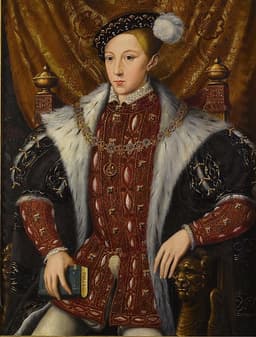
Edward VI of England
Emperor · Modern
43.8Total

George III
Emperor · Modern
52.2Total
Basic Information
Born
1537
1738
Died
1553
1820
Era
Modern
Modern
Nationality
England
United Kingdom
Occupation
Emperor
Emperor
Civilization
Western
Western
Score Comparison
Military (10%)
19.3
22.6
Political (20%)
42.2
61.3
Influence (20%)
51.8
56.7
Legacy (20%)
43.3
52.0
Leadership (15%)
38.1
66.0
Strategy (15%)
60.0
36.8
TOTAL
43.8
52.2
Edward VI of England — Complete Timeline
1547 AD
Coronation of Edward VIPolitical Action◆ Major
Edward VI was crowned king of England at age nine, succeeding his father Henry VIII. His reign was dominated by regents, first Edward Seymour, Duke of Somerset, and later John Dudley, Duke of Northumberland.
CoronationMinor KingTudor
Impact: national
1549 AD
Act of Uniformity 1549Reform◆ Major
Edward VI's government passed the Act of Uniformity, imposing the Book of Common Prayer in English. This reform advanced the Protestant Reformation in England, replacing Latin services with English ones and standardizing worship.
ReformationReligionLiturgy
Impact: nationalprogressive
1553 AD
Forty-Two ArticlesReform◆ Major
Edward VI's government issued the Forty-Two Articles, defining the doctrinal basis of the Church of England. These articles were more Protestant than earlier reforms, but were repealed after Edward's death under Mary I.
ReformationDoctrineChurch of England
Impact: nationalprogressive
Devise for the SuccessionPolitical Action
Edward VI, on his deathbed, drafted a will excluding his half-sisters Mary and Elizabeth from the succession, naming Lady Jane Grey as his heir. This attempt to maintain Protestant rule failed after his death, leading to Mary I's accession.
SuccessionProtestantCrisis
Impact: national
George III — Complete Timeline
1775 AD
American Revolutionary WarWar
George III's reign saw the outbreak of the American Revolutionary War after colonial protests against British taxation. Britain lost the war after the French intervention. The Treaty of Paris in 1783 recognized American independence, ending British control of the Thirteen Colonies.
American RevolutionLoss of ColoniesTreaty of Paris
Impact: globaldestructive
1800 AD
Acts of Union 1800Political Action◆ Major
George III gave royal assent to the Acts of Union, which united Great Britain and Ireland into the United Kingdom of Great Britain and Ireland. This created a single parliament in London and ended the Irish Parliament. The union took effect on January 1, 1801.
UnionIrelandConstitutional Change
Impact: nationalconstructive
1803 AD
Napoleonic WarsWar◆ Major
George III's reign included the Napoleonic Wars against France under Napoleon Bonaparte. Britain fought coalitions across Europe and at sea. The wars ended with Napoleon's defeat at Waterloo in 1815, establishing British naval supremacy and colonial expansion.
Napoleonic WarsWaterlooEuropean Conflict
Impact: global
1810 AD
Mental Illness and Regency CrisisOther◆ Major
George III suffered a final relapse of mental illness, likely due to porphyria. He became permanently incapacitated, leading to the Regency Act of 1811. His son George IV became Prince Regent, ruling in his stead until George III's death in 1820.
Mental IllnessRegencySuccession
Impact: nationaltragic
1820 AD
Death at Windsor CastleOther◆ Major
George III died at Windsor Castle at age 81, blind and deaf. He was buried in St George's Chapel. His 60-year reign was the longest of any British monarch at that time. His death ended the Regency era and passed the throne to George IV.
DeathLong ReignMonarchy
Impact: nationaltragic
Expert Analysis
Origins
Edward VI was born on October 12, 1537, at Hampton Court Palace, the long-awaited male heir of Henry VIII and his third wife, Jane Seymour. His mother died shortly after his birth. Edward was educated by leading Protestant scholars, including John Cheke and Richard Cox, and was raised in a humanist and Reformed tradition. He was precocious, fluent in Latin and Greek, and deeply committed to Protestant theology. His half-sisters Mary (Catholic) and Elizabeth (moderate Protestant) were excluded from the succession under Henry's will, but Edward's own views would later override that.
George III was born on June 4, 1738, in London, the first British monarch of the House of Hanover to be born in Britain and speak English as his first language. His father, Frederick, Prince of Wales, died in 1751, making George heir at age 12. He was educated by tutors and developed a strong sense of duty and moral rectitude. He was shy and conscientious, with a passion for agriculture and science. Unlike Edward, George was raised in a stable family environment, though his relationship with his mother and her favorite, Lord Bute, influenced his early reign.
Rise to Power
Edward became king at age nine on January 28, 1547, upon Henry VIII's death. A regency council was established by Henry's will, but Edward's maternal uncle, Edward Seymour, 1st Duke of Somerset, quickly seized power as Lord Protector. Edward's role was largely ceremonial, but he was an active participant in religious debates and supported the Reformation. In 1549, after Somerset's fall, John Dudley, Duke of Northumberland, took control. Edward's health was fragile, and by 1553 he was dying of tuberculosis.
George III ascended the throne on October 25, 1760, at age 22, following his grandfather George II's death. He was the first Hanoverian king to identify as British. He sought to assert royal authority after years of Whig dominance, appointing his former tutor Lord Bute as Prime Minister. This led to political instability and conflict with the powerful Whig factions. His determination to maintain royal prerogative set the stage for the American Revolution.
Leadership & Governance
Edward's reign was dominated by regents, but his personal influence was felt in religious policy. He supported the radical Protestant reforms of Archbishop Thomas Cranmer, including the 1549 and 1552 Books of Common Prayer and the Forty-Two Articles of 1553. These moved the Church of England away from Catholicism and towards Calvinism. Edward's government also saw social and economic reforms, such as poor laws and currency debasement, but these were often ineffective. His leadership score of 38.1 reflects his limited personal control.
George III was a hands-on monarch who involved himself in policy, especially during the American crisis. He insisted on parliamentary supremacy and refused to compromise with the American colonies, leading to the loss of the Thirteen Colonies. However, he also presided over victories in the Napoleonic Wars and the union with Ireland in 1800. His political score of 61.3 indicates a more active role than Edward, though his rigidity contributed to his failures.
Triumph & Tragedy
Edward's greatest triumph was the solidification of Protestantism in England. The reforms enacted during his reign laid the foundation for the Elizabethan Religious Settlement. His tragedy was his early death at 15, which cut short his rule and led to the succession crisis. His attempt to alter the succession via the "Devise for the Succession" in 1553, naming Lady Jane Grey, failed within nine days after his death, as Mary I rallied support and took the throne.
George III's triumphs include the defeat of Napoleon and the growth of the British Empire. The Acts of Union 1800 created the United Kingdom. His tragedy was the loss of the American colonies, a major blow to British prestige. His mental illness, likely porphyria, led to the Regency Crisis of 1811, effectively ending his active reign. He spent his last decade blind, deaf, and mad.
Character & Destiny
Edward was intelligent, pious, and stubborn. His devotion to Protestantism drove his policies, but his youth and illness made him dependent on advisors. His early death was a turning point that allowed Mary's Catholic reaction. George III was conscientious, moral, and stubborn. His belief in royal authority and his refusal to compromise with the colonists led to disaster. His mental illness was a personal tragedy that shaped the end of his reign.
Legacy
Edward's legacy is the Protestant Reformation in England. The Forty-Two Articles and the Book of Common Prayer influenced the Church of England for centuries. His score of 43.3 in legacy reflects his short reign but significant religious impact. George III's legacy is mixed. He is remembered as the king who lost America, but also as a patron of the arts and sciences, and a symbol of British resilience during the Napoleonic Wars. His legacy score of 52.0 is higher due to his long reign and the transformation of the British monarchy into a more constitutional role.
Conclusion
George III had a greater impact than Edward VI, as reflected in his higher total score of 52.2 vs 43.8. While Edward's religious reforms were profound, they were largely continued by his sister Elizabeth I. George III's reign saw the loss of the American colonies, the union with Ireland, and the defeat of Napoleon, shaping the modern United Kingdom. Edward's early death limited his direct influence, whereas George's 60-year reign, despite its tragedies, left a more enduring mark on world history.
Rankings
🥇
George IIILeader
Mil: 22.6Pol: 61.3Inf: 56.7
52.2
🥈
Edward VI of England
Mil: 19.3Pol: 42.2Inf: 51.8
43.8
+8.4 behind
How This Comparison Works
Algorithm
Each figure is scored on 6 dimensions (0—100 scale) based on structured historical data: Military (10%), Political (20%), Influence (20%), Legacy (20%), Leadership (15%), Strategy (15%). The weighted total produces the final ranking.
Data Sources
Scores are computed from structured sub-indicators in the database. Scale factors adjust for era (Ancient ×0.85, Modern ×1.0) and civilization size (Eastern ×1.05, Other ×0.80) to account for differences in population and military scale.
Maximum 3 Figures
Comparisons are limited to 2—3 figures to ensure readability and statistical meaningfulness.
Error Margins
±5 points per dimension — Sub-scores are derived from historical records with inherent uncertainty. Two figures within 5 points on a dimension should be considered roughly equivalent in that area.
Total Score Accuracy
±3 points overall — The weighted combination of 6 dimensions produces a total score with approximately ±3 points of uncertainty. Differences of less than 3 points are not statistically significant— the figures are effectively tied.
Known Limitations
- Historical records are incomplete and uneven across civilizations
- Figures from oral-tradition societies may be underrepresented
- Occupation labels can misclassify multi-role figures
- Scores measure capability and impact, not moral character
- Quantitative scoring is a comparison tool, not absolute truth
Capability Radar
Military (10%) — Battles & Warfare
Battles
36
15
Win Rate
37
10
Expansion
44
10
Political (20%) — Governance & Reform
Reform
55
40
Diplomacy
20
30
Economy
10
45
Influence (20%) — Cultural & Global Reach
Cultural
30
55
Global
20
60
Legacy (20%) — Historical Impact
Historical
40
70
Longevity
30
65
Leadership (15%) — Power & Stability
Tenure
15
90
Stability
10
25
Strategy (15%) — Tactics & Innovation
Strategy
47
15
Tactics
50
10
Reform
49
20
Similar Comparisons
Comments & Discussion
No comments yet. Be the first to share your thoughts!