Loading...
Edward VI of England vs Mbandzeni
Mbandzeni leads by 4.9 pts · 2 figures compared
…
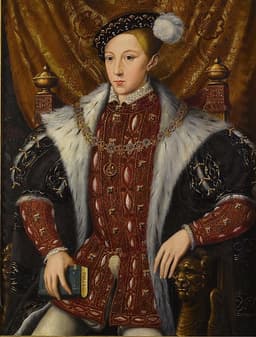
Edward VI of England
Emperor · Modern
43.8Total

Mbandzeni
Emperor · Modern
48.7Total
Basic Information
Born
1537
1855
Died
1553
1889
Era
Modern
Modern
Nationality
England
Eswatini
Occupation
Emperor
Emperor
Civilization
Western
Other
Score Comparison
Military (10%)
19.3
20.0
Political (20%)
42.2
54.7
Influence (20%)
51.8
51.8
Legacy (20%)
43.3
43.3
Leadership (15%)
38.1
62.2
Strategy (15%)
60.0
54.3
TOTAL
43.8
48.7
Edward VI of England — Complete Timeline
1547 AD
Coronation of Edward VIPolitical Action◆ Major
Edward VI was crowned king of England at age nine, succeeding his father Henry VIII. His reign was dominated by regents, first Edward Seymour, Duke of Somerset, and later John Dudley, Duke of Northumberland.
CoronationMinor KingTudor
Impact: national
1549 AD
Act of Uniformity 1549Reform◆ Major
Edward VI's government passed the Act of Uniformity, imposing the Book of Common Prayer in English. This reform advanced the Protestant Reformation in England, replacing Latin services with English ones and standardizing worship.
ReformationReligionLiturgy
Impact: nationalprogressive
1553 AD
Forty-Two ArticlesReform◆ Major
Edward VI's government issued the Forty-Two Articles, defining the doctrinal basis of the Church of England. These articles were more Protestant than earlier reforms, but were repealed after Edward's death under Mary I.
ReformationDoctrineChurch of England
Impact: nationalprogressive
Devise for the SuccessionPolitical Action
Edward VI, on his deathbed, drafted a will excluding his half-sisters Mary and Elizabeth from the succession, naming Lady Jane Grey as his heir. This attempt to maintain Protestant rule failed after his death, leading to Mary I's accession.
SuccessionProtestantCrisis
Impact: national
Mbandzeni — Complete Timeline
1880 AD
Granting of Land Concessions to EuropeansPolitical Action◆ Major
Mbandzeni issued numerous land concessions to European settlers, miners, and traders, granting rights to vast areas of Swazi territory. By 1889, nearly all Swazi land was claimed by foreigners, undermining traditional land tenure.
Land ConcessionsColonial EncroachmentEconomic Change
Impact: nationaldestructive
1881 AD
Signing of the First Swazi ConventionPolitical Action◆ Major
Mbandzeni signed a convention with the British and Transvaal governments that defined Swaziland's borders and recognized its independence. However, the agreement failed to protect Swazi sovereignty from increasing European pressure.
TreatyBorder DefinitionDiplomacy
Impact: regional
1888 AD
Establishment of the Swaziland Concessions CommissionPolitical Action
Mbandzeni agreed to the creation of a commission to adjudicate land disputes between Swazis and European concessionaires. This body later became a tool for colonial control, as it often ruled in favor of settlers.
Land DisputesColonial AdministrationLegal System
Impact: nationaldestructive
Expert Analysis
Origins
Edward VI was born on October 12, 1537, at Hampton Court Palace, the long-awaited male heir of Henry VIII and Jane Seymour. His mother died shortly after his birth. Edward was educated by leading Protestant scholars such as John Cheke and Richard Cox, receiving a rigorous humanist and Protestant education. His tutors instilled in him a strong commitment to Reformed theology.
Mbandzeni (also known as Dlamini IV) was born around 1855 in Swaziland, the son of King Mswati II and Queen Tsandile. He grew up in a period of increasing European encroachment. His early life was marked by training in Swazi customs and governance, but his education was not formalized as Edward's was. He ascended to the throne in 1875 after a period of regency following his father's death.
Rise to Power
Edward became king at age nine upon Henry VIII's death in January 1547. His uncle, Edward Seymour, Duke of Somerset, served as Lord Protector and dominated the early years. Edward's personal involvement grew after Seymour's fall in 1549, when John Dudley, Duke of Northumberland, took control. Despite his youth, Edward showed a keen interest in religious and political affairs, attending council meetings and signing documents.
Mbandzeni became king in 1875 after the death of his father Mswati II. His rise was contested, but he emerged as the legitimate heir with the support of senior chiefs. He faced immediate pressure from European powers, particularly the Boers of the Transvaal and British colonial interests. His reign was defined by the need to navigate these external forces while maintaining Swazi sovereignty.
Leadership & Governance
Edward's governance was largely exercised through regents, but his personal influence was significant in religious matters. He pushed for more radical Protestant reforms than his advisors initially intended. The Act of Uniformity 1549 imposed the Book of Common Prayer, and the Forty-Two Articles of 1553 defined a Calvinist-influenced doctrine. His government also oversaw the dissolution of chantries and the removal of images from churches. Edward's political score of 42.2 reflects his limited direct control.
Mbandzeni ruled as an absolute monarch within Swazi tradition, but his reign was characterized by the granting of numerous land concessions to European settlers, miners, and traders. By 1889, nearly all Swazi land had been concessioned. He attempted to balance the interests of his people with the demands of Europeans, often playing British and Boer interests against each other. His leadership score of 62.2 indicates his effectiveness in maintaining power, though at a high cost to Swazi land rights.
Triumph & Tragedy
Edward's greatest triumph was the solidification of Protestantism in England. The 1549 and 1552 Prayer Books and the Forty-Two Articles laid the groundwork for the Elizabethan Religious Settlement. However, his greatest tragedy was his early death at age 15 from tuberculosis, which plunged England into the Marian restoration of Catholicism. His Devise for the Succession, naming Lady Jane Grey, was a desperate attempt to prevent a Catholic succession but failed, leading to political chaos.
Mbandzeni's triumph was his ability to maintain Swaziland's nominal independence during a period of intense European colonization. He secured the First Swazi Convention in 1881, which recognized Swazi borders. However, his tragedy was the massive loss of land and sovereignty through concessions. The Swaziland Concessions Commission, established in his reign, later became a tool for European control. His legacy score of 43.3 reflects the mixed outcomes.
Character & Destiny
Edward was precocious, devoutly Protestant, and stubborn. His letters and diary show a serious, principled boy who believed in his divine right to reform the church. His health was always fragile, and his early death was perhaps inevitable given the medical knowledge of the time. His character shaped his destiny: his religious zeal drove the Reformation, but his youth prevented him from consolidating his achievements.
Mbandzeni was pragmatic and diplomatic, but ultimately overwhelmed by the scale of European encroachment. He tried to manage concessions rather than resist outright, a strategy that preserved his throne but sacrificed land. His character was that of a traditional king facing modern pressures with limited tools. His destiny was to preside over the beginning of Swaziland's loss of autonomy.
Legacy
Edward's legacy is the Edwardian Reformation, which set England on a Protestant path that would be restored under Elizabeth I. His reign saw the first English-language prayer book and a clear doctrinal shift toward Calvinism. He scored 43.3 in legacy, but his influence was profound for such a short reign. The Forty-Two Articles later influenced the Thirty-Nine Articles of the Church of England.
Mbandzeni's legacy is deeply controversial. He is remembered as the king who gave away Swaziland's land, but also as a ruler who tried to preserve his nation through diplomacy. The concessions he granted led to the eventual establishment of Swaziland as a British protectorate in 1902. His political score of 54.7 indicates his relative skill in navigating colonial pressures, but his legacy is one of loss.
Conclusion
Edward VI and Mbandzeni both ruled during periods of profound change, but their impacts differ greatly. Edward's total score of 43.8 versus Mbandzeni's 48.7 reflects Mbandzeni's higher scores in leadership and strategy, yet Edward's influence on a major world power—England—was more globally significant. Mbandzeni's actions, while locally impactful, did not reshape international systems. Edward's religious reforms had lasting effects on the Anglican Communion and English identity, whereas Mbandzeni's concessions ultimately led to Swazi subjugation. Therefore, Edward VI had greater historical impact due to the scale and endurance of his religious changes. Mbandzeni's scores are higher in some categories, but the breadth of Edward's influence on a major European nation outweighs Mbandzeni's regional significance.
Rankings
🥇
MbandzeniLeader
Mil: 20.0Pol: 54.7Inf: 51.8
48.7
🥈
Edward VI of England
Mil: 19.3Pol: 42.2Inf: 51.8
43.8
+4.9 behind
How This Comparison Works
Algorithm
Each figure is scored on 6 dimensions (0—100 scale) based on structured historical data: Military (10%), Political (20%), Influence (20%), Legacy (20%), Leadership (15%), Strategy (15%). The weighted total produces the final ranking.
Data Sources
Scores are computed from structured sub-indicators in the database. Scale factors adjust for era (Ancient ×0.85, Modern ×1.0) and civilization size (Eastern ×1.05, Other ×0.80) to account for differences in population and military scale.
Maximum 3 Figures
Comparisons are limited to 2—3 figures to ensure readability and statistical meaningfulness.
Error Margins
±5 points per dimension — Sub-scores are derived from historical records with inherent uncertainty. Two figures within 5 points on a dimension should be considered roughly equivalent in that area.
Total Score Accuracy
±3 points overall — The weighted combination of 6 dimensions produces a total score with approximately ±3 points of uncertainty. Differences of less than 3 points are not statistically significant— the figures are effectively tied.
Known Limitations
- Historical records are incomplete and uneven across civilizations
- Figures from oral-tradition societies may be underrepresented
- Occupation labels can misclassify multi-role figures
- Scores measure capability and impact, not moral character
- Quantitative scoring is a comparison tool, not absolute truth
Capability Radar
Military (10%) — Battles & Warfare
Battles
36
5
Win Rate
37
5
Expansion
44
5
Political (20%) — Governance & Reform
Reform
55
30
Diplomacy
20
50
Economy
10
30
Influence (20%) — Cultural & Global Reach
Cultural
30
30
Global
20
20
Legacy (20%) — Historical Impact
Historical
40
40
Longevity
30
30
Leadership (15%) — Power & Stability
Tenure
15
40
Stability
10
20
Strategy (15%) — Tactics & Innovation
Strategy
47
5
Tactics
50
5
Reform
49
5
Similar Comparisons
Comments & Discussion
No comments yet. Be the first to share your thoughts!