Loading...
Edward VI of England vs Oba Akenzua II
Oba Akenzua II leads by 4.7 pts · 2 figures compared
…
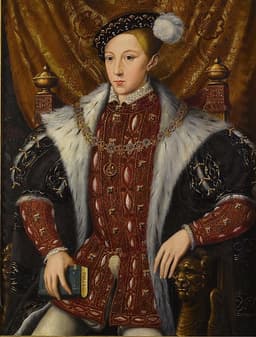
Edward VI of England
Emperor · Modern
43.8Total

Oba Akenzua II
Emperor · Modern
48.5Total
Basic Information
Born
1537
1899
Died
1553
1978
Era
Modern
Modern
Nationality
England
Benin Kingdom
Occupation
Emperor
Emperor
Civilization
Western
Other
Score Comparison
Military (10%)
19.3
27.6
Political (20%)
42.2
45.0
Influence (20%)
51.8
55.7
Legacy (20%)
43.3
46.7
Leadership (15%)
38.1
72.0
Strategy (15%)
60.0
26.4
TOTAL
43.8
48.5
Edward VI of England — Complete Timeline
1547 AD
Coronation of Edward VIPolitical Action◆ Major
Edward VI was crowned king of England at age nine, succeeding his father Henry VIII. His reign was dominated by regents, first Edward Seymour, Duke of Somerset, and later John Dudley, Duke of Northumberland.
CoronationMinor KingTudor
Impact: national
1549 AD
Act of Uniformity 1549Reform◆ Major
Edward VI's government passed the Act of Uniformity, imposing the Book of Common Prayer in English. This reform advanced the Protestant Reformation in England, replacing Latin services with English ones and standardizing worship.
ReformationReligionLiturgy
Impact: nationalprogressive
1553 AD
Forty-Two ArticlesReform◆ Major
Edward VI's government issued the Forty-Two Articles, defining the doctrinal basis of the Church of England. These articles were more Protestant than earlier reforms, but were repealed after Edward's death under Mary I.
ReformationDoctrineChurch of England
Impact: nationalprogressive
Devise for the SuccessionPolitical Action
Edward VI, on his deathbed, drafted a will excluding his half-sisters Mary and Elizabeth from the succession, naming Lady Jane Grey as his heir. This attempt to maintain Protestant rule failed after his death, leading to Mary I's accession.
SuccessionProtestantCrisis
Impact: national
Oba Akenzua II — Complete Timeline
1914 AD
Restoration of the Benin monarchyPolitical Action◆ Major
Oba Akenzua II was installed as the Oba of Benin, restoring the monarchy that had been abolished after the 1897 Punitive Expedition. The British allowed the restoration as part of their indirect rule policy in Nigeria.
RestorationKingshipBenin
Impact: regionalconstructive
1950 AD
Promotion of Benin cultureCultural
Oba Akenzua II promoted the preservation and revival of Benin cultural heritage, including the arts, festivals, and traditional institutions. He supported the documentation of Benin history and the return of some artifacts looted in 1897.
CultureHeritageBenin
Impact: regionalconstructive
1960 AD
Integration into Nigerian federationPolitical Action◆ Major
Oba Akenzua II led the Benin monarchy's integration into the independent Nigerian federation. He worked to maintain the traditional institution's relevance within the modern Nigerian state, balancing customary authority with constitutional governance.
IndependenceNigeriaBenin
Impact: regionalconstructive
Expert Analysis
Origins
Edward VI of England (born 1537) was the only surviving male heir of Henry VIII. His mother Jane Seymour died shortly after his birth. He was raised in a humanist Protestant court, tutored by scholars like John Cheke and Richard Cox, who instilled in him a strong Protestant faith. Edward's education emphasized theology and classical languages, preparing him for his role as a godly prince.
Oba Akenzua II (born 1899) was the son of Oba Eweka II. The Benin monarchy had been abolished after the British Punitive Expedition of 1897, which exiled Oba Ovonramwen. Akenzua grew up in the aftermath of the expedition, in a period when the monarchy was restored as a ceremonial institution under British colonial rule. He was educated at the Government School in Benin City and later trained in traditional customs.
Rise to Power
Edward VI became king at age nine upon Henry VIII's death in 1547. His uncle Edward Seymour, Duke of Somerset, served as Lord Protector. The young king was a figurehead, but his personal convictions influenced religious policy. Edward's reign was marked by power struggles between Protestant factions, culminating in the rise of John Dudley, Duke of Northumberland, after Somerset's fall in 1549.
Oba Akenzua II ascended the throne in 1933 after the death of his father Oba Eweka II. His rise was facilitated by British colonial authorities who allowed the restoration of the monarchy in 1914 as a way to co-opt traditional rulers. Akenzua II had to navigate colonial expectations while asserting the dignity of the Benin throne. He was formally recognized as Oba by the British and later by the independent Nigerian government.
Leadership & Governance
Edward VI's governance was dominated by regents, but he personally approved key religious reforms. The Act of Uniformity 1549 introduced the Book of Common Prayer, and the Forty-Two Articles (1553) defined a Calvinist doctrine for the Church of England. Edward also supported the destruction of images and relics. His leadership score of 38.1 reflects his limited actual power, though his symbolic role was crucial.
Oba Akenzua II governed as a traditional ruler within the Nigerian federation. He focused on integrating the Benin monarchy into the modern state while preserving its cultural authority. He supported education and infrastructure, and he worked to revive Benin arts, including bronze casting. His political score of 45.0 reflects his ability to adapt to changing political circumstances, while his leadership score of 72.0 indicates strong personal influence within his domain.
Triumph & Tragedy
Edward VI's greatest triumph was advancing the Protestant Reformation in England. The Book of Common Prayer and the Forty-Two Articles set the doctrinal foundation for the Church of England. However, his early death at age 15 in 1553 led to a succession crisis. His Devise for the Succession, naming Lady Jane Grey as his heir, failed utterly; Mary I reversed his Protestant reforms and executed many reformers. Edward's reign is often seen as a brief interlude of radical Protestantism that was quickly undone.
Oba Akenzua II's greatest triumph was restoring the prestige of the Benin monarchy after its destruction. He promoted cultural revival, including the annual Igue festival and the preservation of oral traditions. He also successfully integrated the kingdom into Nigeria, maintaining relevance in a modern state. However, his reign was constrained by colonial and post-colonial realities; the monarchy remained largely ceremonial, and he had limited political power. His legacy score of 46.7 reflects his moderate impact.
Character & Destiny
Edward VI was described as precocious, pious, and stubborn. His strong Protestant convictions drove his policies, but his youth made him dependent on advisors. His early death was a tragedy that cut short his potential. Historians often view him as a pawn of power-hungry regents, but his personal agency in religious matters is noted.
Oba Akenzua II was known for his diplomacy and cultural nationalism. He navigated colonial rule with tact, preserving the monarchy's dignity. His destiny was shaped by the aftermath of colonialism; he had to rebuild an institution that had been humiliated. His character of patience and strategic adaptation allowed him to succeed where more confrontational leaders might have failed.
Legacy
Edward VI's legacy is the Protestant foundation of the Church of England. Although Mary I reversed his reforms, Elizabeth I reinstated many of them, and the Thirty-Nine Articles (1563) were based on his Forty-Two Articles. His reign established a precedent for a Protestant monarchy. However, his influence score of 51.8 is limited by his short reign and the subsequent reversals.
Oba Akenzua II's legacy is the survival and revival of the Benin monarchy. He ensured that the institution remained relevant in modern Nigeria. His cultural initiatives helped preserve Benin heritage, which gained international recognition. His legacy score of 46.7 reflects his impact on cultural preservation, though his political influence was modest.
Conclusion
Oba Akenzua II had a greater overall impact within his context, scoring 48.5 total compared to Edward VI's 43.8. Edward VI's reforms were significant but temporary, and his reign was too short to solidify lasting change. Akenzua II, by contrast, restored an institution that had been nearly destroyed and ensured its continuity into the modern era. While Edward's religious changes influenced England's future, Akenzua's cultural restoration had a more direct and enduring effect on his people. The score gap of 4.7 points reflects this difference.
Rankings
🥇
Oba Akenzua IILeader
Mil: 27.6Pol: 45.0Inf: 55.7
48.5
🥈
Edward VI of England
Mil: 19.3Pol: 42.2Inf: 51.8
43.8
+4.7 behind
How This Comparison Works
Algorithm
Each figure is scored on 6 dimensions (0—100 scale) based on structured historical data: Military (10%), Political (20%), Influence (20%), Legacy (20%), Leadership (15%), Strategy (15%). The weighted total produces the final ranking.
Data Sources
Scores are computed from structured sub-indicators in the database. Scale factors adjust for era (Ancient ×0.85, Modern ×1.0) and civilization size (Eastern ×1.05, Other ×0.80) to account for differences in population and military scale.
Maximum 3 Figures
Comparisons are limited to 2—3 figures to ensure readability and statistical meaningfulness.
Error Margins
±5 points per dimension — Sub-scores are derived from historical records with inherent uncertainty. Two figures within 5 points on a dimension should be considered roughly equivalent in that area.
Total Score Accuracy
±3 points overall — The weighted combination of 6 dimensions produces a total score with approximately ±3 points of uncertainty. Differences of less than 3 points are not statistically significant— the figures are effectively tied.
Known Limitations
- Historical records are incomplete and uneven across civilizations
- Figures from oral-tradition societies may be underrepresented
- Occupation labels can misclassify multi-role figures
- Scores measure capability and impact, not moral character
- Quantitative scoring is a comparison tool, not absolute truth
Capability Radar
Military (10%) — Battles & Warfare
Battles
36
7
Win Rate
37
11
Expansion
44
15
Political (20%) — Governance & Reform
Reform
55
60
Diplomacy
20
65
Economy
10
40
Influence (20%) — Cultural & Global Reach
Cultural
30
45
Global
20
30
Legacy (20%) — Historical Impact
Historical
40
50
Longevity
30
40
Leadership (15%) — Power & Stability
Tenure
15
55
Stability
10
55
Strategy (15%) — Tactics & Innovation
Strategy
47
13
Tactics
50
17
Reform
49
21
Similar Comparisons
Comments & Discussion
No comments yet. Be the first to share your thoughts!