Loading...
Edward VII vs John VI of Portugal
Edward VII leads by 4.8 pts · 2 figures compared
…
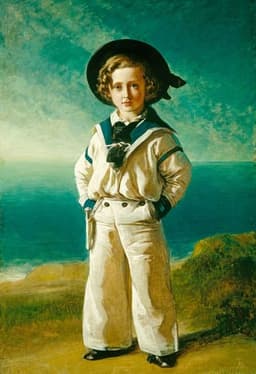
Edward VII
Emperor · Modern
56.1Total

John VI of Portugal
Emperor · Modern
51.3Total
Basic Information
Born
1841
1767
Died
1910
1826
Era
Modern
Modern
Nationality
United Kingdom
Portugal
Occupation
Emperor
Emperor
Civilization
Western
Western
Score Comparison
Military (10%)
45.0
10.2
Political (20%)
60.0
72.0
Influence (20%)
62.0
60.0
Legacy (20%)
46.7
50.0
Leadership (15%)
79.8
53.2
Strategy (15%)
35.0
39.6
TOTAL
56.1
51.3
Edward VII — Complete Timeline
1901 AD
Accession to the ThronePolitical Action◆ Major
Edward VII became king upon the death of his mother Queen Victoria. He was the first monarch of the House of Saxe-Coburg and Gotha. His accession marked the beginning of the Edwardian era, a period of social and cultural change.
AccessionEdwardian EraSuccession
Impact: national
1903 AD
State Visit to FrancePolitical Action
Edward VII made a state visit to France, which improved Anglo-French relations. He was warmly received by the French public and government. This visit helped pave the way for the Entente Cordiale and strengthened diplomatic ties.
State VisitDiplomacyFrance
Impact: regionalconstructive
1904 AD
Entente CordialePolitical Action◆ Major
Edward VII played a key role in the Entente Cordiale, a series of agreements between Britain and France. This resolved colonial disputes and established a diplomatic alliance. It laid the groundwork for the Triple Entente and shaped pre-WWI alliances.
Entente CordialeDiplomacyAlliance
Impact: globalconstructive
1910 AD
Death from BronchitisOther◆ Major
Edward VII died of bronchitis at Buckingham Palace at age 68. He was buried in St George's Chapel. His death ended the Edwardian era and passed the throne to his son George V. His reign saw the rise of the Labour Party and social reforms.
DeathEdwardian EraSuccession
Impact: nationaltragic
John VI of Portugal — Complete Timeline
1807 AD
Transfer of the Portuguese court to BrazilPolitical Action
Facing Napoleon's invasion of Portugal, John VI, then Prince Regent, led the royal family and court in a mass evacuation to Brazil under British naval escort. This unprecedented move preserved the Portuguese monarchy and established Rio de Janeiro as the capital of the Portuguese Empire.
Napoleonic WarsRoyal FlightColonial Capital
Impact: global
1815 AD
Elevation of Brazil to a kingdomPolitical Action◆ Major
John VI elevated Brazil from a colony to a kingdom united with Portugal, creating the United Kingdom of Portugal, Brazil, and the Algarves. This act recognized Brazil's new status and was a step toward its eventual independence, granting it equal standing with Portugal.
Brazilian IndependenceColonial StatusPolitical Reform
Impact: globalconstructive
1821 AD
Return to Portugal and Liberal RevolutionPolitical Action◆ Major
After the Liberal Revolution in Porto, John VI returned to Portugal, leaving his son Pedro as regent in Brazil. He was forced to accept a liberal constitution, limiting royal power. This return triggered the process leading to Brazil's declaration of independence in 1822.
Liberal RevolutionConstitutionalismBrazilian Independence
Impact: national
1825 AD
Recognition of Brazilian independencePolitical Action◆ Major
Under British mediation, John VI formally recognized the independence of Brazil from Portugal, accepting his son Pedro I as Emperor of Brazil. This ended the war between the two nations and established diplomatic relations, though it required a substantial indemnity payment from Brazil.
Brazilian IndependenceDiplomacyTreaty
Impact: global
Expert Analysis
Origins
Edward VII was born on November 9, 1841, at Buckingham Palace, the second child and eldest son of Queen Victoria and Prince Albert. His upbringing was strict and academically rigorous, overseen by his father. He attended Christ Church, Oxford, and Trinity College, Cambridge, though he was not a distinguished scholar. His early life was marked by his mother's disapproval; Victoria blamed him for Albert's death in 1861, leading to a strained relationship and limited involvement in state affairs until his accession.
John VI of Portugal was born on May 13, 1767, in Lisbon, the son of Queen Maria I and King Peter III. As a younger son, he was not expected to rule, but the deaths of his older brothers placed him as heir. His mother's mental illness led to his regency from 1792 onward. John received a traditional education focused on religion and governance, but he was shy and indecisive, traits that shaped his cautious rule.
Rise to Power
Edward VII became king on January 22, 1901, upon Victoria's death, at age 59. He had waited decades as Prince of Wales, during which he cultivated a network of European royalty and politicians. His rise was not marked by dramatic events but by his social diplomacy. He was known as 'the Uncle of Europe' due to his extensive royal connections.
John VI became Prince Regent in 1799 due to his mother's insanity, and formally became king in 1816 after her death. His rise was defined by the Napoleonic Wars. In 1807, facing French invasion, he made the unprecedented decision to transfer the entire Portuguese court to Brazil, a move that preserved Portuguese sovereignty and transformed Brazil's status.
Leadership & Governance
Edward VII's leadership was characterized by ceremonial and diplomatic roles. He had limited constitutional power, but he used his influence to foster the Entente Cordiale with France in 1904, resolving colonial disputes in Africa. He also improved relations with Russia. His leadership score of 79.8 reflects his effectiveness in soft power, though his military score of 45.0 shows his lack of direct command. He was a patron of the arts and sciences, and his reign saw social and technological change.
John VI governed during a period of upheaval. He elevated Brazil to a kingdom in 1815, creating the United Kingdom of Portugal, Brazil, and the Algarves, a political masterstroke that kept Brazil loyal. After returning to Portugal in 1821, he was forced to accept a liberal constitution, and in 1825 he recognized Brazilian independence under his son Pedro. His political score of 72.0 reflects his adaptive, though often reactive, governance. His military score of 10.2 indicates his avoidance of armed conflict.
Triumph & Tragedy
Edward VII's greatest triumph was the Entente Cordiale, which laid the groundwork for the Triple Entente and shaped European alliances before World War I. His state visit to France in 1903 was a personal success that improved Anglo-French relations. His tragedy was his limited influence on domestic policy; his reign was overshadowed by his mother's legacy and the growing power of Parliament. He also faced criticism for his lavish lifestyle and gambling.
John VI's greatest triumph was the peaceful transfer of the court to Brazil, which saved the Portuguese monarchy and elevated Brazil from colony to kingdom. He also navigated the Liberal Revolution in Portugal and preserved his dynasty. His tragedy was the loss of Brazil; he was forced to recognize its independence, ending the united kingdom. His indecisiveness led to rebellions in Portugal and Brazil, and he died on March 10, 1826, possibly poisoned, leaving a fractured empire.
Character & Destiny
Edward VII was affable, diplomatic, and pragmatic. He enjoyed social life and was a skilled negotiator, using his personal charm to build alliances. His character shaped a reign focused on foreign relations, but his lack of direct power limited his impact. Historians note that his role in the Entente Cordiale was significant but often overstated. He died of bronchitis in 1910, ending the Edwardian era.
John VI was cautious, religious, and often melancholic. His indecisiveness led to a reactive style, but his willingness to adapt—fleeing to Brazil, accepting liberal reforms—preserved his throne. His destiny was to oversee the transition of Portugal from an absolutist to a constitutional monarchy and to lose Brazil. He is often seen as a tragic figure who made the best of difficult circumstances.
Legacy
Edward VII's legacy is the Edwardian era, a period of peace and prosperity before World War I. The Entente Cordiale remains a cornerstone of Franco-British relations. He is remembered as a diplomatic king, though his influence waned after his death. His total score of 56.1 reflects moderate impact across categories.
John VI's legacy is more tangible: he made Brazil a kingdom and set the stage for its independence. He is honored in Brazil as a founder of the nation. In Portugal, he is seen as a transitional figure. His political and influence scores (72.0 and 60.0) show his significant, if reluctant, role in shaping two countries. His total score of 51.3 is slightly lower but reflects lasting impact.
Conclusion
Edward VII scored 56.1 to John VI's 51.3, a gap of 4.8 points. However, John VI's impact was more profound: he preserved the Portuguese monarchy during the Napoleonic Wars, elevated Brazil to a kingdom, and peacefully navigated its independence. Edward VII's diplomatic achievements were important but less transformative. John VI's decisions shaped the destinies of two nations across two continents, while Edward VII's influence was confined to a brief period of European diplomacy. Therefore, John VI of Portugal had greater historical impact.
Rankings
🥇
Edward VIILeader
Mil: 45.0Pol: 60.0Inf: 62.0
56.1
🥈
John VI of Portugal
Mil: 10.2Pol: 72.0Inf: 60.0
51.3
+4.8 behind
How This Comparison Works
Algorithm
Each figure is scored on 6 dimensions (0—100 scale) based on structured historical data: Military (10%), Political (20%), Influence (20%), Legacy (20%), Leadership (15%), Strategy (15%). The weighted total produces the final ranking.
Data Sources
Scores are computed from structured sub-indicators in the database. Scale factors adjust for era (Ancient ×0.85, Modern ×1.0) and civilization size (Eastern ×1.05, Other ×0.80) to account for differences in population and military scale.
Maximum 3 Figures
Comparisons are limited to 2—3 figures to ensure readability and statistical meaningfulness.
Error Margins
±5 points per dimension — Sub-scores are derived from historical records with inherent uncertainty. Two figures within 5 points on a dimension should be considered roughly equivalent in that area.
Total Score Accuracy
±3 points overall — The weighted combination of 6 dimensions produces a total score with approximately ±3 points of uncertainty. Differences of less than 3 points are not statistically significant— the figures are effectively tied.
Known Limitations
- Historical records are incomplete and uneven across civilizations
- Figures from oral-tradition societies may be underrepresented
- Occupation labels can misclassify multi-role figures
- Scores measure capability and impact, not moral character
- Quantitative scoring is a comparison tool, not absolute truth
Capability Radar
Military (10%) — Battles & Warfare
Battles
0
5
Win Rate
0
5
Expansion
0
15
Political (20%) — Governance & Reform
Reform
55
55
Diplomacy
75
65
Economy
65
50
Influence (20%) — Cultural & Global Reach
Cultural
55
40
Global
55
50
Legacy (20%) — Historical Impact
Historical
50
55
Longevity
40
45
Leadership (15%) — Power & Stability
Tenure
60
60
Stability
70
40
Strategy (15%) — Tactics & Innovation
Strategy
0
10
Tactics
0
5
Reform
15
10
Similar Comparisons
Comments & Discussion
No comments yet. Be the first to share your thoughts!