Loading...
This comparison has not been analyzed yet.
One-time AI generation (~1 minute). Scores and timeline are already available below.
Emil Constantinescu vs Omar Bongo
Emil Constantinescu leads by 0.4 pts · 2 figures compared
…

Emil Constantinescu
Politician · Modern
53.7Total
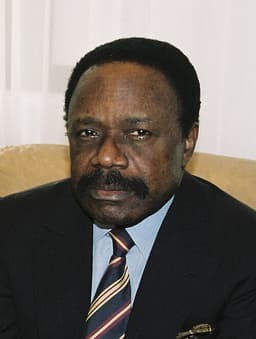
Omar Bongo
Politician · Modern
53.3Total
Basic Information
Born
1939
1935
Died
—
—
Era
Modern
Modern
Nationality
Romania
Gabon
Occupation
Politician
Politician
Civilization
Western
Other
Score Comparison
Military (10%)
48.5
39.9
Political (20%)
68.0
45.1
Influence (20%)
54.9
53.3
Legacy (20%)
43.3
52.0
Leadership (15%)
65.7
78.0
Strategy (15%)
42.6
44.8
TOTAL
53.7
53.3
Emil Constantinescu — Complete Timeline
1996 AD
Elected President of RomaniaPolitical Action
Emil Constantinescu was elected President of Romania on November 17, 1996, defeating incumbent Ion Iliescu. He was the first anti-communist president after the 1989 revolution, representing the Romanian Democratic Convention.
ElectionPost-CommunismDemocratic Transition
Impact: nationalprogressive
1997 AD
Initiated Reforms for NATO and EU IntegrationPolitical Action◆ Major
Constantinescu pursued a pro-Western foreign policy, initiating reforms to meet NATO and European Union accession criteria. His government restructured the economy, fought corruption, and improved relations with Hungary, leading to NATO membership in 2004.
NATOEU IntegrationForeign Policy
Impact: nationalconstructive
Oversaw the Closure of the 'Pitești Experiment' PrisonsPolitical Action◆ Major
Constantinescu's administration closed the remaining political prisons and rehabilitation centers from the communist era, including the infamous Pite
Human RightsDecommunizationPrison Reform
Impact: nationalprogressive
2000 AD
Failed to Secure Re-election in 2000Political Action◆ Major
Constantinescu lost the 2000 presidential election to Ion Iliescu, receiving only 33% of the vote in the second round. His defeat was attributed to economic hardships, slow reforms, and public disillusionment with the political elite.
ElectionDefeatPolitical Transition
Impact: nationaltragic
Omar Bongo — Complete Timeline
1967 AD
Became President of GabonPolitical Action
Bongo succeeded Leon Mba as President of Gabon after Mba's death. He inherited a one-party state and began a 42-year rule characterized by authoritarianism and oil wealth.
PresidencyGabonSuccession
Impact: national
1968 AD
Introduced One-Party RulePolitical Action◆ Major
Bongo established the Gabonese Democratic Party as the sole legal party, consolidating his power. One-party rule lasted until 1990, suppressing political opposition.
One-Party StateGabonAuthoritarianism
Impact: nationaldestructive
1993 AD
Re-elected in Controversial ElectionsPolitical Action◆ Major
Bongo was re-elected in Gabon's first multi-party elections, which were marred by allegations of fraud. The election sparked protests and highlighted the limits of democratic reform.
ElectionGabonControversy
Impact: national
2009 AD
Died in OfficePolitical Action
Bongo died in office after 42 years as president, making him the longest-serving head of state in Africa. His death ended an era of authoritarian rule and led to a succession by his son Ali Bongo.
DeathGabonEnd of Era
Impact: national
This comparison has not been analyzed yet.
One-time AI generation (~1 minute). Scores and timeline are already available below.
Rankings
🥇
Emil ConstantinescuLeader
Mil: 48.5Pol: 68.0Inf: 54.9
53.7
🥈
Omar Bongo
Mil: 39.9Pol: 45.1Inf: 53.3
53.3
+0.4 behind
How This Comparison Works
Algorithm
Each figure is scored on 6 dimensions (0—100 scale) based on structured historical data: Military (10%), Political (20%), Influence (20%), Legacy (20%), Leadership (15%), Strategy (15%). The weighted total produces the final ranking.
Data Sources
Scores are computed from structured sub-indicators in the database. Scale factors adjust for era (Ancient ×0.85, Modern ×1.0) and civilization size (Eastern ×1.05, Other ×0.80) to account for differences in population and military scale.
Maximum 3 Figures
Comparisons are limited to 2—3 figures to ensure readability and statistical meaningfulness.
Error Margins
±5 points per dimension — Sub-scores are derived from historical records with inherent uncertainty. Two figures within 5 points on a dimension should be considered roughly equivalent in that area.
Total Score Accuracy
±3 points overall — The weighted combination of 6 dimensions produces a total score with approximately ±3 points of uncertainty. Differences of less than 3 points are not statistically significant— the figures are effectively tied.
Known Limitations
- Historical records are incomplete and uneven across civilizations
- Figures from oral-tradition societies may be underrepresented
- Occupation labels can misclassify multi-role figures
- Scores measure capability and impact, not moral character
- Quantitative scoring is a comparison tool, not absolute truth
Capability Radar
Military (10%) — Battles & Warfare
Battles
29
22
Win Rate
32
26
Expansion
37
25
Political (20%) — Governance & Reform
Reform
55
20
Diplomacy
50
60
Economy
40
30
Influence (20%) — Cultural & Global Reach
Cultural
30
20
Global
30
30
Legacy (20%) — Historical Impact
Historical
40
30
Longevity
20
70
Leadership (15%) — Power & Stability
Tenure
30
95
Stability
35
50
Strategy (15%) — Tactics & Innovation
Strategy
38
29
Tactics
40
34
Reform
45
35
Similar Comparisons
Comments & Discussion
No comments yet. Be the first to share your thoughts!