Loading...
Nikolai Bukharin vs Omar Bongo
Omar Bongo leads by 2.2 pts · 2 figures compared
…

Nikolai Bukharin
Politician · Modern
51.1Total
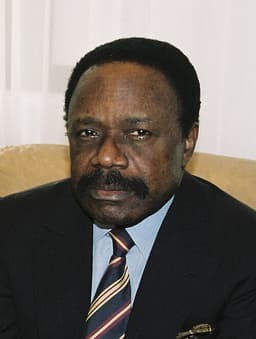
Omar Bongo
Politician · Modern
53.3Total
Basic Information
Born
1888
1935
Died
1938
—
Era
Modern
Modern
Nationality
Russia
Gabon
Occupation
Politician
Politician
Civilization
Western
Other
Score Comparison
Military (10%)
50.0
39.9
Political (20%)
53.8
45.1
Influence (20%)
56.4
53.3
Legacy (20%)
47.5
52.0
Leadership (15%)
51.9
78.0
Strategy (15%)
42.9
44.8
TOTAL
51.1
53.3
Nikolai Bukharin — Complete Timeline
1917 AD
Editor of PravdaCultural◆ Major
Bukharin became editor of Pravda, the Bolshevik newspaper, in 1917. He used the platform to advocate for radical socialist policies, including the immediate nationalization of industry and opposition to the Treaty of Brest-Litovsk, shaping early Bolshevik ideology.
Bolshevik PressIdeologyPropaganda
Impact: national
1920 AD
Author of 'Economics of the Transition Period'Cultural
Bukharin published 'Economics of the Transition Period', a theoretical work arguing for the necessity of state capitalism and forced industrialization during the transition to socialism. The book influenced early Soviet economic policy and debates on the NEP.
Economic TheoryBolshevismPublication
Impact: national
1928 AD
Leader of the Right OppositionPolitical Action◆ Major
Bukharin led the Right Opposition within the Communist Party, opposing Stalin's forced collectivization and rapid industrialization policies. He advocated for a continuation of the NEP and a more gradual approach, but was defeated and removed from power by 1929.
Soviet PoliticsOppositionNEP
Impact: national
1938 AD
Trial and Execution in the Great PurgePolitical Action◆ Major
Bukharin was tried in the third Moscow Show Trial in March 1938, accused of espionage, sabotage, and plotting to restore capitalism. Despite a vigorous defense, he was found guilty and executed on March 15, 1938, becoming one of the last prominent Old Bolsheviks purged.
Great PurgeShow TrialExecution
Impact: nationaltragic
Omar Bongo — Complete Timeline
1967 AD
Became President of GabonPolitical Action
Bongo succeeded Leon Mba as President of Gabon after Mba's death. He inherited a one-party state and began a 42-year rule characterized by authoritarianism and oil wealth.
PresidencyGabonSuccession
Impact: national
1968 AD
Introduced One-Party RulePolitical Action◆ Major
Bongo established the Gabonese Democratic Party as the sole legal party, consolidating his power. One-party rule lasted until 1990, suppressing political opposition.
One-Party StateGabonAuthoritarianism
Impact: nationaldestructive
1993 AD
Re-elected in Controversial ElectionsPolitical Action◆ Major
Bongo was re-elected in Gabon's first multi-party elections, which were marred by allegations of fraud. The election sparked protests and highlighted the limits of democratic reform.
ElectionGabonControversy
Impact: national
2009 AD
Died in OfficePolitical Action
Bongo died in office after 42 years as president, making him the longest-serving head of state in Africa. His death ended an era of authoritarian rule and led to a succession by his son Ali Bongo.
DeathGabonEnd of Era
Impact: national
Expert Analysis
Origins
Nikolai Bukharin was born in 1888 in Moscow, Russia, into a family of teachers. He studied economics at Moscow University but was expelled for revolutionary activities. Bukharin joined the Bolsheviks in 1906 and became a key theorist, writing extensively on Marxism. His early exile in Europe and the US shaped his views on capitalism and imperialism.
Omar Bongo was born in 1935 in Lewai, French Equatorial Africa (now Gabon), to a poor farming family. He attended primary school in Brazzaville and later joined the French Air Force, where he served as a pilot and intelligence officer. After Gabon's independence in 1960, Bongo entered politics under President Léon Mba, becoming his protégé.
Rise to Power
Bukharin rose through Bolshevik ranks as a brilliant intellectual. He edited Pravda in 1917 and became a member of the Politburo in 1919. His influence peaked during the New Economic Policy (NEP) in the 1920s, when he advocated for a mixed economy. However, his opposition to Stalin's forced collectivization led to his marginalization. By 1929, he was stripped of party posts and forced to recant.
Bongo became President of Gabon in 1967 after Mba's death. He quickly consolidated power by establishing the Gabonese Democratic Party (PDG) as the sole legal party in 1968. Bongo maintained control through a patronage network and strategic use of oil revenues. He faced coup attempts but survived, ruling unchallenged for decades.
Leadership & Governance
Bukharin's leadership was theoretical and factional. He led the Right Opposition within the Communist Party, arguing for a gradual transition to socialism. His governance approach was more moderate than Stalin's, favoring market mechanisms and peasant cooperation. However, Bukharin's lack of ruthless pragmatism made him vulnerable. His political score of 53.8 reflects his inability to secure power.
Bongo's leadership was authoritarian and pragmatic. He suppressed political opposition, controlled the media, and rigged elections. Yet he also brought stability and economic growth through oil wealth. Bongo's leadership score of 78.0 is the highest in this comparison, reflecting his long tenure and effective control. However, his regime was marred by corruption and inequality.
Triumph & Tragedy
Bukharin's greatest success was his theoretical contribution to Marxism, particularly his critique of Stalin's industrialization. His book 'Economics of the Transition Period' remains studied. But his tragedy was his execution in 1938 after a show trial, where he was forced to confess to absurd crimes. Bukharin's legacy score of 47.5 is tarnished by his association with Stalin's purges.
Bongo's triumph was his longevity: 42 years in power, making him Africa's longest-serving head of state. He transformed Gabon into a stable, oil-rich state. However, his tragedy was the lack of democratic development and widespread poverty despite oil wealth. Bongo's legacy score of 52.0 is modest, as his rule is often seen as a classic African autocracy.
Character & Destiny
Bukharin was an idealist and intellectual, described as the 'golden boy' of the revolution. His character was that of a principled Marxist who believed in persuasion over force. This led to his downfall in a system that rewarded ruthlessness. His strategy score of 42.9 indicates poor political maneuvering against Stalin.
Bongo was a pragmatic survivor. He skillfully balanced ethnic groups, co-opted opponents, and maintained French support. His character was that of a shrewd operator who prioritized power over ideology. This enabled his long rule but also perpetuated corruption. Bongo's strategy score of 44.8 is slightly higher than Bukharin's, reflecting his adaptability.
Legacy
Bukharin's legacy is as a martyr of Stalin's purges and a symbol of alternative paths to socialism. His ideas on market socialism influenced later reformers. However, his direct impact on history is limited compared to Stalin or Lenin. Bukharin's total score of 51.1 reflects his diminished stature.
Bongo's legacy is more tangible: he shaped modern Gabon's political and economic structures. His death in 2009 led to a transition to his son, Ali Bongo, indicating dynastic rule. Bongo's influence score of 53.3 is modest, as his rule is criticized for authoritarianism and inequality.
Conclusion
While Bukharin was a more original thinker, Omar Bongo had greater practical impact. Bongo's 42-year rule directly shaped the lives of millions in Gabon, whereas Bukharin's theoretical contributions were overshadowed by Stalin's terror. Bongo's total score of 53.3 exceeds Bukharin's 51.1, reflecting his longer tenure and enduring influence on Gabon's political system. The data supports Bongo as the more impactful figure, despite the moral repugnance of his authoritarian methods.
Rankings
🥇
Omar BongoLeader
Mil: 39.9Pol: 45.1Inf: 53.3
53.3
🥈
Nikolai Bukharin
Mil: 50.0Pol: 53.8Inf: 56.4
51.1
+2.2 behind
How This Comparison Works
Algorithm
Each figure is scored on 6 dimensions (0—100 scale) based on structured historical data: Military (10%), Political (20%), Influence (20%), Legacy (20%), Leadership (15%), Strategy (15%). The weighted total produces the final ranking.
Data Sources
Scores are computed from structured sub-indicators in the database. Scale factors adjust for era (Ancient ×0.85, Modern ×1.0) and civilization size (Eastern ×1.05, Other ×0.80) to account for differences in population and military scale.
Maximum 3 Figures
Comparisons are limited to 2—3 figures to ensure readability and statistical meaningfulness.
Error Margins
±5 points per dimension — Sub-scores are derived from historical records with inherent uncertainty. Two figures within 5 points on a dimension should be considered roughly equivalent in that area.
Total Score Accuracy
±3 points overall — The weighted combination of 6 dimensions produces a total score with approximately ±3 points of uncertainty. Differences of less than 3 points are not statistically significant— the figures are effectively tied.
Known Limitations
- Historical records are incomplete and uneven across civilizations
- Figures from oral-tradition societies may be underrepresented
- Occupation labels can misclassify multi-role figures
- Scores measure capability and impact, not moral character
- Quantitative scoring is a comparison tool, not absolute truth
Capability Radar
Military (10%) — Battles & Warfare
Battles
28
22
Win Rate
32
26
Expansion
33
25
Political (20%) — Governance & Reform
Reform
65
20
Diplomacy
40
60
Economy
70
30
Influence (20%) — Cultural & Global Reach
Cultural
40
20
Global
40
30
Legacy (20%) — Historical Impact
Historical
55
30
Longevity
30
70
Leadership (15%) — Power & Stability
Tenure
30
95
Stability
15
50
Strategy (15%) — Tactics & Innovation
Strategy
36
29
Tactics
41
34
Reform
47
35
Similar Comparisons
Comments & Discussion
No comments yet. Be the first to share your thoughts!