Loading...
Emiliano Zapata vs Julius Caesar
Julius Caesar leads by 26.5 pts · 2 figures compared
…
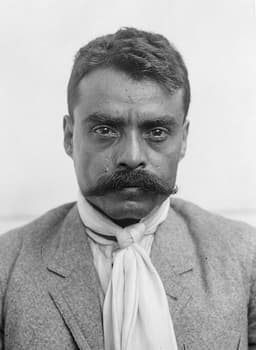
Emiliano Zapata
Revolutionary · Modern
56.3Total

Julius Caesar
General · Ancient
82.8Total
Basic Information
Born
1879
-100
Died
1919
-44
Era
Modern
Ancient
Nationality
Mexico
Roman Republic
Occupation
Revolutionary
General
Civilization
Western
Western
Score Comparison
Military (10%)
40.0
88.0
Political (20%)
68.0
78.0
Influence (20%)
58.0
85.0
Legacy (20%)
54.0
82.0
Leadership (15%)
54.2
80.0
Strategy (15%)
60.0
85.0
TOTAL
56.3
82.8
Emiliano Zapata — Complete Timeline
1911 AD
Plan of AyalaPolitical Action
Zapata issued the Plan of Ayala, denouncing Francisco I. Madero for failing to implement land reform. The plan called for the return of land to peasants and became the ideological foundation of the Zapatista movement.
Land ReformAgrarian MovementRevolution
Impact: nationalprogressive
1914 AD
Occupation of Mexico CityWar◆ Major
Zapata's forces, allied with Villa's Division of the North, occupied Mexico City. They held the capital for several weeks but failed to establish lasting control, highlighting the limits of their coalition.
Military OccupationRevolutionary AllianceCapital
Impact: national
Convention of AguascalientesPolitical Action◆ Major
Zapata attended the Convention of Aguascalientes, where revolutionary factions attempted to unify. He allied with Pancho Villa against Venustiano Carranza, but the convention failed to produce a stable government.
Revolutionary AlliancePolitical DivisionCivil War
Impact: national
1919 AD
Assassination at ChinamecaPolitical Action
Zapata was lured to the Hacienda de Chinameca by Colonel Jesus Guajardo, who pretended to defect. Guajardo's troops ambushed and killed Zapata, ending his leadership of the agrarian rebellion.
AssassinationBetrayalEnd of Leadership
Impact: nationaltragic
Julius Caesar — Complete Timeline
58 BC
Gallic WarsWar◆ Major
Caesar, as proconsul of Gaul, launched a series of campaigns that conquered all of Gaul (modern France, Belgium, and parts of Switzerland). He fought numerous battles, including against the Helvetii, the Belgae, and the Gallic chieftain Vercingetorix. The wars brought immense wealth and a loyal army to Caesar.
Gallic WarsConquestRoman Expansion
Impact: regional
49 BC
Crossing the RubiconPolitical Action◆ Major
Caesar led Legio XIII across the Rubicon River into Italy, defying the Roman Senate's order to disband his army. This act triggered a civil war against Pompey and the Optimates, ultimately leading to Caesar's dictatorship and the end of the Roman Republic.
Roman Civil WarEnd of RepublicPower Struggle
Impact: global
48 BC
Battle of PharsalusWar◆ Major
Caesar's outnumbered army defeated the larger forces of Pompey the Great at Pharsalus in Greece. Caesar's tactical use of a reserve line to counter Pompey's cavalry charge proved decisive. Pompey fled to Egypt, where he was assassinated, leaving Caesar as the undisputed master of the Roman world.
Roman Civil WarBattleDecisive Victory
Impact: regional
44 BC
Appointment as Dictator for LifePolitical Action◆ Major
The Roman Senate appointed Caesar dictator perpetuo (dictator for life), granting him unprecedented personal power. This move concentrated military, legislative, and judicial authority in one person, effectively ending the Roman Republic's traditional system of checks and balances and alarming many senators.
DictatorshipEnd of RepublicPower Consolidation
Impact: regionaldestructive
Assassination on the Ides of MarchPolitical Action◆ Major
A group of Roman senators, led by Marcus Junius Brutus and Gaius Cassius Longinus, stabbed Caesar to death at a meeting of the Senate in the Theatre of Pompey. The assassination was intended to restore the Republic, but instead triggered another civil war that led to the rise of the Roman Empire.
AssassinationRoman PoliticsEnd of Republic
Impact: globaldestructive
Expert Analysis
emiliano-zapata-vs-julius-caesar
The General and the Guerrilla
On a January night in 49 BCE, Julius Caesar stood at the banks of the Rubicon, a small river that marked the boundary of his lawful command. To cross with his army was treason. To turn back was political oblivion. He is said to have muttered, “The die is cast,” and plunged his horse into the water. Eighteen centuries later and an ocean away, in the dusty hills of Morelos, Mexico, another man faced a different kind of crossing. Emiliano Zapata, a peasant leader with a dark mustache and a white sombrero, had no legions, no Senate, no grand Republic to reshape. He had only a mimeographed document called the Plan of Ayala and the loyalty of men who farmed corn with their hands. Both men would die violently—one stabbed in the Senate chamber, one ambushed in a hacienda courtyard. But their paths to that final moment could not have been more different. Why did Caesar remake the world, while Zapata could not remake his own country?
Origins
Julius Caesar was born into the patrician class of Rome, a family that traced its lineage to the goddess Venus. But the Republic of his youth was a cauldron of civil wars, debt crises, and political corruption. Caesar’s father died when he was sixteen, and the young nobleman was forced to flee Rome to avoid the dictator Sulla’s proscriptions. He learned early that survival meant audacity and that the old rules of the Republic were already crumbling. His education was in rhetoric, law, and military command—the tools of a man who intended to climb.
Emiliano Zapata was born in 1879 in Anenecuilco, a small village in the state of Morelos. His family were mestizo peasants, not wealthy but not destitute—they owned a small plot of land and a few animals. Yet the world around them was being devoured by sugar haciendas that expanded through fraud and force, stealing the communal lands of indigenous villages. Zapata’s father died when he was a teenager as well, and young Emiliano watched his neighbors lose their fields to the landowners. His education was not in the Senate but in the saddle and the cornfield. He learned to read and write, but his real teacher was injustice.
Rise to Power
Caesar’s rise was a masterpiece of calculated risk. He borrowed enormous sums to fund public spectacles and win popularity, then secured a governorship in Spain to pay his debts. He formed the First Triumvirate with Pompey and Crassus, a backroom alliance that controlled Rome. Then he launched the Gallic Wars—eight years of brutal campaigns that conquered modern France and Belgium and gave him a veteran army loyal to him alone. When the Senate ordered him to disband his forces, he chose civil war instead. The crossing of the Rubicon was not a moment of passion; it was the logical endpoint of a man who had bet everything on his own ambition.
Zapata’s rise was slower, more reluctant. In 1909, the villagers of Anenecuilco elected him their president of the defense committee—essentially their legal advocate against the haciendas. He tried petitions, lawsuits, and negotiations. Nothing worked. When the Mexican Revolution erupted in 1910 against the dictator Porfirio Díaz, Zapata saw an opening. He raised a small army of peasants and captured the town of Cuautla. But unlike Caesar, he did not seek power for its own sake. He wanted land for the villages, and he believed that Francisco I. Madero, the revolutionary leader who became president, would deliver it. When Madero failed, Zapata issued the Plan of Ayala in November 1911—a document that denounced Madero as a traitor and demanded the return of stolen lands. This was his Rubicon, but it was a river he crossed not to conquer Rome, but to reclaim his village.
Leadership & Governance
Caesar governed as a military genius and a political reformer. He reorganized the calendar, granted citizenship to provincials, initiated public works, and reformed debt laws. He was ruthless in war—he boasted of killing a million Gauls—but clement in victory, pardoning former enemies like Cicero and Brutus. His strategy was to centralize power in himself while preserving the forms of the Republic. He understood that Rome needed order, and he believed only he could provide it.
Zapata governed differently. He never sought the presidency. At the Convention of Aguascalientes in 1914, where revolutionary factions tried to unite, Zapata allied with Pancho Villa but refused to take national power. Instead, he returned to Morelos and tried to implement land reform on a local scale. His forces occupied Mexico City in 1914, but they did not loot or terrorize the capital; they held it for weeks, distributing food and printing propaganda. Zapata’s governance was not about building an empire but about restoring a world—a world where villages governed themselves and land belonged to those who worked it. This was his strength and his limitation. He could win battles but not a war of national consolidation.
Triumph & Tragedy
Caesar’s greatest moment was his triumph over Pompey at the Battle of Pharsalus in 48 BCE, where he defeated an army twice his size through sheer tactical brilliance. His tragedy came on the Ides of March, 44 BCE, when senators he had pardoned stabbed him to death. He died believing he had saved Rome, but his assassination plunged the Republic into another civil war, from which his adopted heir, Octavian, emerged as the first emperor.
Zapata’s triumph was the occupation of Mexico City in 1914—a moment when the peasant army of the south stood in the halls of power. But his tragedy was the betrayal at Chinameca in 1919. Colonel Jesús Guajardo, pretending to defect, lured Zapata to a hacienda. As Zapata entered the courtyard, Guajardo’s troops raised their rifles and fired. He fell, and his body was photographed and displayed to prove he was dead. The revolution continued without him, but it would be co-opted by more pragmatic men.
Character & Destiny
Caesar was driven by an almost inhuman will to dominate. He was charming, literate, and generous—but also vain, calculating, and incapable of sharing power. His personality made him a conqueror but also a target. He could not imagine that others might not love him as Rome did.
Zapata was driven by loyalty—to his village, to his people, to the land. He was stubborn, suspicious of intellectuals and city politicians, and deeply provincial. He could not imagine that his local struggle needed a national strategy. Where Caesar saw the world as a stage for his ambition, Zapata saw it as a garden to be tended. Both were betrayed by the very men they trusted—Caesar by Brutus, Zapata by Guajardo. But Caesar’s betrayal was ideological; Zapata’s was mercenary.
Legacy
Caesar’s legacy is the Roman Empire. His name became a title—Kaiser, Tsar, Caesar—and his reforms shaped Western governance for two millennia. He is remembered as a genius and a tyrant, the man who destroyed the Republic and created the Empire.
Zapata’s legacy is the idea of agrarian justice. His image appears on murals, banknotes, and revolutionary posters across Latin America. The Zapatista Army of National Liberation, which rose in Chiapas in 1994, took his name. He is remembered as a martyr, not a ruler—a man who failed to seize power but succeeded in defining a cause.
Conclusion
Standing at the Rubicon, Caesar asked himself what a man of ambition should do. Standing in the fields of Morelos, Zapata asked himself what a man of justice should do. Their answers defined their fates. Caesar reshaped the world but died by the sword of his own peers. Zapata reshaped a dream but died by the bullet of a bought man. Perhaps the difference is not in their courage or their vision, but in what they were willing to sacrifice. Caesar sacrificed the Republic for himself. Zapata sacrificed himself for the village. And history, in its strange accounting, has given both men what they truly sought: Caesar got the world, and Zapata got the memory.
Rankings
🥇
Julius CaesarLeader
Mil: 88.0Pol: 78.0Inf: 85.0
82.8
🥈
Emiliano Zapata
Mil: 40.0Pol: 68.0Inf: 58.0
56.3
+26.5 behind
How This Comparison Works
Algorithm
Each figure is scored on 6 dimensions (0—100 scale) based on structured historical data: Military (10%), Political (20%), Influence (20%), Legacy (20%), Leadership (15%), Strategy (15%). The weighted total produces the final ranking.
Data Sources
Scores are computed from structured sub-indicators in the database. Scale factors adjust for era (Ancient ×0.85, Modern ×1.0) and civilization size (Eastern ×1.05, Other ×0.80) to account for differences in population and military scale.
Maximum 3 Figures
Comparisons are limited to 2—3 figures to ensure readability and statistical meaningfulness.
Error Margins
±5 points per dimension — Sub-scores are derived from historical records with inherent uncertainty. Two figures within 5 points on a dimension should be considered roughly equivalent in that area.
Total Score Accuracy
±3 points overall — The weighted combination of 6 dimensions produces a total score with approximately ±3 points of uncertainty. Differences of less than 3 points are not statistically significant— the figures are effectively tied.
Known Limitations
- Historical records are incomplete and uneven across civilizations
- Figures from oral-tradition societies may be underrepresented
- Occupation labels can misclassify multi-role figures
- Scores measure capability and impact, not moral character
- Quantitative scoring is a comparison tool, not absolute truth
Capability Radar
Military (10%) — Battles & Warfare
Battles
45
95
Win Rate
50
92
Expansion
35
97
Political (20%) — Governance & Reform
Reform
70
90
Diplomacy
40
85
Economy
35
82
Influence (20%) — Cultural & Global Reach
Cultural
65
88
Global
55
94
Legacy (20%) — Historical Impact
Historical
70
95
Longevity
65
96
Leadership (15%) — Power & Stability
Tenure
30
75
Stability
25
60
Strategy (15%) — Tactics & Innovation
Strategy
50
94
Tactics
55
96
Reform
60
88
Similar Comparisons
Comments & Discussion
No comments yet. Be the first to share your thoughts!