Loading...
Emperor Meiji vs Kaikhusrau Jahan
Emperor Meiji leads by 14.9 pts · 2 figures compared
…
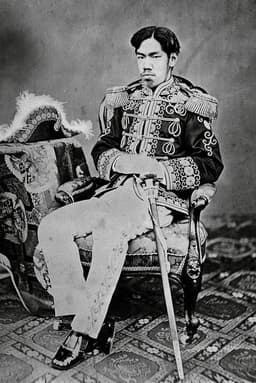
Emperor Meiji
Emperor · Modern
69.2Total
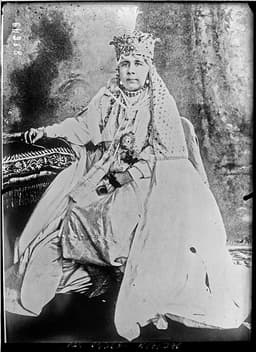
Kaikhusrau Jahan
Emperor · Modern
54.3Total
Basic Information
Born
1852
1858
Died
1912
1930
Era
Modern
Modern
Nationality
Japan
India
Occupation
Emperor
Emperor
Civilization
Eastern
Indian
Score Comparison
Military (10%)
25.0
42.8
Political (20%)
82.0
59.3
Influence (20%)
75.0
57.2
Legacy (20%)
68.0
45.8
Leadership (15%)
80.0
72.0
Strategy (15%)
66.3
46.0
TOTAL
69.2
54.3
Emperor Meiji — Complete Timeline
1868 AD
Meiji RestorationPolitical Action
Emperor Meiji was restored to political power after the fall of the Tokugawa shogunate. The new government, led by young samurai, abolished the feudal system and began modernizing Japan along Western lines, marking the start of the Meiji era.
RestorationModernizationPolitical Change
Impact: globalconstructive
Charter OathPolitical Action◆ Major
Emperor Meiji issued the Charter Oath, a five-article document outlining the principles of the new government. It promised deliberative assemblies, public participation, abolition of outdated customs, and the pursuit of knowledge worldwide.
ReformGovernment PolicyModernization
Impact: nationalprogressive
1871 AD
Abolition of the Han SystemReform◆ Major
The Meiji government abolished the feudal domains (han) and replaced them with prefectures under central control. This reform eliminated the power of the daimyo and created a unified, centralized state.
Administrative ReformCentralizationFeudalism
Impact: nationalconstructive
1889 AD
Promulgation of the Meiji ConstitutionPolitical Action
Emperor Meiji promulgated the Constitution of the Empire of Japan, establishing a constitutional monarchy with a bicameral parliament (Diet). The constitution granted the emperor supreme authority while creating a modern legal framework.
ConstitutionGovernmentLaw
Impact: nationalconstructive
1895 AD
Sino-Japanese War VictoryWar◆ Major
Japan defeated Qing China in the First Sino-Japanese War, gaining Taiwan, the Pescadores, and influence over Korea. The victory demonstrated Japan's military modernization and established it as a major Asian power.
WarVictoryImperial Expansion
Impact: regional
1902 AD
Anglo-Japanese AlliancePolitical Action◆ Major
Japan signed a military alliance with the United Kingdom, its first equal treaty with a Western power. The alliance recognized Japan's interests in Korea and provided diplomatic support, enhancing Japan's international standing.
DiplomacyAllianceInternational Relations
Impact: globalconstructive
1905 AD
Russo-Japanese War VictoryWar
Japan defeated Russia in the Russo-Japanese War, gaining control of Port Arthur, the Liaodong Peninsula, and southern Sakhalin. The victory shocked the world and marked the first time an Asian power defeated a European empire in modern warfare.
WarVictoryImperial Expansion
Impact: global
Kaikhusrau Jahan — Complete Timeline
1901 AD
Accession as Begum of BhopalPolitical Action◆ Major
Kaikhusrau Jahan, also known as Sultan Jahan Begum, became the ruling Begum of Bhopal after her mother's death. She was a progressive female Muslim ruler.
SuccessionFemale Ruler
Impact: regional
1905 AD
Women's Education Reforms in BhopalReform◆ Major
The Begum implemented reforms to expand girls' education in Bhopal, including opening new schools and training female teachers. She also advocated for women's rights within Islamic law.
Women's EducationReformIslamic
Impact: regionalprogressive
1912 AD
Publication of AutobiographyCultural
Kaikhusrau Jahan published her autobiography, 'An Account of My Life', detailing her reign and views on governance. It is a rare primary source on a female Muslim ruler in India.
AutobiographyLiteratureWomen's History
Impact: regional
1920 AD
Establishment of Aligarh Muslim UniversityCultural◆ Major
Kaikhusrau Jahan was a key supporter and donor to the establishment of Aligarh Muslim University. She served as its first chancellor, promoting modern education for Muslims.
EducationUniversityMuslim
Impact: nationalprogressive
Expert Analysis
Origins
Emperor Meiji, born Mutsuhito in 1852, was the 122nd emperor of Japan according to the traditional order. He was the son of Emperor Komei and a court lady, raised in the secluded imperial palace in Kyoto. His early education was steeped in classical Confucian and Japanese traditions, but he also received instruction in foreign affairs as Japan faced increasing pressure from Western powers. The black ships of Commodore Perry in 1853 had forced Japan to open its ports, creating a crisis that would define his reign.
Kaikhusrau Jahan, also known as Sultan Jahan Begum, was born in 1858 in Bhopal, India, into the ruling family of the princely state. She was the granddaughter of Sikandar Begum, a renowned female ruler, and the daughter of Shah Jahan Begum. From an early age, she was groomed for leadership, receiving education in Persian, Urdu, and Islamic studies. She also learned English and studied modern subjects, influenced by her mother's progressive views. Her upbringing combined traditional Islamic governance with exposure to British colonial administration.
Rise to Power
Emperor Meiji ascended the throne in 1867 at age 15, following his father's death. The Tokugawa shogunate, which had ruled Japan for over 250 years, was collapsing. In 1868, the Meiji Restoration occurred: a coalition of samurai from the Satsuma and Choshu domains overthrew the shogunate and restored the emperor to political power. Meiji became the symbol of a new centralized state. The imperial capital moved from Kyoto to Tokyo, and the emperor was portrayed as the modern leader of a unified nation.
Kaikhusrau Jahan became Begum of Bhopal in 1901 after her mother's death. Unlike Meiji, her accession was peaceful and hereditary. Bhopal was a princely state under British suzerainty, and she ruled as a Muslim queen in a male-dominated society. Her rise was smooth, but she faced challenges in asserting her authority within the patriarchal norms of the time. She quickly established herself as a reformer, focusing on education and infrastructure.
Leadership & Governance
Emperor Meiji's leadership was largely symbolic but crucial. He served as a unifying figurehead while a group of oligarchs (the Meiji oligarchy) implemented sweeping reforms. The government abolished feudalism, created a centralized bureaucracy, and adopted Western military, industrial, and legal systems. The Meiji Constitution of 1889 established a constitutional monarchy with a bicameral Diet, though the emperor held supreme command of the military and extensive prerogatives. Meiji scored 82.0 in political leadership, reflecting his role in legitimizing these changes.
Kaikhusrau Jahan exercised direct executive power in Bhopal. She was a hands-on ruler, personally overseeing administration. She promoted modern education, especially for girls, and established schools, hospitals, and public works. She was a key supporter of Aligarh Muslim University, serving as its first chancellor. She also published her autobiography, 'An Account of My Life', to document her reign. Her political score of 59.3 reflects her effective but limited scope within British India. She scored 72.0 in leadership, higher than her overall average, due to her proactive governance.
Triumph & Tragedy
Emperor Meiji's greatest triumph was the transformation of Japan into a world power. Under his reign, Japan won the First Sino-Japanese War (1894-1895), gaining Taiwan and influence over Korea. The Anglo-Japanese Alliance of 1902 elevated Japan's international status. The Russo-Japanese War victory in 1905 shocked the world and established Japan as a major military power. However, his reign also saw the suppression of political dissent and the imposition of authoritarian rule. The High Treason Incident of 1910 led to the execution of socialists. Japan's rapid militarization sowed seeds for future conflicts.
Kaikhusrau Jahan's major success was in education. She founded numerous schools for girls and promoted women's literacy. Her support for Aligarh Muslim University helped create a modern Muslim elite. She also implemented public health measures and improved infrastructure. However, her rule was constrained by British paramountcy; she could not pursue independence or major political reforms. Her legacy is limited to Bhopal, and she is less known outside India.
Character & Destiny
Emperor Meiji was reserved and dignified, embodying the modern monarch. He rarely intervened in policy but was a stabilizing symbol. His decision-making was cautious, deferring to his advisors. Historians note his quiet determination and ability to inspire loyalty. His destiny was to preside over Japan's modernization, but his passive role meant credit goes to the oligarchs. He scored 66.3 in strategy, reflecting his indirect influence.
Kaikhusrau Jahan was assertive and progressive, challenging gender norms. She was a prolific writer and orator. Her character combined piety with pragmatism. She faced the tragedy of being a female ruler in a conservative society, yet she used her position to advocate for women's rights. Her destiny was to be a model of enlightened Muslim leadership, but her impact was localized.
Legacy
Emperor Meiji's legacy is monumental. He is remembered as the father of modern Japan. The Meiji era saw Japan adopt industrialization, a constitution, and a military capable of defeating a European power. His influence score of 75.0 reflects his role in shaping Japan's trajectory. The Meiji Constitution lasted until 1947, and many institutions he endorsed persist. However, his legacy is also tied to Japan's imperialist expansion.
Kaikhusrau Jahan's legacy is more modest. She is celebrated as a pioneer of women's education in India, particularly among Muslims. Aligarh Muslim University remains a major institution. Her autobiography provides insight into female governance. She scored 45.8 in legacy, reflecting limited global recognition. Her reforms were significant but did not transform India as a whole.
Conclusion
Emperor Meiji had a greater impact on world history. His leadership during the Meiji Restoration transformed Japan from an isolated feudal state into a modern industrial power, altering the balance of power in Asia and the world. Kaikhusrau Jahan was a progressive ruler who advanced education in Bhopal, but her influence was confined to a princely state under British rule. Meiji's total score of 69.2 versus her 54.3 reflects this disparity. While both were effective leaders, Meiji's changes were systemic and global, while Jahan's were incremental and local. Therefore, Emperor Meiji is the more historically significant figure.
Rankings
🥇
Emperor MeijiLeader
Mil: 25.0Pol: 82.0Inf: 75.0
69.2
🥈
Kaikhusrau Jahan
Mil: 42.8Pol: 59.3Inf: 57.2
54.3
+14.9 behind
How This Comparison Works
Algorithm
Each figure is scored on 6 dimensions (0—100 scale) based on structured historical data: Military (10%), Political (20%), Influence (20%), Legacy (20%), Leadership (15%), Strategy (15%). The weighted total produces the final ranking.
Data Sources
Scores are computed from structured sub-indicators in the database. Scale factors adjust for era (Ancient ×0.85, Modern ×1.0) and civilization size (Eastern ×1.05, Other ×0.80) to account for differences in population and military scale.
Maximum 3 Figures
Comparisons are limited to 2—3 figures to ensure readability and statistical meaningfulness.
Error Margins
±5 points per dimension — Sub-scores are derived from historical records with inherent uncertainty. Two figures within 5 points on a dimension should be considered roughly equivalent in that area.
Total Score Accuracy
±3 points overall — The weighted combination of 6 dimensions produces a total score with approximately ±3 points of uncertainty. Differences of less than 3 points are not statistically significant— the figures are effectively tied.
Known Limitations
- Historical records are incomplete and uneven across civilizations
- Figures from oral-tradition societies may be underrepresented
- Occupation labels can misclassify multi-role figures
- Scores measure capability and impact, not moral character
- Quantitative scoring is a comparison tool, not absolute truth
Capability Radar
Military (10%) — Battles & Warfare
Battles
20
30
Win Rate
30
33
Expansion
75
35
Political (20%) — Governance & Reform
Reform
95
70
Diplomacy
85
65
Economy
90
60
Influence (20%) — Cultural & Global Reach
Cultural
85
50
Global
85
35
Legacy (20%) — Historical Impact
Historical
90
45
Longevity
80
40
Leadership (15%) — Power & Stability
Tenure
85
55
Stability
70
65
Strategy (15%) — Tactics & Innovation
Strategy
70
39
Tactics
25
40
Reform
95
43
Similar Comparisons
Comments & Discussion
No comments yet. Be the first to share your thoughts!