Loading...
Emperor Meiji vs Napoleon Bonaparte
Napoleon Bonaparte leads by 1.7 pts · 2 figures compared
…
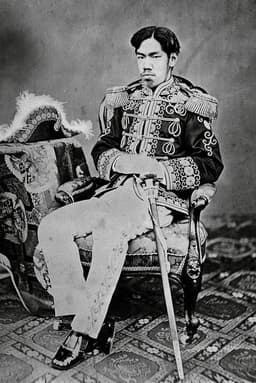
Emperor Meiji
Emperor · Modern
69.2Total

Napoleon Bonaparte
General · Modern
70.9Total
Basic Information
Born
1852
1769
Died
1912
1821
Era
Modern
Modern
Nationality
Japan
France
Occupation
Emperor
General
Civilization
Eastern
Western
Score Comparison
Military (10%)
25.0
94.0
Political (20%)
82.0
72.0
Influence (20%)
75.0
40.0
Legacy (20%)
68.0
80.0
Leadership (15%)
80.0
78.0
Strategy (15%)
66.3
90.0
TOTAL
69.2
70.9
Emperor Meiji — Complete Timeline
1868 AD
Meiji RestorationPolitical Action
Emperor Meiji was restored to political power after the fall of the Tokugawa shogunate. The new government, led by young samurai, abolished the feudal system and began modernizing Japan along Western lines, marking the start of the Meiji era.
RestorationModernizationPolitical Change
Impact: globalconstructive
Charter OathPolitical Action◆ Major
Emperor Meiji issued the Charter Oath, a five-article document outlining the principles of the new government. It promised deliberative assemblies, public participation, abolition of outdated customs, and the pursuit of knowledge worldwide.
ReformGovernment PolicyModernization
Impact: nationalprogressive
1871 AD
Abolition of the Han SystemReform◆ Major
The Meiji government abolished the feudal domains (han) and replaced them with prefectures under central control. This reform eliminated the power of the daimyo and created a unified, centralized state.
Administrative ReformCentralizationFeudalism
Impact: nationalconstructive
1889 AD
Promulgation of the Meiji ConstitutionPolitical Action
Emperor Meiji promulgated the Constitution of the Empire of Japan, establishing a constitutional monarchy with a bicameral parliament (Diet). The constitution granted the emperor supreme authority while creating a modern legal framework.
ConstitutionGovernmentLaw
Impact: nationalconstructive
1895 AD
Sino-Japanese War VictoryWar◆ Major
Japan defeated Qing China in the First Sino-Japanese War, gaining Taiwan, the Pescadores, and influence over Korea. The victory demonstrated Japan's military modernization and established it as a major Asian power.
WarVictoryImperial Expansion
Impact: regional
1902 AD
Anglo-Japanese AlliancePolitical Action◆ Major
Japan signed a military alliance with the United Kingdom, its first equal treaty with a Western power. The alliance recognized Japan's interests in Korea and provided diplomatic support, enhancing Japan's international standing.
DiplomacyAllianceInternational Relations
Impact: globalconstructive
1905 AD
Russo-Japanese War VictoryWar
Japan defeated Russia in the Russo-Japanese War, gaining control of Port Arthur, the Liaodong Peninsula, and southern Sakhalin. The victory shocked the world and marked the first time an Asian power defeated a European empire in modern warfare.
WarVictoryImperial Expansion
Impact: global
Napoleon Bonaparte — Complete Timeline
1799 AD
Coup of 18 BrumaireOther◆ Major
Napoleon Bonaparte, with support from his brother Lucien and key political figures, overthrew the Directory in a bloodless coup. He established the Consulate with himself as First Consul, effectively becoming the ruler of France. This event ended the French Revolution's most unstable period.
French RevolutionCoupRise to Power
Impact: regional
1804 AD
Promulgation of the Napoleonic CodeOther◆ Major
Napoleon enacted the Civil Code of the French, known as the Napoleonic Code, a comprehensive set of laws that replaced the fragmented feudal legal systems. The code established legal equality, protected property rights, and secularized law. It became the basis for legal systems in many European and world countries.
Legal ReformNapoleonic CodeCivil Law
Impact: globalconstructive
1805 AD
Battle of AusterlitzWar◆ Major
Napoleon's Grande Arm
Napoleonic WarsBattleDecisive Victory
Impact: global
1812 AD
Invasion of RussiaWar◆ Major
Napoleon led the Grande Arm
Napoleonic WarsInvasionDisaster
Impact: globaldestructive
1815 AD
Battle of WaterlooWar◆ Major
Napoleon's French army was defeated by the combined forces of the Duke of Wellington's Anglo-Allied army and Gebhard Leberecht von Bl
Napoleonic WarsBattleFinal Defeat
Impact: globaldestructive
Expert Analysis
emperor-meiji-vs-napoleon-bonaparte
# The Conqueror and the Transformer
In the winter of 1812, Napoleon Bonaparte watched his Grand Army burn Moscow to the ground, believing he had broken the Russian spirit. A century later, in 1905, Emperor Meiji received word that Japanese forces had shattered the Russian navy at Tsushima Strait—the first Asian victory over a European power in modern history. Both men reshaped their worlds, but one sought to impose his will through conquest, the other through transformation. Why did Napoleon end his days in exile on a remote Atlantic island, while Meiji died in Tokyo as the revered father of a rising empire?
Origins
Napoleon Bonaparte was born in 1769 on Corsica, an island that had just been sold to France by Genoa. He grew up speaking Italian, a provincial outsider in a nation that would one day tremble at his name. His family was minor nobility, struggling and resentful. The French Revolution, which erupted when he was twenty, shattered the old order and opened paths that birth alone could never have granted. Napoleon seized them.
Emperor Meiji, born Mutsuhito in 1852, entered a world that seemed frozen in time. Japan had spent over two centuries in self-imposed isolation under the Tokugawa shogunate, a feudal system where the emperor was a sacred figurehead with no real power. But in 1853, the year after his birth, American Commodore Matthew Perry sailed black warships into Tokyo Bay, forcing Japan to open its doors. The shock of that humiliation defined Meiji’s era before he could even speak.
Rise to Power
Napoleon’s ascent was a masterpiece of audacity. By 1796, at twenty-six, he commanded the French army in Italy, winning battles that seemed impossible. He rode the Revolution’s chaos like a wave, turning military glory into political capital. In 1799, he staged a coup and made himself First Consul. By 1804, he crowned himself Emperor in Notre Dame, snatching the crown from the Pope’s hands and placing it on his own head.
Meiji’s rise was the opposite: he was handed power, but it was power that others had defined. In 1868, at just fifteen, he was restored to the throne after the Tokugawa shogunate collapsed. The Meiji Restoration was not his personal coup but a revolution carried out in his name by young samurai from the Satsuma and Choshu domains. They needed an emperor to legitimize their vision, and Mutsuhito became the symbol of a nation reborn.
Leadership & Governance
Napoleon governed as he conquered: with relentless energy and absolute control. He reformed French law through the Napoleonic Code, standardized education, and built roads and bridges. But his genius was military, not administrative in the peacetime sense. His political score of 75 reflects a man who could organize a campaign brilliantly but could not build lasting alliances. He defeated Austria, Prussia, and Russia repeatedly, yet each victory bred new enemies. His strategy score of 93 was world-class, but his leadership score of 80 suggests a flaw: he inspired loyalty until he asked for too much.
Emperor Meiji, by contrast, was a constitutional monarch, not a dictator. His political score of 81 and leadership score of 84.5 reflect a ruler who knew when to step back. He issued the Charter Oath in 1868, promising deliberative assemblies and the pursuit of knowledge from around the world. He allowed his ministers—brilliant men like Ito Hirobumi and Yamagata Aritomo—to abolish the feudal domains in 1871, build a modern army, and draft the Meiji Constitution of 1889. Meiji did not command the army; he presided over a system that produced victories. His military score of 32.2 is low because he never led troops. Yet under his reign, Japan won the Sino-Japanese War in 1895 and the Russo-Japanese War in 1905—a feat Napoleon never achieved against Russia.
Triumph & Tragedy
Napoleon’s greatest moment was Austerlitz in 1805, where he crushed the combined armies of Austria and Russia. His empire stretched from Spain to Poland. But his tragedy was hubris. In 1812, he invaded Russia with over 600,000 men; fewer than 100,000 returned. He was exiled to Elba in 1814, escaped in 1815, and was finally defeated at Waterloo. He died in 1821 on Saint Helena, a prisoner.
Meiji’s triumph was the transformation of Japan itself. In 1902, Japan signed the Anglo-Japanese Alliance, its first equal treaty with a Western power. In 1905, victory over Russia stunned the world. But there was a quiet tragedy: the old Japan—the samurai, the traditions, the isolation—was erased. Many who had helped restore him, like Saigo Takamori, were crushed when they resisted modernization. Meiji presided over a revolution that consumed its own children.
Character & Destiny
Napoleon’s character was fire. He was restless, brilliant, and incapable of stopping. “I am not a man, but a thing,” he once said. His decisions were driven by an insatiable need for glory. He could not share power, could not compromise, could not retreat. That made him a conqueror but doomed his empire.
Meiji’s character was water. He was quiet, observant, and patient. He wore Western clothes and ate Western food to set an example, but he also composed traditional waka poetry. He understood that leadership sometimes means letting others lead. His destiny was not to conquer but to transform—and transformation requires listening as much as commanding.
Legacy
Napoleon left the Napoleonic Code, which influenced legal systems worldwide. He also left a legend: the self-made emperor, the little corporal who shook thrones. But his legacy is ambiguous—a genius who caused endless war.
Emperor Meiji left a modern Japan: industrialized, militarized, and recognized as a world power. His legacy is woven into the fabric of Japanese identity. The Meiji era is remembered as a golden age of progress, even as it planted seeds for the militarism that would devastate Japan in the 1940s. His total score of 74.4 versus Napoleon’s 82.4 reflects a quieter kind of greatness—not the flash of conquest, but the slow burn of national rebirth.
Conclusion
Napoleon and Meiji both faced a world in upheaval. Napoleon tried to master it through force, and for a decade, he did. Meiji tried to join it through change, and for a century, his nation did. The difference between them is the difference between a storm and a tide. The storm uproots trees but passes; the tide reshapes the shoreline forever. Napoleon’s empire crumbled in his lifetime. Meiji’s Japan, for all its flaws, became a power that would endure. Perhaps the deepest lesson is this: the leaders who change history are not always the ones who shout the loudest or strike the hardest. Sometimes they are the ones who listen, adapt, and transform—not themselves alone, but the world around them.
Rankings
🥇
Napoleon BonaparteLeader
Mil: 94.0Pol: 72.0Inf: 40.0
70.9
🥈
Emperor Meiji
Mil: 25.0Pol: 82.0Inf: 75.0
69.2
+1.7 behind
How This Comparison Works
Algorithm
Each figure is scored on 6 dimensions (0—100 scale) based on structured historical data: Military (10%), Political (20%), Influence (20%), Legacy (20%), Leadership (15%), Strategy (15%). The weighted total produces the final ranking.
Data Sources
Scores are computed from structured sub-indicators in the database. Scale factors adjust for era (Ancient ×0.85, Modern ×1.0) and civilization size (Eastern ×1.05, Other ×0.80) to account for differences in population and military scale.
Maximum 3 Figures
Comparisons are limited to 2—3 figures to ensure readability and statistical meaningfulness.
Error Margins
±5 points per dimension — Sub-scores are derived from historical records with inherent uncertainty. Two figures within 5 points on a dimension should be considered roughly equivalent in that area.
Total Score Accuracy
±3 points overall — The weighted combination of 6 dimensions produces a total score with approximately ±3 points of uncertainty. Differences of less than 3 points are not statistically significant— the figures are effectively tied.
Known Limitations
- Historical records are incomplete and uneven across civilizations
- Figures from oral-tradition societies may be underrepresented
- Occupation labels can misclassify multi-role figures
- Scores measure capability and impact, not moral character
- Quantitative scoring is a comparison tool, not absolute truth
Capability Radar
Military (10%) — Battles & Warfare
Battles
20
95
Win Rate
30
90
Expansion
75
95
Political (20%) — Governance & Reform
Reform
95
95
Diplomacy
85
80
Economy
90
85
Influence (20%) — Cultural & Global Reach
Cultural
85
85
Global
85
90
Legacy (20%) — Historical Impact
Historical
90
95
Longevity
80
90
Leadership (15%) — Power & Stability
Tenure
85
85
Stability
70
70
Strategy (15%) — Tactics & Innovation
Strategy
70
95
Tactics
25
98
Reform
95
92
Similar Comparisons
Comments & Discussion
THE_CORINTHIAN6/17/2026
Calling Meiji a "transformer" and Napoleon a "conqueror" is naive history. Napoleon was thegreatest institutional reformer since Charlemagne. His Civil Code still shapes Europe, and he introduced meritocracy, secular education, and central banking across a continent. Meiji, meanwhile, was a puppet presiding over a samurai elite's desperate industrial race—Japan's constitution was a German copy, its army Prussian, its navy British. One man invented modern governance; the other, and his advisors,
金戈铁马客6/17/2026
说拿破仑只会征服,简直是对军事史的侮辱!他的「机动战术」直接碾压了当时所有古老国家的战争逻辑。从第一次意大利战役到奥斯特里茨,他用快速穿插打散了半个欧洲的军队。而明治?不过是抓住了殖民国家之间的空隙和黑船来袭后的恐慌反应,然后照搬一套现代军队体系。日本后来在日俄战争赢的是防御工事和俄海军不力的运气,不是拿破仑那种战场天才。
RETROSPECTIVE_VOID6/17/2026
The comparison completely ignores the catastrophic ending of Meiji's project. Napoleon's empire collapsed in his lifetime—we can count the cost in lives and properly assess the ambition. Meiji died in 1912 as a "revered father," but his industrialization created the economic and military monster that would devour Asia within thirty years. Korea's annexation in 1910, the militarism, the war crimes—that's Meiji's legacy as much as the trains and telegraphs. A "transformer" who set Japan on a path
东海散人6/17/2026
一个数据点就能戳破这个神话:拿破仑时期法国人口约2800万,军队峰值近百万人,战争消耗了帝国近20%的GDP。而明治时期日本从3000万人增加到5000万,但其工业化依赖巨额外债和国内农民的极端压榨。1890年代日本农民暴动超过200次,因为税收达到了收入的40%。所谓的「明治奇迹」本质上是被迫商业贷款和国家赤字的骗局,只不过被日俄战争的表面胜利掩盖了。
THE_PAPYRUS_SCROLL6/17/2026
From a classical perspective, both figures represent a fatal break with tradition, but Napoleon's rupture was temporary. He respected the papacy, restored the Church in France, and sought legitimacy through dynastic marriage and imperial coronation—essentially a Roman imperial model. Meiji's "restoration" was actually an abolition of the old order: the samurai class was legally destroyed, Buddhist institutions suppressed, and Shinto fabricated into a state cult. One a traditional conqueror-king;
破壁人6/17/2026
别把明治当圣人!他登基时日本有260多个大名各自统治领地,武士是社会顶端等级。到