Loading...
This comparison has not been analyzed yet.
One-time AI generation (~1 minute). Scores and timeline are already available below.
Enmebaragesi vs Tukulti-Ninurta I
Tukulti-Ninurta I leads by 15.5 pts · 2 figures compared
…

Enmebaragesi
Emperor · Ancient
43.8Total
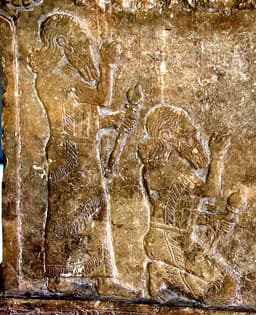
Tukulti-Ninurta I
Emperor · Ancient
59.3Total
Basic Information
Born
-2700
-1243
Died
-2650
-1207
Era
Ancient
Ancient
Nationality
Kish
Assyria
Occupation
Emperor
Emperor
Civilization
Middle Eastern
Middle Eastern
Score Comparison
Military (10%)
45.0
74.0
Political (20%)
27.9
68.0
Influence (20%)
50.2
55.7
Legacy (20%)
45.0
45.8
Leadership (15%)
55.3
65.0
Strategy (15%)
30.3
65.4
TOTAL
43.8
59.3
Enmebaragesi — Complete Timeline
2700 BC
Conflict with Gilgamesh of UrukWar
Enmebaragesi led a campaign against Gilgamesh, king of Uruk, as recorded in the Sumerian epic. The conflict ended with Enmebaragesi's defeat and his son Aga being captured, though later released. This event is part of the legendary cycle of Gilgamesh.
GilgameshUrukLegendary Conflict
Construction of the Temple of Enlil at NippurCultural◆ Major
Enmebaragesi, king of Kish, built the temple of Enlil at Nippur, as recorded in the Sumerian King List. This act established Nippur as a major religious center and demonstrated his wealth and power, making him the first Sumerian king confirmed by archaeological evidence.
Temple ConstructionReligious CenterNippur
Impact: regionalconstructive
Tukulti-Ninurta I — Complete Timeline
1235 BC
Sack of BabylonWar
Tukulti-Ninurta I led a successful campaign against Babylon, sacking the city and destroying its temples. He captured the Babylonian king Kashtiliash IV and carried the statue of Marduk to Assyria, asserting Assyrian supremacy over Mesopotamia.
Military CampaignBabylonSack
Impact: regionaldestructive
Adoption of the Title King of KingsPolitical Action◆ Major
Following his victory over Babylon, Tukulti-Ninurta I adopted the title 'King of Kings' (Shar Sharrani), a claim to universal sovereignty. This was the first known use of this title by an Assyrian ruler, setting a precedent for later emperors.
TitulatureImperial IdeologyAssyrian Empire
Impact: regional
1230 BC
Construction of Kar-Tukulti-NinurtaCultural◆ Major
Tukulti-Ninurta I founded a new capital city named Kar-Tukulti-Ninurta (Fort of Tukulti-Ninurta) across the Tigris from Ashur. The city featured a large palace and temple complex, intended to rival Ashur as the imperial center.
Urban PlanningCapital CityAssyrian Empire
Impact: regionalconstructive
1207 BC
Assassination by SonPolitical Action◆ Major
Tukulti-Ninurta I was assassinated in a palace coup led by his own son, Ashur-nadin-apli, and other nobles. His death marked the end of his reign and led to a period of instability in the Assyrian Empire.
AssassinationPalace CoupSuccession Crisis
Impact: nationaltragic
This comparison has not been analyzed yet.
One-time AI generation (~1 minute). Scores and timeline are already available below.
Rankings
🥇
Tukulti-Ninurta ILeader
Mil: 74.0Pol: 68.0Inf: 55.7
59.3
🥈
Enmebaragesi
Mil: 45.0Pol: 27.9Inf: 50.2
43.8
+15.5 behind
How This Comparison Works
Algorithm
Each figure is scored on 6 dimensions (0—100 scale) based on structured historical data: Military (10%), Political (20%), Influence (20%), Legacy (20%), Leadership (15%), Strategy (15%). The weighted total produces the final ranking.
Data Sources
Scores are computed from structured sub-indicators in the database. Scale factors adjust for era (Ancient ×0.85, Modern ×1.0) and civilization size (Eastern ×1.05, Other ×0.80) to account for differences in population and military scale.
Maximum 3 Figures
Comparisons are limited to 2—3 figures to ensure readability and statistical meaningfulness.
Error Margins
±5 points per dimension — Sub-scores are derived from historical records with inherent uncertainty. Two figures within 5 points on a dimension should be considered roughly equivalent in that area.
Total Score Accuracy
±3 points overall — The weighted combination of 6 dimensions produces a total score with approximately ±3 points of uncertainty. Differences of less than 3 points are not statistically significant— the figures are effectively tied.
Known Limitations
- Historical records are incomplete and uneven across civilizations
- Figures from oral-tradition societies may be underrepresented
- Occupation labels can misclassify multi-role figures
- Scores measure capability and impact, not moral character
- Quantitative scoring is a comparison tool, not absolute truth
Capability Radar
Military (10%) — Battles & Warfare
Battles
20
75
Win Rate
20
80
Expansion
25
80
Political (20%) — Governance & Reform
Reform
20
55
Diplomacy
25
50
Economy
20
45
Influence (20%) — Cultural & Global Reach
Cultural
30
50
Global
30
45
Legacy (20%) — Historical Impact
Historical
50
55
Longevity
40
40
Leadership (15%) — Power & Stability
Tenure
40
60
Stability
30
40
Strategy (15%) — Tactics & Innovation
Strategy
15
75
Tactics
15
70
Reform
10
65
Similar Comparisons
Comments & Discussion
No comments yet. Be the first to share your thoughts!