Loading...
Etienne Macdonald vs Julius Caesar
Julius Caesar leads by 29.0 pts · 2 figures compared
…
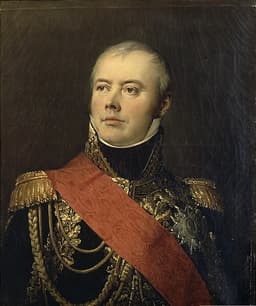
Etienne Macdonald
General · Modern
53.8Total

Julius Caesar
General · Ancient
82.8Total
Basic Information
Born
1765
-100
Died
1840
-44
Era
Modern
Ancient
Nationality
France
Roman Republic
Occupation
General
General
Civilization
Western
Western
Score Comparison
Military (10%)
67.5
88.0
Political (20%)
42.2
78.0
Influence (20%)
54.1
85.0
Legacy (20%)
46.7
82.0
Leadership (15%)
65.0
80.0
Strategy (15%)
57.5
85.0
TOTAL
53.8
82.8
Etienne Macdonald — Complete Timeline
1809 AD
Battle of WagramWar◆ Major
Macdonald commanded a corps at Wagram. He led a massive infantry assault that broke the Austrian center, earning him the baton of Marshal of the Empire on the battlefield.
Napoleonic WarsBattlePromotion
Impact: regional
1812 AD
Battle of the BerezinaWar◆ Major
Macdonald commanded the X Corps during the retreat from Russia. His corps covered the crossing of the Berezina River, suffering heavy losses but allowing the main army to escape.
Napoleonic WarsRetreatBerezina
Impact: regional
1813 AD
Battle of LeipzigWar◆ Major
Macdonald commanded a corps at Leipzig. His forces were routed by the Allies, and he was wounded while trying to rally his troops during the French defeat.
Napoleonic WarsBattleDefeatWounded
Impact: global
Battle of the KatzbachWar◆ Major
Macdonald commanded the French Army of the Bober at the Katzbach. His forces were defeated by Bl
Napoleonic WarsBattleDefeat
Impact: regional
1815 AD
Grand Chancellor of the Legion of HonourPolitical Action
Macdonald served as Grand Chancellor of the Legion of Honour under the Bourbon Restoration. He administered the order and maintained its prestige.
Legion of HonourBourbon RestorationAdministration
Impact: national
Julius Caesar — Complete Timeline
58 BC
Gallic WarsWar◆ Major
Caesar, as proconsul of Gaul, launched a series of campaigns that conquered all of Gaul (modern France, Belgium, and parts of Switzerland). He fought numerous battles, including against the Helvetii, the Belgae, and the Gallic chieftain Vercingetorix. The wars brought immense wealth and a loyal army to Caesar.
Gallic WarsConquestRoman Expansion
Impact: regional
49 BC
Crossing the RubiconPolitical Action◆ Major
Caesar led Legio XIII across the Rubicon River into Italy, defying the Roman Senate's order to disband his army. This act triggered a civil war against Pompey and the Optimates, ultimately leading to Caesar's dictatorship and the end of the Roman Republic.
Roman Civil WarEnd of RepublicPower Struggle
Impact: global
48 BC
Battle of PharsalusWar◆ Major
Caesar's outnumbered army defeated the larger forces of Pompey the Great at Pharsalus in Greece. Caesar's tactical use of a reserve line to counter Pompey's cavalry charge proved decisive. Pompey fled to Egypt, where he was assassinated, leaving Caesar as the undisputed master of the Roman world.
Roman Civil WarBattleDecisive Victory
Impact: regional
44 BC
Appointment as Dictator for LifePolitical Action◆ Major
The Roman Senate appointed Caesar dictator perpetuo (dictator for life), granting him unprecedented personal power. This move concentrated military, legislative, and judicial authority in one person, effectively ending the Roman Republic's traditional system of checks and balances and alarming many senators.
DictatorshipEnd of RepublicPower Consolidation
Impact: regionaldestructive
Assassination on the Ides of MarchPolitical Action◆ Major
A group of Roman senators, led by Marcus Junius Brutus and Gaius Cassius Longinus, stabbed Caesar to death at a meeting of the Senate in the Theatre of Pompey. The assassination was intended to restore the Republic, but instead triggered another civil war that led to the rise of the Roman Empire.
AssassinationRoman PoliticsEnd of Republic
Impact: globaldestructive
Expert Analysis
etienne-macdonald-vs-julius-caesar
# The General Who Crossed the Rubicon, and the One Who Crossed the Berezina
On a January morning in 44 BCE, Julius Caesar walked into the Senate chamber in Rome, ignoring a soothsayer’s warning and the whispered omens that had followed him for days. Within minutes, sixty senators had encircled him, daggers hidden in their togas. He fell at the base of Pompey’s statue, his blood pooling on the marble floor. Nearly eighteen centuries later, on a frozen November day in 1812, Étienne Macdonald stood on the banks of the Berezina River in Russia, watching his starving, frostbitten soldiers struggle across a makeshift bridge. The water was choked with ice and corpses. Both men were generals. Both faced moments of supreme crisis. But one reshaped the world; the other was reshaped by it. Why?
Origins
Julius Caesar was born into a patrician family that had seen better days. The Roman Republic of 100 BCE was a ruthless arena of political vendettas, slave revolts, and civil wars. Young Caesar learned early that survival meant cultivating allies, crushing enemies, and never forgetting a debt—or a slight. His uncle by marriage was Gaius Marius, the populist general who had saved Rome from German invaders, and Caesar absorbed Marius’s belief that the Republic’s old institutions were rotting. He was a product of a collapsing system, and he intended to either fix it or inherit its ruins.
Étienne Macdonald, born in 1765 in Sedan, France, came from a different world. His father was a Scottish Jacobite exile, his mother a French innkeeper’s daughter. The family had no money, no connections, and no hope—until the French Revolution exploded. The Revolution’s great promise was that any man could rise by talent alone, and Macdonald seized it. He joined the army in 1785 as a common soldier, and by 1793, he was a general. He was a child of the Revolution, not the aristocracy, and he carried that meritocratic faith throughout his life.
Rise to Power
Caesar’s path was a masterclass in strategic patience. He served as a military tribune in Asia Minor, then as a quaestor in Spain, where he supposedly wept before a statue of Alexander the Great, lamenting that he had done nothing at an age when Alexander had conquered the world. He climbed the political ladder methodically: aedile, praetor, pontifex maximus. His great breakthrough came in 58 BCE, when he secured command of Gaul. Over eight years, he conquered a territory larger than Italy, built a loyal army, and amassed enough wealth to buy the loyalty of Rome itself.
Macdonald’s rise was faster but less calculated. He distinguished himself at the Battle of Jemappes in 1792 and became a division commander. In 1799, he fought brilliantly at the Battle of Trebbia in Italy, but his army was destroyed, and he was blamed. He spent years in obscurity. Napoleon Bonaparte, who had seized power, distrusted him—Macdonald was too independent, too republican. Only in 1809, after Napoleon had alienated many of his original marshals, did he recall Macdonald for the Austrian campaign.
Leadership & Governance
Caesar governed like a force of nature. As dictator, he reformed the calendar, granted citizenship to provincials, launched public works projects, and began planning the codification of Roman law. He was a brilliant politician who understood that power needed a human face—he pardoned enemies, staged lavish games, and let the people believe he was one of them. On the battlefield, he was even more dangerous. At Alesia in 52 BCE, he besieged the Gallic chieftain Vercingetorix while simultaneously fighting off a massive relief army, winning through sheer tactical audacity.
Macdonald was a solid, dependable commander, but not a revolutionary one. At Wagram in 1809, he led a massive infantry assault that broke the Austrian center—a moment of genuine courage that earned him his marshal’s baton. Napoleon himself watched and praised him. Yet Macdonald’s real strength was loyalty, not genius. He was the man you trusted to hold the line, not the man who would outflank the enemy. His political career after Napoleon’s fall was more successful: he served as Grand Chancellor of the Legion of Honour under the Bourbon Restoration, administering the order with integrity.
Triumph & Tragedy
Caesar’s greatest triumph was the conquest of Gaul, which doubled Rome’s territory and made him the richest man in the Republic. His crossing of the Rubicon in 49 BCE—the river that separated his province from Italy proper—was a gamble that could have ended in his execution. Instead, it triggered a civil war he won in five years. His tragedy was the Ides of March: he had become so powerful that even his friends feared him, and the Republic he tried to save died with him.
Macdonald’s triumph was Wagram, where he earned his marshal’s baton. His tragedy was the Katzbach River in 1813. Commanding the French Army of the Bober against the Prussian general Blücher, he was outmaneuvered and routed. His corps was shattered, and he was wounded at Leipzig trying to rally his men. The retreat from Russia, where he covered the Berezina crossing, was a grim achievement—he saved many lives, but he could not save Napoleon’s empire.
Character & Destiny
Caesar was driven by an almost supernatural ambition. He believed he was destined for greatness, and he shaped events to match that belief. He was ruthless when necessary—executing prisoners, breaking treaties, and marching on his own capital—but he was also magnanimous. His character was the storm that broke the Republic.
Macdonald was a man of duty, not destiny. He served Napoleon because Napoleon was France, but he never worshipped him. After Napoleon’s first abdication in 1814, he did not follow the emperor to Elba. He accepted the Bourbon restoration, believing it was the path to peace. His character was the rock that weathered the storm, not the storm itself.
Legacy
Caesar’s legacy is immeasurable. His name became synonymous with emperor—Kaiser and Tsar both derive from it. His military writings are still studied. His reforms outlived him, and the Roman Empire he inadvertently created lasted for five centuries in the West and a thousand years in the East.
Macdonald’s legacy is quieter. He is remembered as one of Napoleon’s marshals, but not among the greatest. His name appears in histories of the Napoleonic Wars, but rarely in the popular imagination. He died in 1840, the same year Napoleon’s body was returned to Paris, a final irony.
Conclusion
What separates Caesar from Macdonald is not talent or courage—both had plenty of both. It is the scale of their historical moment. Caesar lived when the entire Mediterranean world was up for grabs, when one man could topple a republic and build an empire. Macdonald lived in the shadow of Napoleon, a giant who consumed all the light. Caesar made his own fate; Macdonald responded to fate made by others. In the end, history remembers those who shape its currents, not those who swim bravely against them. But both men, standing on the banks of the Rubicon and the Berezina, understood the same truth: that a general’s choices are never just his own. They belong to the men he leads, the nation he serves, and the centuries that follow.
Rankings
🥇
Julius CaesarLeader
Mil: 88.0Pol: 78.0Inf: 85.0
82.8
🥈
Etienne Macdonald
Mil: 67.5Pol: 42.2Inf: 54.1
53.8
+29.0 behind
How This Comparison Works
Algorithm
Each figure is scored on 6 dimensions (0—100 scale) based on structured historical data: Military (10%), Political (20%), Influence (20%), Legacy (20%), Leadership (15%), Strategy (15%). The weighted total produces the final ranking.
Data Sources
Scores are computed from structured sub-indicators in the database. Scale factors adjust for era (Ancient ×0.85, Modern ×1.0) and civilization size (Eastern ×1.05, Other ×0.80) to account for differences in population and military scale.
Maximum 3 Figures
Comparisons are limited to 2—3 figures to ensure readability and statistical meaningfulness.
Error Margins
±5 points per dimension — Sub-scores are derived from historical records with inherent uncertainty. Two figures within 5 points on a dimension should be considered roughly equivalent in that area.
Total Score Accuracy
±3 points overall — The weighted combination of 6 dimensions produces a total score with approximately ±3 points of uncertainty. Differences of less than 3 points are not statistically significant— the figures are effectively tied.
Known Limitations
- Historical records are incomplete and uneven across civilizations
- Figures from oral-tradition societies may be underrepresented
- Occupation labels can misclassify multi-role figures
- Scores measure capability and impact, not moral character
- Quantitative scoring is a comparison tool, not absolute truth
Capability Radar
Military (10%) — Battles & Warfare
Battles
65
95
Win Rate
60
92
Expansion
55
97
Political (20%) — Governance & Reform
Reform
20
90
Diplomacy
40
85
Economy
25
82
Influence (20%) — Cultural & Global Reach
Cultural
25
88
Global
30
94
Legacy (20%) — Historical Impact
Historical
40
95
Longevity
30
96
Leadership (15%) — Power & Stability
Tenure
45
75
Stability
35
60
Strategy (15%) — Tactics & Innovation
Strategy
60
94
Tactics
55
96
Reform
30
88
Similar Comparisons
Comments & Discussion
RubiconRider6/17/2026
You can't put these two in the same colosseum. Caesar crossed the Rubicon—an act of deliberate treason that split history in half. Macdonald crossed the Berezina trying to save Napoleon's half-frozen carcass. Big difference. Caesar gambled for absolute power and won an empire. Macdonald gambled for survival and lost 50,000 men to ice and hunger. One changed Rome forever; the other was a footnote Napoleon blamed for the retreat. Sorry, Étienne—you're not even in Caesar's legion.
冰河溃将6/17/2026
拿凯撒和麦克唐纳比,简直是对历史的侮辱。凯撒在卢比孔河前犹豫过吗?没有。他扛着元老院的禁令,带着一个军团就敢挑战整个共和国。而麦克唐纳呢?1812年渡别列津纳河时,他眼睁睁看着冻僵的士兵在冰水里扑腾,然后拿破仑把失败全甩锅给他。凯撒是下棋的人,麦克唐纳只是棋盘上的一颗卒——还是被吃的那颗。这就是为什么凯撒的名字刻进了历史,而麦克唐纳需要搜索引擎才找得到。
DataCounter6/17/2026
Remove the narrative gloss and the comparison collapses. Caesar had 40,000 men at the Rubicon; Macdonald faced 120,000 frostbitten stragglers across a frozen river. Resource asymmetry alone explains the outcomes—Caesar fought for a strategic prize with a disciplined force; Macdonald fought for basic survival with a starving mob. The real variable isn't "genius" but supply lines and morale. Strip away the "great man" mythology and you're comparing two mid-level commanders who got lucky or unlucky
史实钉子户6/17/2026
吹嘘凯撒的“伟大”往往忽略了另一个事实:他跨过卢比孔河后,罗马内战死了十万人,元老院制度被彻底碾碎。这不是胜利,是一场灾难的开端。麦克唐纳至少没把法国拖进同样的深渊——别列津纳河惨是惨,但拿破仑的帝国垮台不是他一个人的锅。凯撒是破坏者,麦克唐纳是幸存者。你问我佩服谁?那个在零下三十度哭着扶士兵过桥的法国人,比持刀进元老院的独裁者更有温度。历史不需要更多凯撒,需要更多悲壮的凡人。
ClassicsNerd6/17/2026
Caesar's crisis was political and self-inflicted; Macdonald's was existential and inflicted by winter. Caesar chose his battle—he could have lived in exile but instead plunged into civil war to claim supremacy. Macdonald had no choice: Napoleon ordered him to hold the rear guard, and he obeyed until his men froze to death. Caesar wrote his own story in "Commentarii"; Macdonald got a footnote in Napoleon's memoirs. One is a legend by design,